Ventilation in school buildings
Is demand-controlled ventilation useful in school buildings?
Despite substantial investment, energy bills and operational maintenance costs in many school buildings have not fallen significantly compared with those of the old building stock. However, sensible ventilation can have a very positive impact …
Text and images: Botec
You will remember the old school buildings, with their high ceilings and outdated building envelopes. Many of us recall the stuffy indoor air, which meant that windows were opened even in winter. The contrast with new buildings is stark. Much more attention is paid to comfort and energy efficiency. Yet in many cases, operating costs have barely fallen, if at all.
Making sensible choices
Engineering firm Botec, based in Wommelgem, has many years’ experience designing building services installations for schools. “Our designs have evolved in line with the spirit of the times, the relevant standards and clients’ ambitions,” the firm says. “School buildings are generally characterised by a low average annual occupancy rate. In Belgium, children have to attend school for an average of 176 days a year, so the buildings are occupied for less than half the year. In addition, they are occupied for just 8 hours a day, bringing the equivalent occupancy down to 59 days, or 16 % of a full year. In other words, we need to think further about making our public school infrastructure available for other purposes at weekends, in the evenings and during school holidays, in order to increase
occupancy.”

Since energy-efficiency investments will pay for themselves much more quickly in a continuously occupied residential care centre, the key is to make sensible choices, particularly given the limited budget. “In schools, very large investments such as geothermal energy, ground tubes and solar collectors will not pay for themselves over their lifecycle. These are purely ethical choices made with sustainability in mind, which we naturally support, but they depend entirely on the client’s outlook and available budget.”
Preference for ventilation system D
Ventilation has a major impact on energy consumption. How ventilation is designed, used and monitored will have a significant effect on the energy bill. “As a general rule, you can assume that around 75 % of all costs over an air handling unit’s lifetime go on energy. This is a guideline figure, which will vary depending on the type of ventilation system and component performance, the type of terminal controls and the air handling unit’s operating hours, the control system and energy management, and whether cooling, humidification and so on are used.”
As for the type of ventilation system, system D is generally used in school buildings. This system supplies and extracts air, with a heat exchanger recovering a large proportion of the heat from the extracted air. The simpler system C, which uses only mechanical extract ventilation, is harder to apply in schools because of the high air flow rates and the associated draught problems. In addition, no heat is recovered, so the “polluted” air is exhausted outdoors at room temperature. “A system D installation with highly energy-efficient fans is therefore the preferred option,” Botec concludes.

Not straightforward for many schools
The type of terminal controls determines whether fresh air reaches the places where it is needed. To ensure this, the ductwork distributing the air can be fitted with various forms of intelligent control. “For example, occupancy detection, CO2 sensors or timers for each zone or room can be used to adjust the total air flow rate. The air flow rate to each zone is then throttled by motorised dampers or VAV boxes, allowing the air handling unit’s total air flow rate to be reduced. The fan laws tell us that the power required from the fan is proportional to the cube of the air flow rate. Halving the air flow rate therefore reduces the electrical energy supplied by a factor of eight. Energy consumption for heating and cooling the air will also fall.”
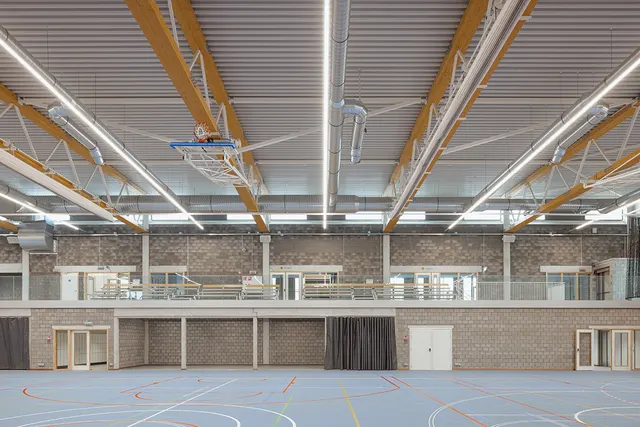
However, this solution is not straightforward for many schools. A final-year project by a student on a professional bachelor’s degree in HVAC, supervised by Botec, found that the additional investment does not pay for itself within a reasonable period. Even in larger classrooms with a nominal air flow rate of 1 500 m³/u, the extra cost is not offset by lower energy consumption after fifteen years. The reasons are the air handling unit’s limited operating hours and the rooms’ almost uniform occupancy during occupied periods. “We therefore tend to recommend installing several air handling units, one for each function, or designing a duct system with just a few main branches and terminal controls for each function, such as classrooms, the dining hall and the sports hall,” says Botec. “We should also remember that a school or school group has only a limited number of skilled tradespeople available to monitor and maintain its systems. The more terminal controls and electronics there are, the greater the need for ongoing support and expertise.”
Ongoing support is crucial
Finally, when it comes to control and energy management, expensive investments in the energy efficiency of an HVAC installation depend on the system being properly commissioned. This is why ongoing support from the installer, controls contractor, engineering firm and client is so important. “When comfort complaints arise during operation, system intelligence is still too often scaled back for convenience, without investigating the actual cause of the problem. It may take years, or the problem may never be discovered, before it becomes clear that a component in the installation is not working properly,” Botec says. “Our conclusion for school buildings: use a system D ventilation installation, divide the building into zones according to occupancy function, with an air handling unit for each function if necessary, and remember that terminal controls offer few benefits for groups of rooms with the same occupancy times. Keep the installation easy to understand and manage, and tailor it to the end client.”
Question about this story? Ask your question
Keep following this
Get an email when a new story is published. No account needed.
- SubjectEducation