FAC and ALUCB further develop their sustainability strategy
Text FAC - Federatie Aluminium ConstructeursImage Vorsselmans, FAC - Federatie Aluminium Constructeurs
Since it was launched early this year, the joint Sustainability & Recycling Working Group of the Federation of Aluminium Joiners (FAC Belgium) and Aluminium Center Belgium (ALUCB) has been busy. Initially, the focus was primarily on mapping the challenges surrounding aluminium’s sustainability, circularity and environmental performance. Now the emphasis is shifting towards testing and substantiating those findings, and developing practical tools. Translating the knowledge gathered into useful information for the market is central to this work.
When FAC and ALUCB launched the joint working group in early 2026, the aim was clear: to develop a shared, objectively substantiated account of aluminium’s sustainability as a building material. The various calculation methods, B-EPDs and sustainability tools currently make transparent comparisons between materials difficult. Moreover, sustainability cannot be reduced to a single CO2 figure. Service life, maintenance, circularity, design flexibility, technical performance and recycling potential all play a part. In recent months, this starting point has been translated into several concrete workstreams.
Strengths and weaknesses
Drawing on input from participating companies, the working group used a SWOT(T) analysis to map aluminium’s strengths, weaknesses, opportunities and threats. More than fifty factors were grouped into ten main themes, including service life, maintenance, circularity, CO2 and environmental impact, thermal insulation performance, design flexibility and investment. These provide a basis for further substantiating aluminium’s position relative to other materials.
The exercise highlighted, above all, the strength of aluminium’s combination of properties. Aluminium scores highly in areas such as service life, maintenance, surface treatment, circularity, design and design flexibility. Safety and structural performance are also among its strengths.
The conclusion is nuanced: aluminium’s strength does not necessarily lie in delivering the best performance on every individual criterion, but in combining a long service life, low maintenance requirements, high recyclability, architectural freedom and strong technical performance. Its suitability for large glazed areas also emerged as an advantage.
From internal analysis to testing with architects
To test these findings against practical experience, an initial survey of architects was conducted. It explored which criteria they consider important when choosing materials for windows, doors and façades, and how they rate aluminium against those criteria. The initial, exploratory results offer some interesting indications. Service life appears to be a property that is already relatively well recognised. By contrast, there is a greater need for information on circularity, CO2 and environmental impact, and architects expect these issues to become more important.
The working group therefore aims to broaden the survey to gain a clearer picture of architects’ expectations, perceptions and information needs. It is also important to reach architects who currently use little or no aluminium.
Towards more representative environmental data for aluminium
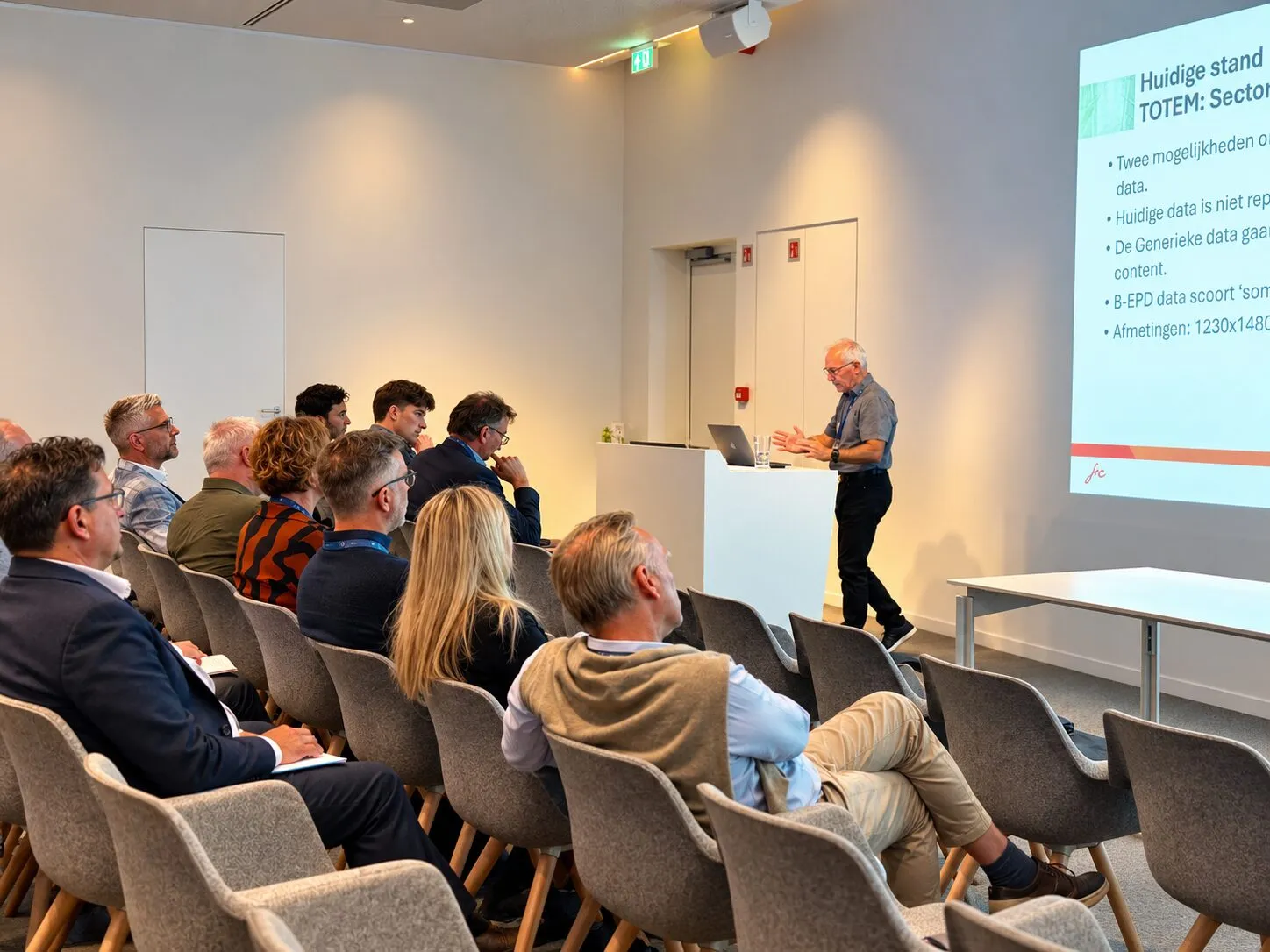
Another important workstream concerns the environmental data used in TOTEM. TOTEM is the Belgian tool for evaluating the environmental impact of buildings and building elements over their life cycle. Global Warming Potential (GWP) can be calculated using, among other sources, specific data (via B-EPDs) and generic data (via the EcoInvent database). The working group is investigating whether it would be worthwhile to supplement the methods currently used with a sectoral B-EPD.
A collective approach of this kind is one possibility, but no final decision has been made. The conditions, verification, costs and practical applicability must first be examined in greater detail. Other European initiatives will also be reviewed to identify any best practices that could be adopted.
Recycling
Aluminium take-back and recycling are already well established in the sector. Several suppliers have developed their own initiatives, while specialist metal recycling companies also have well-developed systems for the professional collection and processing of aluminium scrap. The working group will examine whether further collection and take-back initiatives could add value.
From research to practical information
Ultimately, the working group’s work should produce useful information for the market. A clear information document is therefore being developed to bring together the key properties of aluminium and the points to consider, supported by relevant data. The focus is not only on the material’s well-known advantages, but especially on topics that still raise questions among architects and other users, such as circularity, CO2 and environmental impact. The knowledge gathered should then be usable in various communications for architects, specifiers, members and other stakeholders.
The working group’s activities are therefore gradually moving from analysis to application. The aim remains the same: not to prove that aluminium is the best choice against every individual criterion, but to ensure that the material can be assessed over its entire life cycle on the basis of accurate, representative and complete information.
In the coming months, the various workstreams will take shape: the potential for a sectoral B-EPD will be examined, the architect survey will be broadened, and the knowledge gathered on sustainability and recycling will be substantiated and translated into practical information for architects, clients, specifiers and other stakeholders.
Een zakelijke vraag aan Federatie Aluminium Constructeurs (FAC)? Get in touch
Companies in this story
Keep following this
Get an email when a new story is published. No account needed.
- SubjectSustainable construction
- CompanyFederatie Aluminium Constructeurs (FAC)