Concrete and steel construction
Precast concrete as a driving force
Text and images FEBE – Federation of the concrete industry
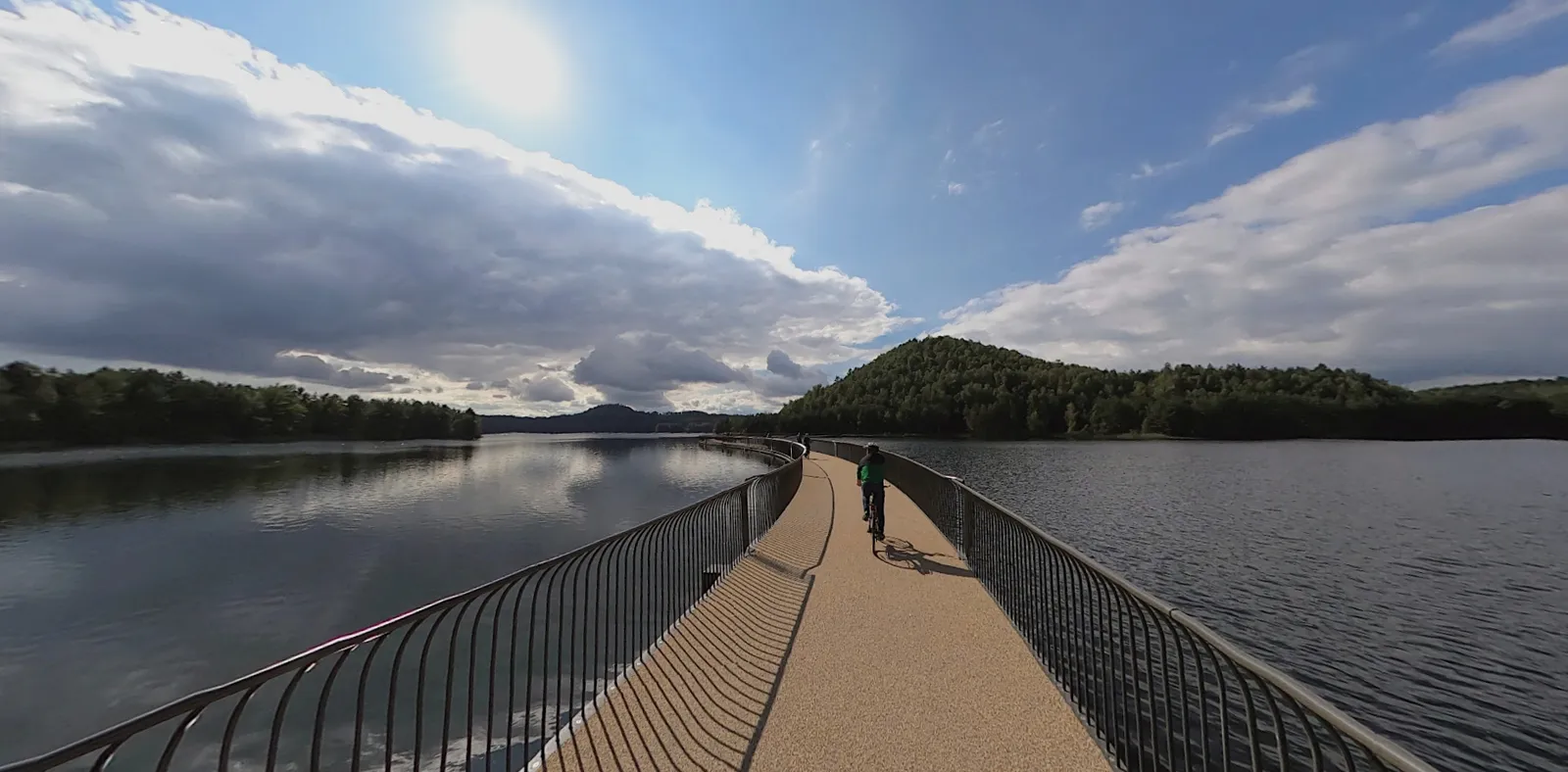
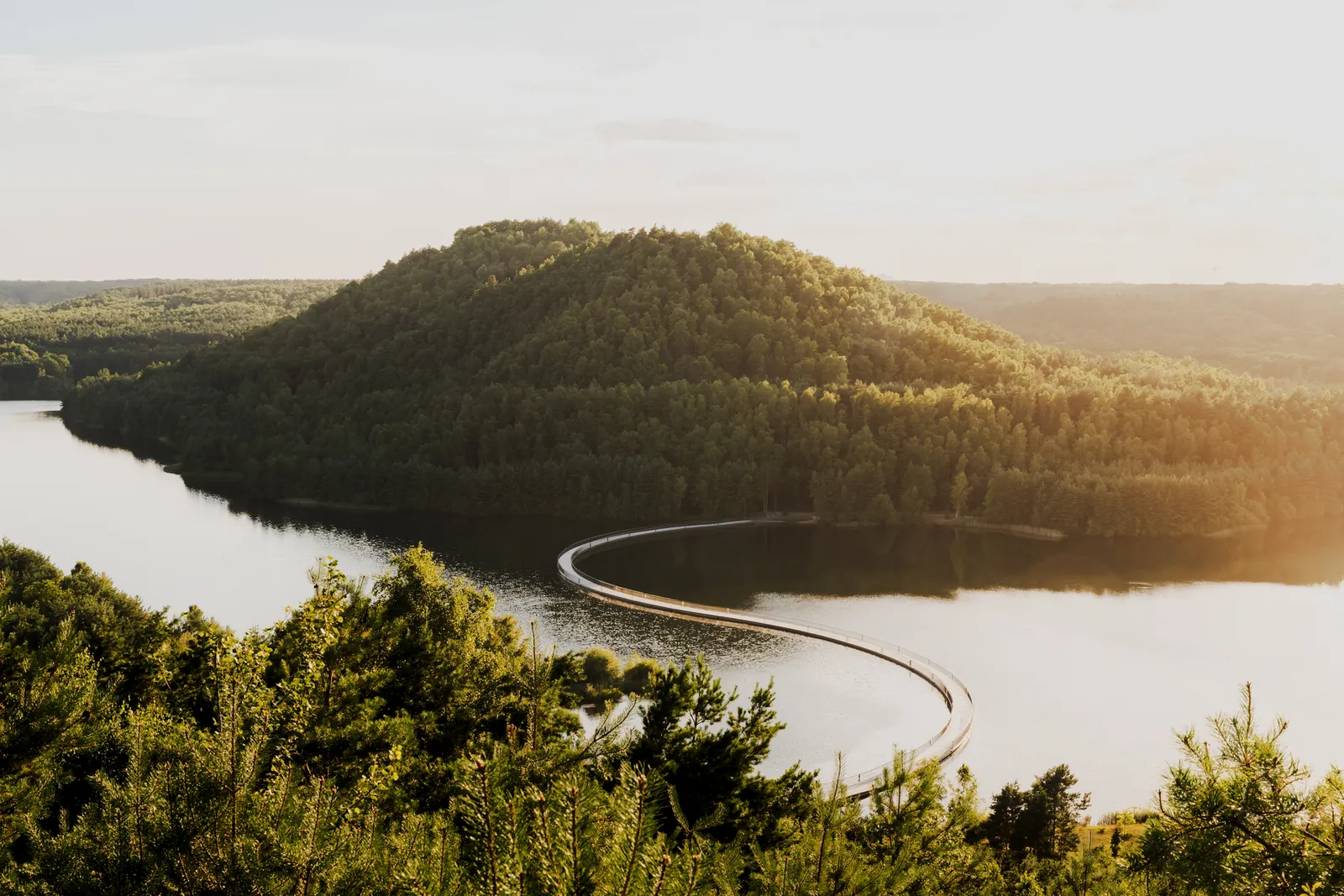
At Terhills, the former Eisden mining site, a remarkable new link has been added to the Limburg cycle route network. The 380-metre floating pontoon bridge between the panorama and twin spoil heaps is not only a tourist attraction, but also an impressive feat of precast concrete, precision engineering and sustainable area development. The S-shaped structure winds its way just above the water’s surface to the opposite shore, allowing cyclists and walkers alike to experience the redeveloped mining landscape from a new perspective.
Today, Terhills is a 365-hectare nature and recreation area on the edge of Hoge Kempen National Park. Where coal was once mined, there is now a landscape of lakes, spoil heaps, flora and fauna, and recreational links. The new pontoon bridge fits perfectly within this wider redevelopment: it adds a new layer to the area without disturbing its existing landscape qualities. Rather than opting for a major infrastructure intervention, the design team chose a lightweight, reversible solution that blends into the landscape.
The bridge was commissioned by LRM and co-funded by Provincie Limburg. Burolandschap drew up the design and landscape integration, while Tractebel was responsible for translating it into a technical solution. The choice of an S-shaped bridge was essential. A straight connection would have created a stark sightline through the area. The curved form, by contrast, follows a more natural rhythm and is better suited to the scale and character of the landscape. Transparent balustrades ensure that views of the water, shorelines and spoil heaps are preserved as much as possible.
Moving with the water
At the heart of this remarkable project is the clever use of precast concrete. The bridge consists of 28 curved concrete pontoon elements, each 13.5 metres long, 3.30 metres wide and weighing 40 tonnes. They are linked together like chain links by cast-in metal hinges. Beneath the water, they are guided and anchored by fifteen steel tubular piles, driven 24 to 26 metres into the lake bed. The result is a stable yet flexible structure that can move with changing water levels.
This interplay between robustness and adaptability is what makes the bridge special. The pontoons contain an EPS core to provide additional buoyancy. According to Archimedes’ principle, they float through the balance between their own weight, the volume of water displaced and the upward force. This is crucial, as water levels can fluctuate considerably due to the seasons, wind and wave action. The structure is designed to accommodate level differences of up to 2.5 metres and waves up to 75 centimetres, while remaining comfortable for cyclists and walkers to use.
A remarkable feat of engineering and production technology
Betca manufactured the precast elements, based on the contractor HYE’s construction concept. Fifteen elements with a left-hand curve and thirteen with a right-hand curve were produced in self-compacting C50/60 concrete. Precast concrete offered clear advantages here: high dimensional accuracy, controlled production conditions, a shorter construction period on site and excellent control of quality and tolerances. The precast approach also made it possible to develop and test the complex geometry accurately in advance.
This level of precision was essential. Steel UPN sections, lifting equipment, connection details and cast-in components were integrated into the pontoons. Some tolerances were as little as 2 millimetres. The position of the guide structures and the connections to the tubular piles also had to be exact to ensure that the entire S-shaped chain aligned correctly with the abutments. 3D CAD therefore played a key role in the engineering, construction planning and coordination of concrete, steel and site work.
Sustainable, modular and reversible
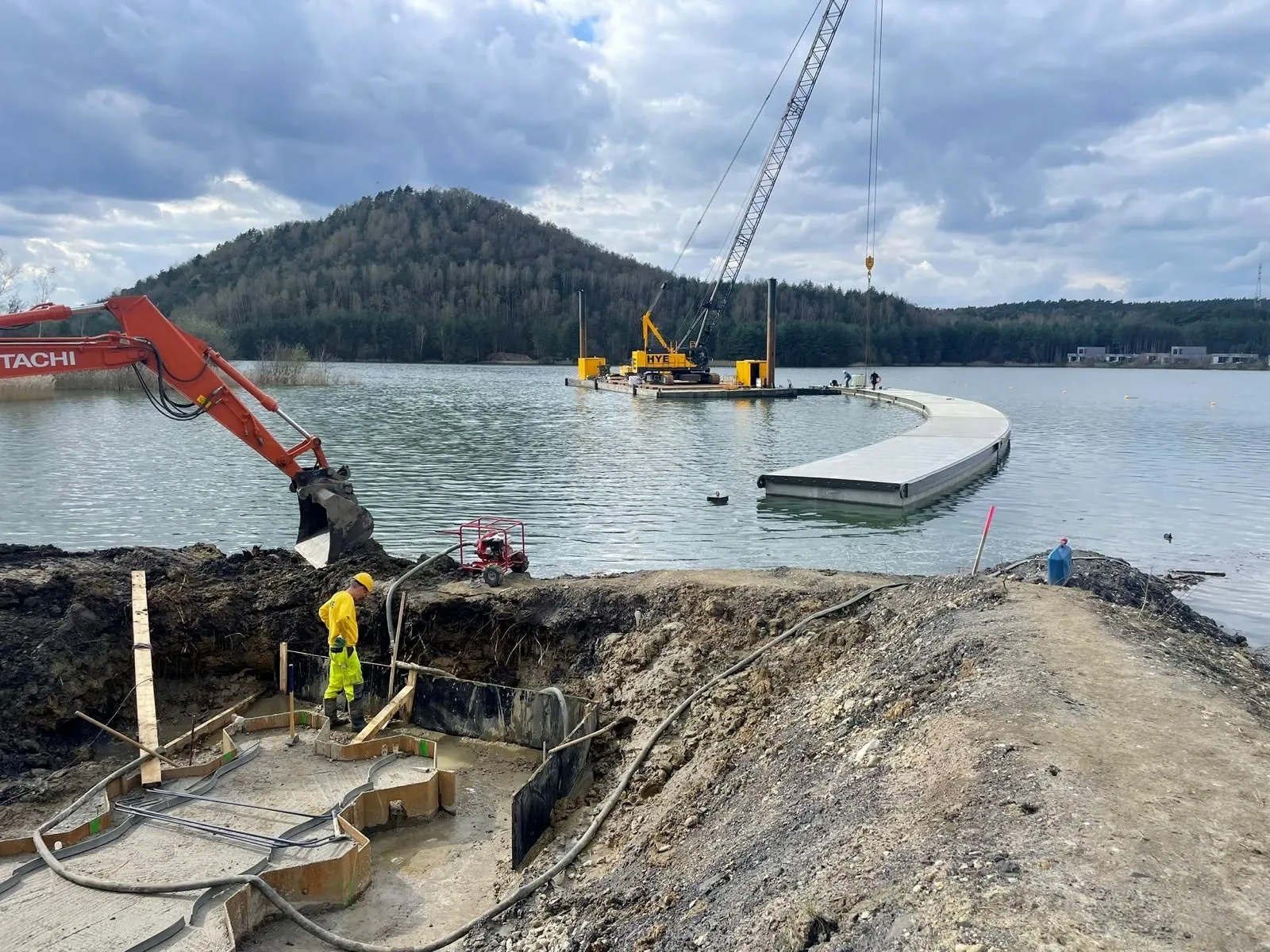
The site organisation also required careful planning. As the lake is completely surrounded by land, the precast elements had to be delivered by road. HYE built a temporary quay for unloading the pontoons and launching them into the water. A coupling pontoon served as a working platform for the cable crane used to position the elements. Despite the technical complexity, high water levels and often difficult weather conditions, the bridge was assembled in just six months.
This pontoon bridge demonstrates how precast concrete can contribute to smart infrastructure in sensitive or valuable environments. The structure is sustainable, modular and, in principle, reversible: if necessary, it can be removed without causing lasting, significant damage to the landscape. The corten steel artwork at the end, made from reused sections of the anchoring piles, also highlights this circular approach.
Since opening in September 2024, the bridge has welcomed tens of thousands of cyclists and walkers. Yet the project goes beyond its recreational function. It shows how targeted infrastructure can give a former industrial site a new purpose. Precast concrete is not merely the technical construction solution here, but the foundation for a broader ambition: to create a landscape that is accessible and forward-looking, while respecting its past.
Question about this story? Ask your question
Keep following this
Get an email when a new story is published. No account needed.
- SubjectConcrete and steel construction