Imposing sludge mono-incineration plant calls for a carefully thought-out DBFMO approach
Text Tim JanssensImage BESIX Group
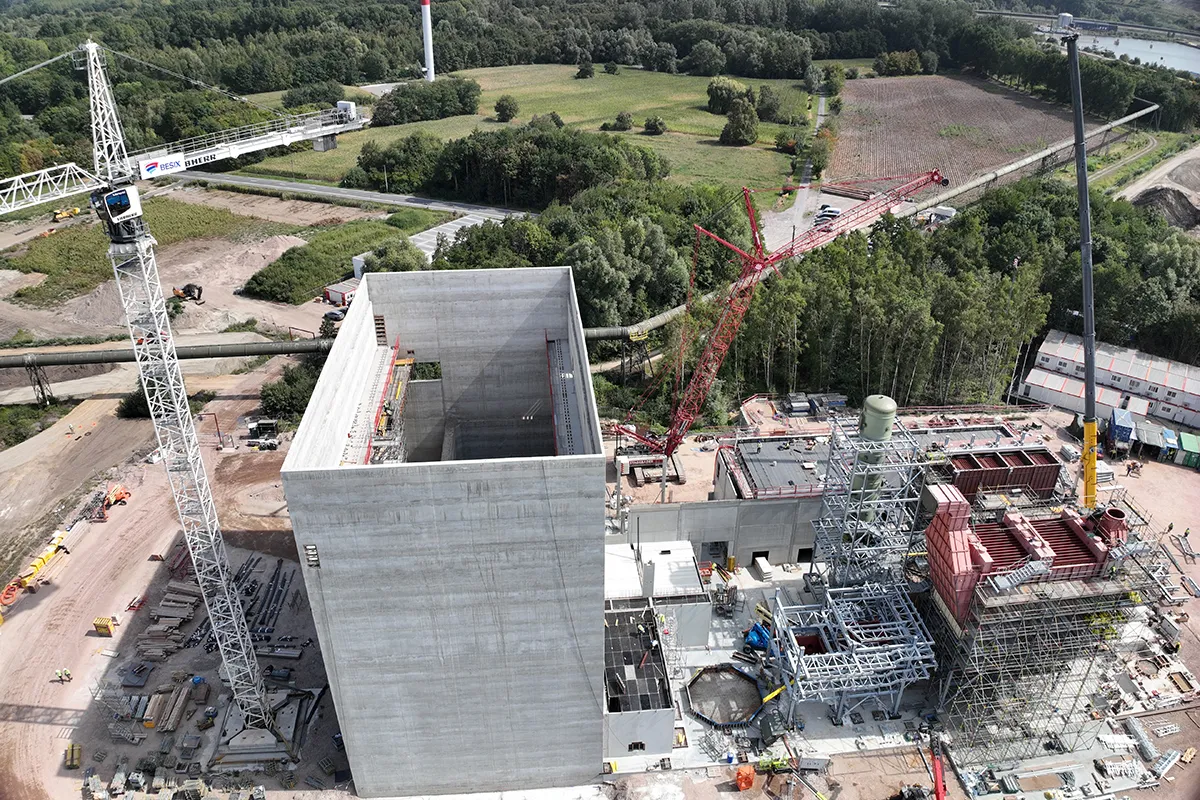
Anyone who has recently spent time in the Port of Ghent area will probably have noticed the imposing outline of Aquafin’s new sludge mono-incineration plant, currently under construction at the ArcelorMittal Belgium site. The prestigious DBFMO contract for the design, construction, financing, 20-year operation and associated maintenance was awarded to FOSTER, the consortium formed by BESIX Group and Indaver. With construction completion less than a year away, we caught up with Koen Van Lerberghe, project director at BESIX Group, for an update. “The schedule is very challenging and coordinating all the work is highly complex, but for now we are right on track.”
Aquafin carries out extensive treatment of domestic wastewater for 86% of all residents in Flanders. The biomass produced in the process is a valuable source of energy and raw materials. This prompted the decision to build a new sludge mono-incineration plant, which from 2027 will provide the final treatment for two thirds of the sludge generated by the treatment of domestic wastewater in Flanders. With a negative global warming impact of 28,000 tonnes of CO2-eq, the plant will make a significant contribution to delivering Aquafin’s ‘road to zero carbon’ plan.
The chosen location was the Ghent site of steel producer ArcelorMittal Belgium. This was partly to minimise the CO2 impact of sludge transport, and partly because of the opportunities to recover value from the energy produced, which ArcelorMittal will use in its production processes in the form of expanded steam. The Port of Ghent’s ambition to become CO2-neutral by 2050 was another decisive factor for Aquafin. In a later phase, the company also intends to use the plant to recover phosphorus from the fly ash produced by sludge processing.
PPP experience and construction expertise
To put its highly ambitious and forward-looking plans into practice, Aquafin tendered a DBFMO contract. The contract is being delivered by a consortium with the fitting name FOSTER, which not only reflects the intention to value sewage sludge as a valuable by-product, but also the (future) recovery of energy and phosphorus. “At BESIX Group, we joined forces with Indaver, with whom we make a highly complementary team,” says Koen Van Lerberghe.
“We are honoured that BESIX is playing a key role in this exceptional PPP project and that, as a long-term industrial partner, we can actively contribute to sustainable and innovative solutions for Aquafin. BESIX has decades of experience in public-private partnerships for complex infrastructure and environmental projects. Our group manages the entire process, from design and construction through to financing, operation and maintenance. We work closely with Indaver, which brings expertise in waste processing and energy recovery to the project. This development is a natural fit with our international experience of industrial facilities on a similar or larger scale. Our multidisciplinary expertise enables us to make the most of our extensive knowledge of project financing, engineering, environmental technology, construction and operational management.”
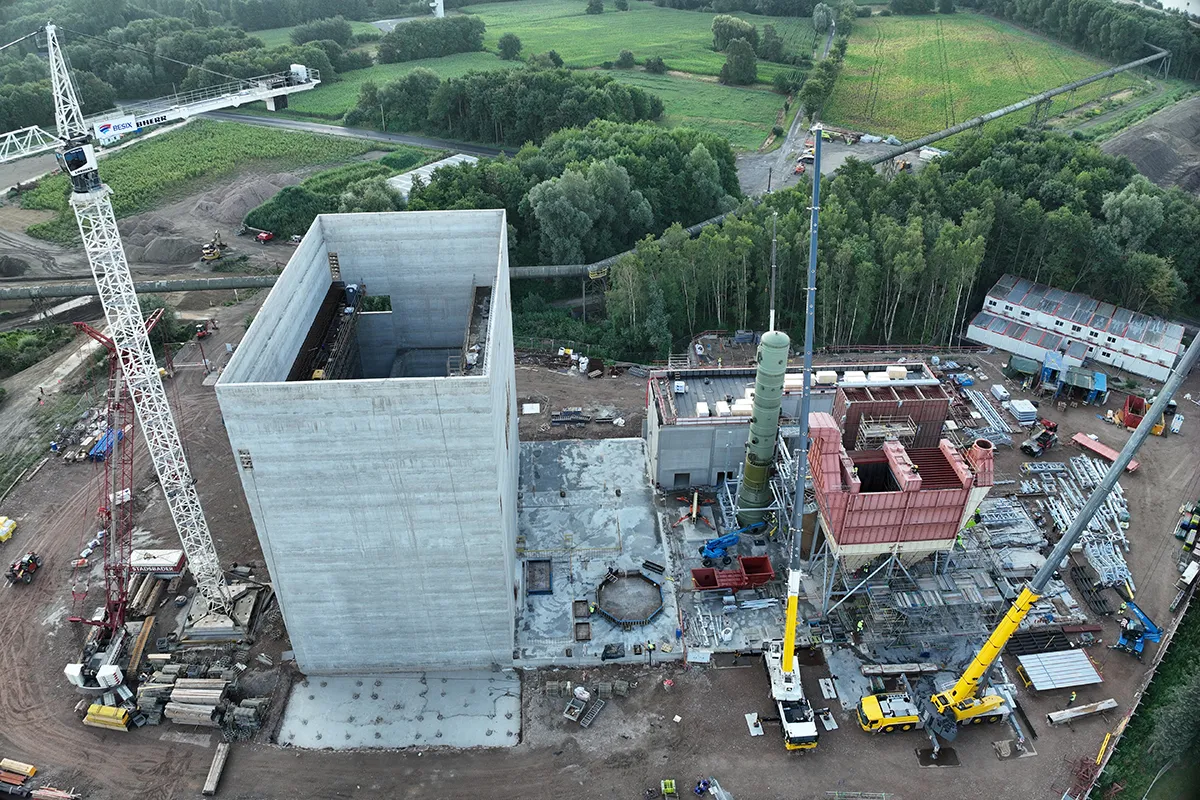
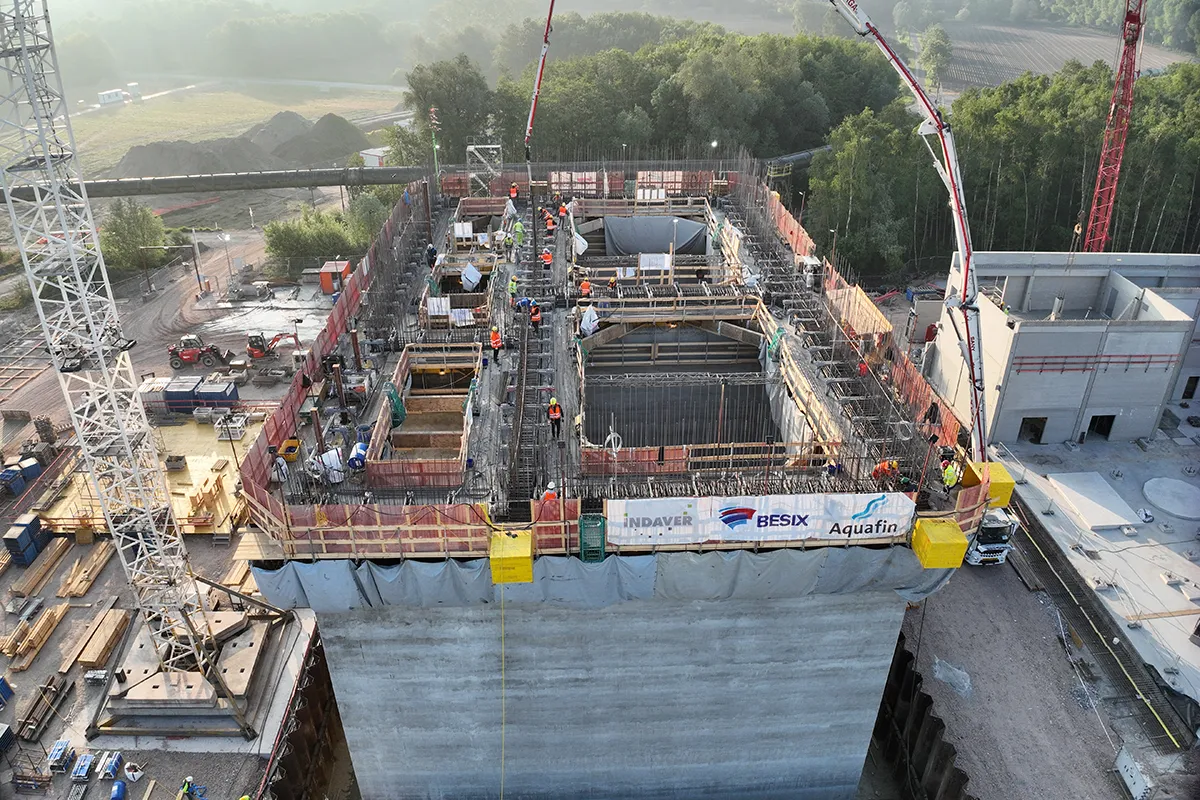
BESIX Group is currently drawing on all its construction expertise to bring the new sludge mono-incineration plant to completion. “The complex includes an office area, a tipping hall, a bunker for dewatered sludge and a process hall with adjoining technical rooms,” explains Koen Van Lerberghe. “We are building the plant mainly in concrete, using a large proportion of precast elements as well as an advanced slipforming operation for the monolithic sludge bunker, which is 40 metres high. The bunker’s rectangular shape and the walls’ reducing thickness as they rise, from 1 metre at the base to 20 centimetres at the top, made the work particularly specialised. We worked on it 24/24 for 20 days, with three temporary stoppages to adjust the formwork. The process plant, including the furnace and the large-scale flue gas treatment system, will also soon be covered by a steel structure.”
A challenging schedule and complex coordination
The symbolic starting signal for the works was given on 25 February. The total construction period is 26 months, including an extensive commissioning phase. “The schedule is very challenging, as it means we have to complete the actual construction work in around eighteen months,” says Koen Van Lerberghe. “To make this possible, we drew up a carefully considered sequence of works based on detailed execution plans, specifying exactly who will be working in which area and when, so that everyone can work as quickly and efficiently as possible. We also monitor all site activities meticulously using lean planning and coordinate the various work packages through a single shared BIM model, allowing us to anticipate potential clashes or problems. Alongside the tight schedule and complex coordination, the compact nature of the construction site is also a challenge, as there is virtually no storage space or room to move. All deliveries therefore take place just in time.”
BESIX Group is currently right on schedule. “Before the summer, we built the sludge bunker and most of the process hall simultaneously. In October, we carried out several major lifting operations using a 700-tonne crane to position large items of technical equipment, including the two sludge cranes in the sludge bunker. We are currently building the steel structure around the process hall. Next year, the task will be to join all the pieces together through the final structural work, installation of the necessary cabling and pipework, construction of all the paved areas on site, and so on,” explains Koen Van Lerberghe. “If all goes well, we will be finished by the end of 2026. In any case, this is a unique project. DBFMO is often used for infrastructure projects, but combining it with the operational aspect, in other words, 20 years of operation and maintenance, is unusual for a factory building of this kind. Together with the environmental focus, through which we are helping to make a substantial reduction in CO2 emissions, this is a flagship project to be proud of.”
Question about this story? Ask your question
Keep following this
Get an email when a new story is published. No account needed.
- SubjectIndustrial construction