Smart climate ceilings for ambitious projects
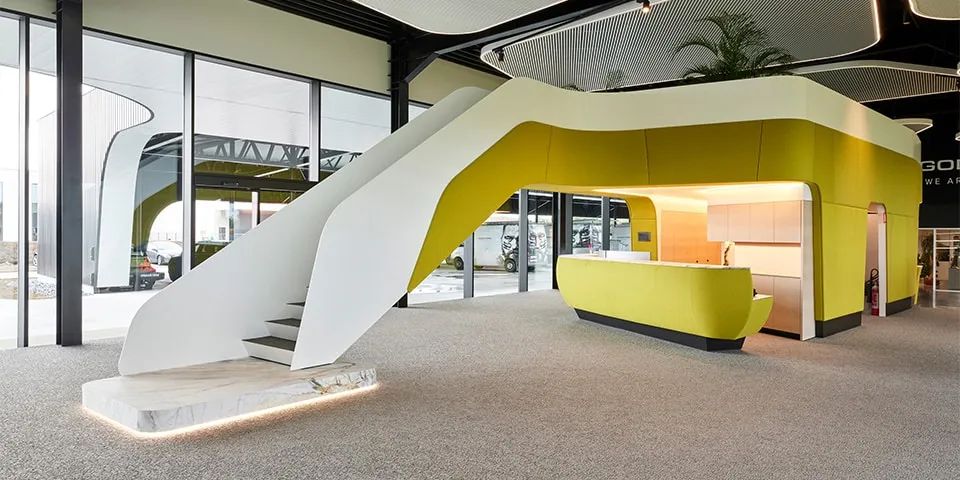
The days when climate ceilings were a niche product used almost exclusively in large office buildings are well and truly over, as are the days when Interalu was known simply as a ‘metal ceiling manufacturer’. Almost fifty years after its foundation in 1971, the Antwerp-based company has grown into a ‘ceiling engineer’, developing climate ceiling systems that combine thermal and acoustic performance with ecological credentials and aesthetic appeal. “Our philosophy is to keep learning, embrace new developments and devise solutions that go beyond today’s standards,” says CEO Anthony Schrauwen.
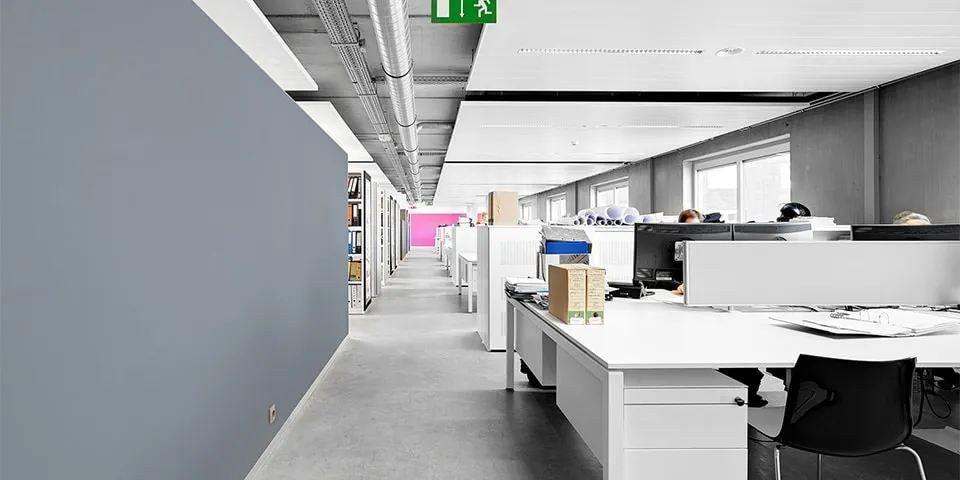
“Some clients want the climate ceiling to contribute to an industrial look, while others ask for it to be integrated as discreetly as possible. In short, our systems are highly versatile,” Anthony Schrauwen emphasises. (Image: Bart Gosselin)
A striking trend is that climate ceilings are no longer reserved exclusively for large buildings. They are now also appearing in small offices, schools and hospitals. Nor are they used only as neutral, continuous structures: today, they come in all kinds of shapes and colours. “Technical and acoustic comfort used to be the main priorities. Now, energy efficiency and aesthetics are also crucial,” says Anthony Schrauwen, who has led Interalu for a quarter of a century. The market-leading family business is headquartered in Wilrijk, with branches in Luxembourg, the Netherlands and France, and a partner in Italy.
Balancing different parameters
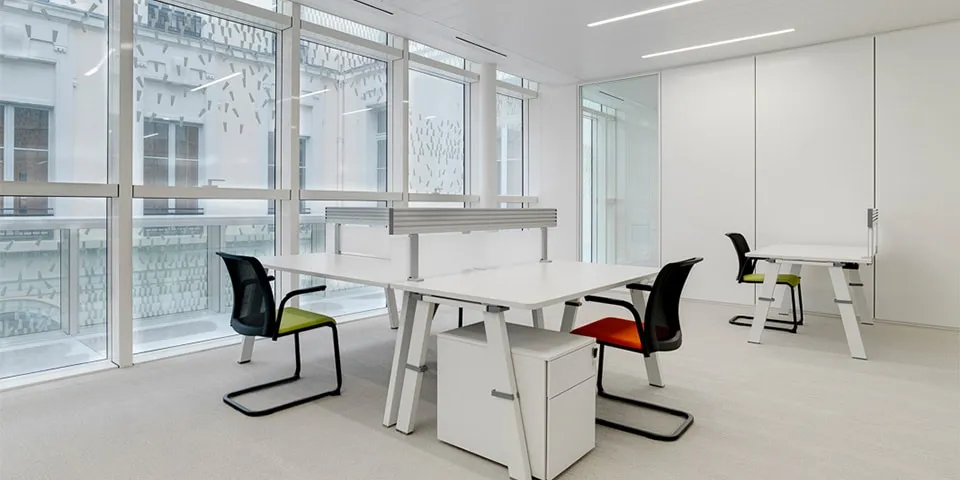
“When developing our climate ceilings, we have to take various factors into account,” Anthony Schrauwen explains. “First, there are heating and cooling requirements, taking into consideration new trends such as flexible use of space and ‘new ways of working’. A climate ceiling also integrates many other technologies, such as lighting. Acoustics are a third consideration. To address these, for example, we often use ceiling islands, which can even be designed in organic shapes if required. And, of course, aesthetics are crucial too. Some clients want the climate ceiling to contribute to an industrial look, while others ask for it to be integrated as discreetly as possible. In short, our systems are highly versatile. We bring together architectural freedom, technical parameters and the client’s wishes in a climate ceiling that is, so to speak, more than the sum of its parts, in both new-build and renovation projects, including those involving heritage buildings. We take care of the entire ceiling package, from A to Z. We go to great lengths to balance all the parameters, not least because we learn a lot from the process ourselves.”
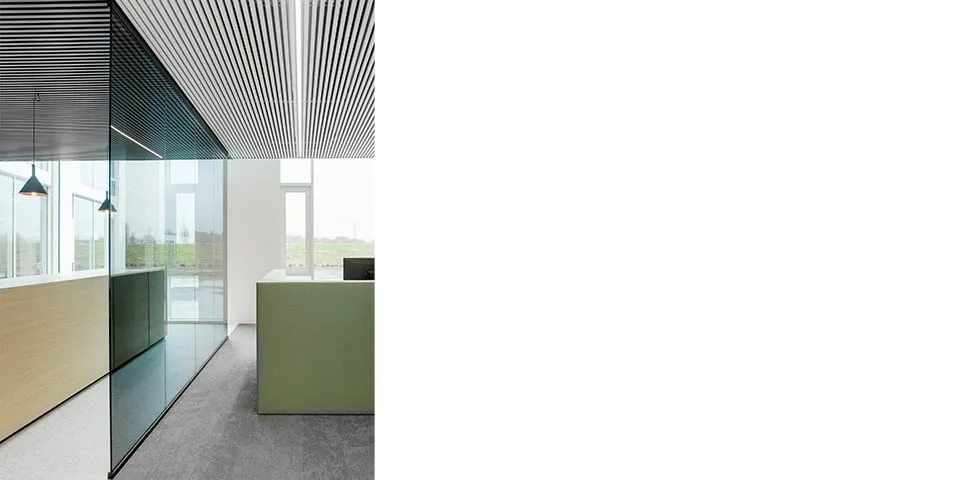
“We do more than just assemble products. Our own R&D enables us to deliver fully bespoke solutions,” says Carlo Miers. (Image: Bart Gosselin)
An ecological approach
One of the key strengths of Interalu’s climate ceilings is their high performance and energy efficiency. “Our systems heat using low temperatures, with water between 30 and 40 °C, and cool using higher temperatures, with water between 15 and 19 °C. This means much less energy is needed to achieve an optimal indoor climate,” explains commercial director Carlo Miers. “We have always prioritised ecology, drawing on our experience with projects abroad, where we regularly work with renowned, forward-thinking engineers. During discussions as part of the Green Deal Circulair Bouwen, we realised that we are already well advanced in closing the loop for our products. Our climate ceilings are fully recyclable and manufactured entirely CO2-free. We have also had a product-based BREAAM audit carried out, and the performance of our ceilings has led to our involvement in numerous BREEAM and WELL projects. At Interalu, we focus on developing high-quality, sustainable systems, with SAPP Ceiling as the prime example. On a recent project, the building services engineer was even able to save half a million euros because our climate ceilings perform so well that the heat pumps can run more efficiently, making geothermal energy unnecessary.”
Bespoke solutions for every project
Interalu is also unique in being the only Belgian company to develop and manufacture its own climate ceilings. “We do more than just assemble products. Our own R&D enables us to deliver fully bespoke solutions,” Anthony Schrauwen emphasises. “Customers are not limited to the standard products in our range. On the contrary, we upgrade our systems in response to current trends. If someone wants a circular climate ceiling, we can deliver it without any problem and without compromising on technical performance. We support architects and design consultancies in designing a building, and the end result is a product, whereas in most other cases it works the other way around. We believe this interaction is extremely valuable. We are currently converting part of our offices into a living showroom of around 500 m², where we will showcase the limitless possibilities of climate ceilings in office environments.”
Question about this story? Ask your question
Keep following this
Get an email when a new story is published. No account needed.
- SubjectProduct information