Which BIM software do architects use?
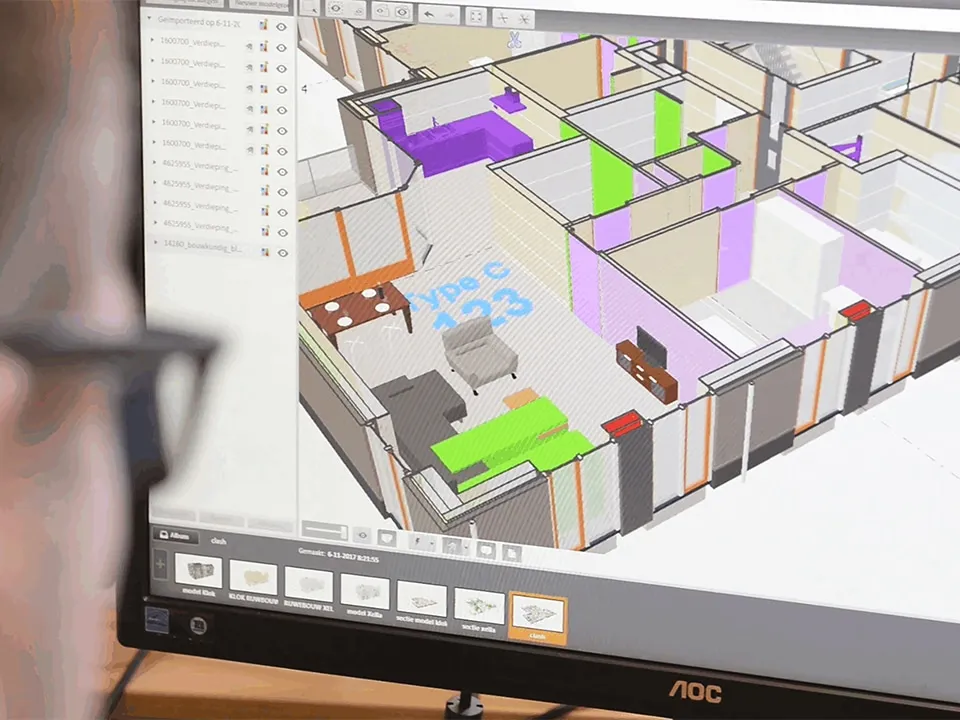
BIM, or Building Information Modelling, has gained considerable momentum in recent years. This is borne out by a survey conducted by Redactiebureau Palindroom among 174 Dutch-speaking architects. The results have been compiled in a white paper on communication in the architecture sector.
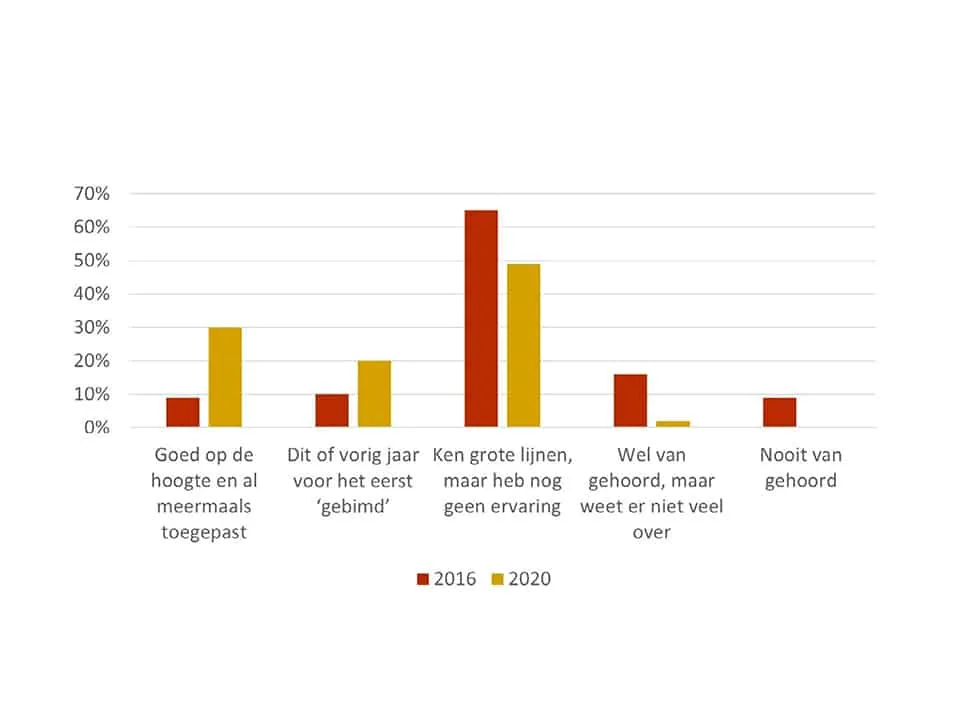
While just 18 % of architects had experience with BIM four years ago, that figure had almost tripled to 50 % by 2020. One of the most challenging aspects of getting started with BIM is choosing the software. After all, every programme has its pros and cons. Many practices therefore combine several solutions. The survey revealed significant regional differences in this respect.
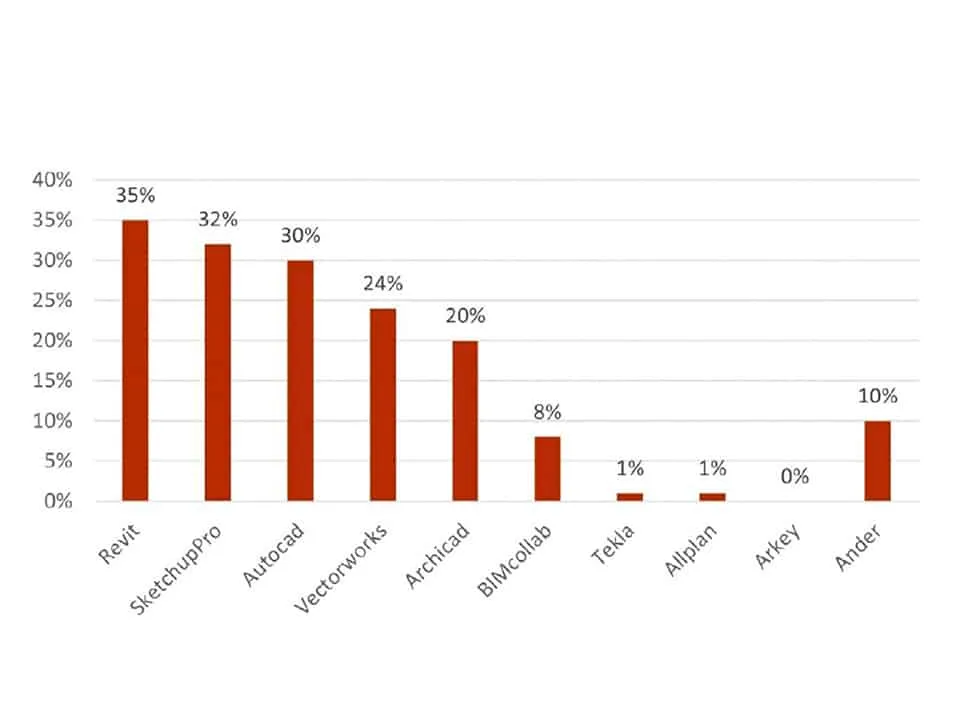
Revit tops the list with 35 %, followed by SketchupPro (32 %) and AutoCAD (30 %). Two other systems score above 20 %: Vectorworks (24 %) and Archicad (21 %). Finally, BIMcollab scores 8 %. It belongs to the same family as Archicad, but is specifically focused on multidisciplinary collaboration between the various construction partners.
No other question in the survey produced such pronounced differences between segments as the choice of BIM software, whether by age, region or practice size, and, to a lesser extent, by the sector in which the practice operates. Bear in mind, however, that the segments are a little too small to support definitive conclusions. Even so, there are some clear differences that are hard to ignore.
Age
The youngest generation has used the greatest number of programmes on average. Vectorworks leads the market among the oldest generation, at 32 %, but its popularity declines as age decreases. Among the youngest generation, Vectorworks drops to fifth place with 20 %. These differing scores among older architects are probably rooted in tradition. Before BIM took off, Vectorworks was very popular with architects, and many continued to use it even after switching
to BIM.
Revit, in turn, performs considerably better among younger architects than older ones. AutoCAD is particularly popular with the very youngest generation, where it is the most widely used software, at 49 %. AutoCAD’s high score among younger architects is probably linked to training at architecture schools, where it is often used. As a result, many architects starting out have a better command of the programme than of the alternatives. SketchupPro and Archicad also fare better among younger architects, although the differences are less pronounced.
Region
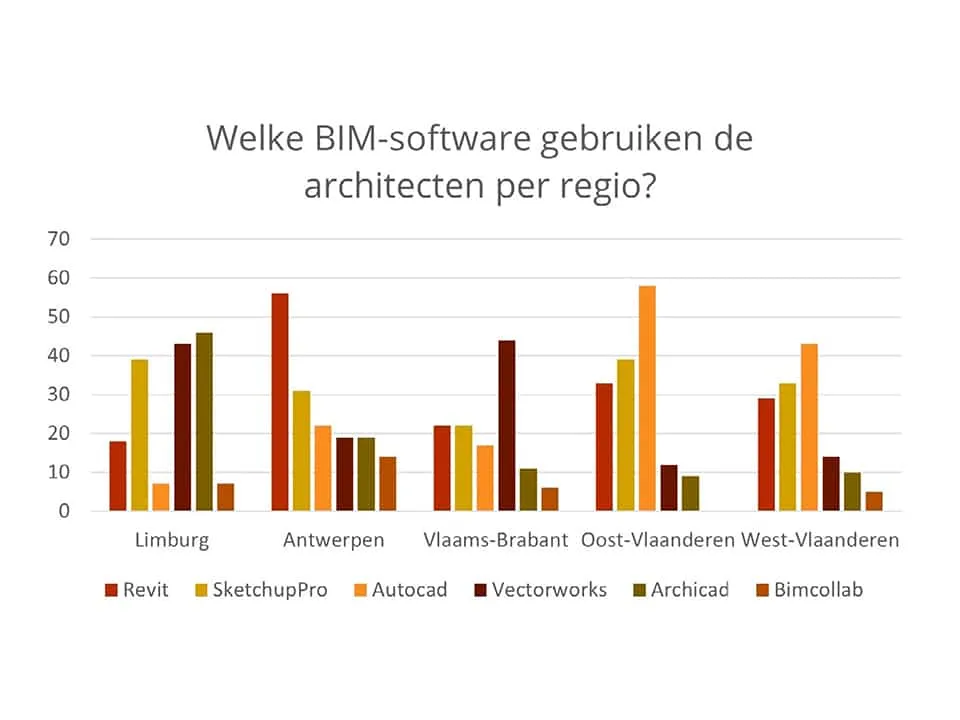
The figures for the various programmes also vary widely by region. Archicad, for example, performs particularly well in Limburg, where it ranks first with 46 %. Vectorworks also fares considerably better here (43 %) than the average (24 %). In Limburg, Revit ranks just third, at 18 %, around half its average score across Flanders.
Antwerp, by contrast, is clearly a Revit province. 56 % of Antwerp architects who use BIM work with Revit. In Flemish Brabant, Vectorworks records the highest score (44 %), while AutoCAD leads in West Flanders (43 %).
It is difficult to explain why there are such large regional differences in BIM software use. Local representatives are probably a major factor. This type of software is often bought on the basis of trust, and manufacturers’ representatives play an important role in building it. Education can also influence the figures. Universities and certain professional development organisations tend to favour one type of software. Software suppliers also play their part. They regularly run BIM courses, where participants use their software. Such training can certainly steer architects towards a specific BIM programme. Courses also tend to be more popular in some provinces than others, usually because of the software manufacturers’ representatives and their networks. Their influence should certainly not be underestimated.
Practice size
Practice size also appears to influence the choice of software. Among sole practitioners, Vectorworks is clearly the most popular, at 40 %, followed by AutoCAD and SketchupPro. The latter programme, in turn, scores highest among practices with two to five employees. Revit takes the top spot among practices with six or more employees.
Among architects who mainly design private homes, SketchupPro is the most widely used programme (31 %), closely followed by AutoCAD (30 %) and Revit (29 %). In non-residential construction, Revit scores highest (54 %), with a fairly wide gap over SketchupPro (34 %) and AutoCAD (29 %) in second and third place.
Download the white paper for free
This article is an excerpt from the white paper published by Redactiebureau Palindroom on 1 December 2020, which examines the results of a survey on communication to and from architects. The survey also asked about respondents’ views on and experience with labels, circular construction and BIM. Interested in the white paper? Email [email protected] or download it for free from whitepaper.architectura.be.
Question about this story? Ask your question
Keep following this
Get an email when a new story is published. No account needed.
- SubjectProduct information