New EN 16755 standard sets the record straight on fire-retardant timber
Text Joris HendrickxImage Houthandel Paulussen
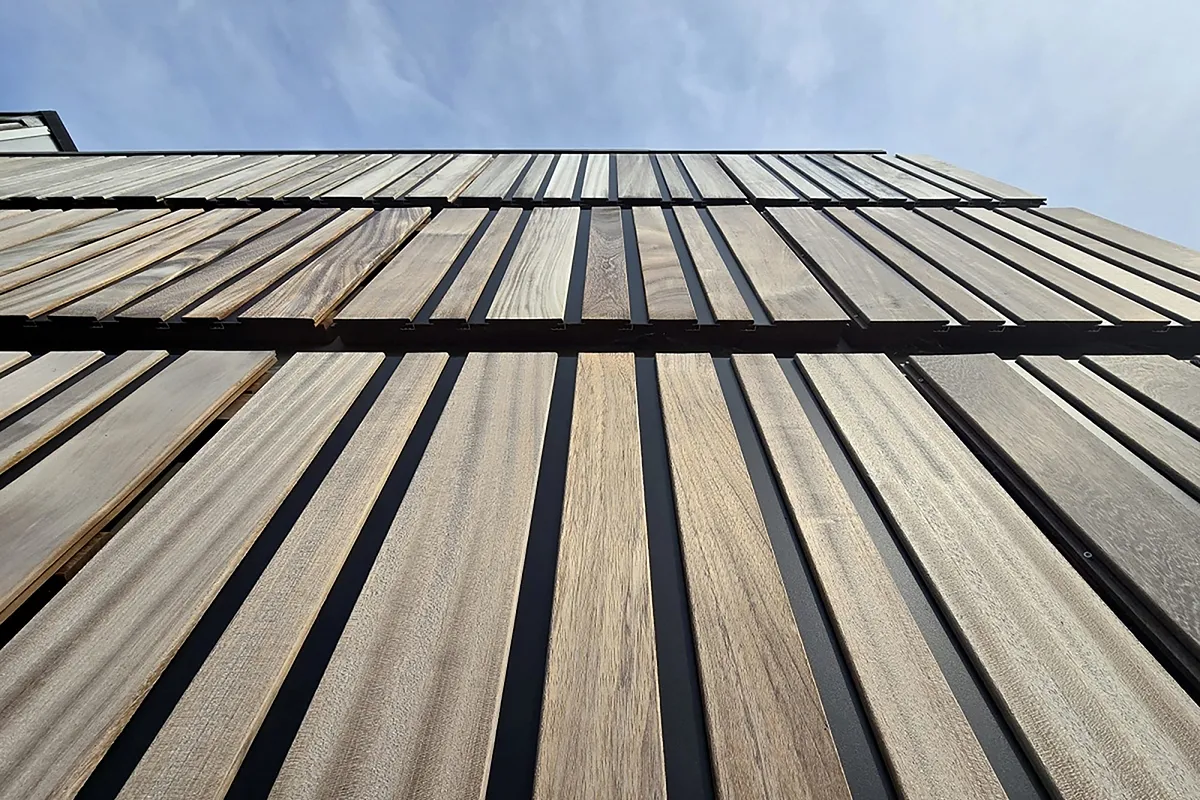
The European standard EN 16755, which assesses the durability of fire-retardant-treated wood products, is undergoing a major revision. A necessary step, says Steven Paulussen of Houthandel Paulussen: “Reality had been catching up with the standard for some time. Exterior applications in particular were a problem.”
EN 16755, formally titled ‘Durability of reaction to fire performance: Classification of fire-retardant treated wood products for interior and exterior end use’, is the European standard that specifies which test method(s) manufacturers of fire-retardant-treated timber and wood products must use to demonstrate the durability of the treatment over time. It is the reference standard for both interior and exterior use. However, the previous version, which dated from 2017, was outdated in several respects.
Broader scope
According to Steven Paulussen, the revision shows how difficult it is to capture a complex natural product such as wood in a standard. “Wood is diverse. Combine that with the many types of fire-retardant treatment and a fast-moving market, and you can see how quickly a standard can become outdated.” So what was going wrong? In practice, durability in exterior applications often proved far worse than the test results suggested. “Some manufacturers were supposedly able to show that there was no leaching,” Paulussen explains, “but in reality it happened very quickly.”
Time for a revision
The new version of the standard addresses this comprehensively. The introduction has been rewritten and the scope of application expanded. The standard now covers all forms of timber, from preservative-treated to thermally modified timber, and a range of treatments: impregnations, coatings and even products that incorporate fire retardants during manufacture. Treatments in which a non-fire-retardant coating is applied over a treated wood product are also
now covered by the standard.
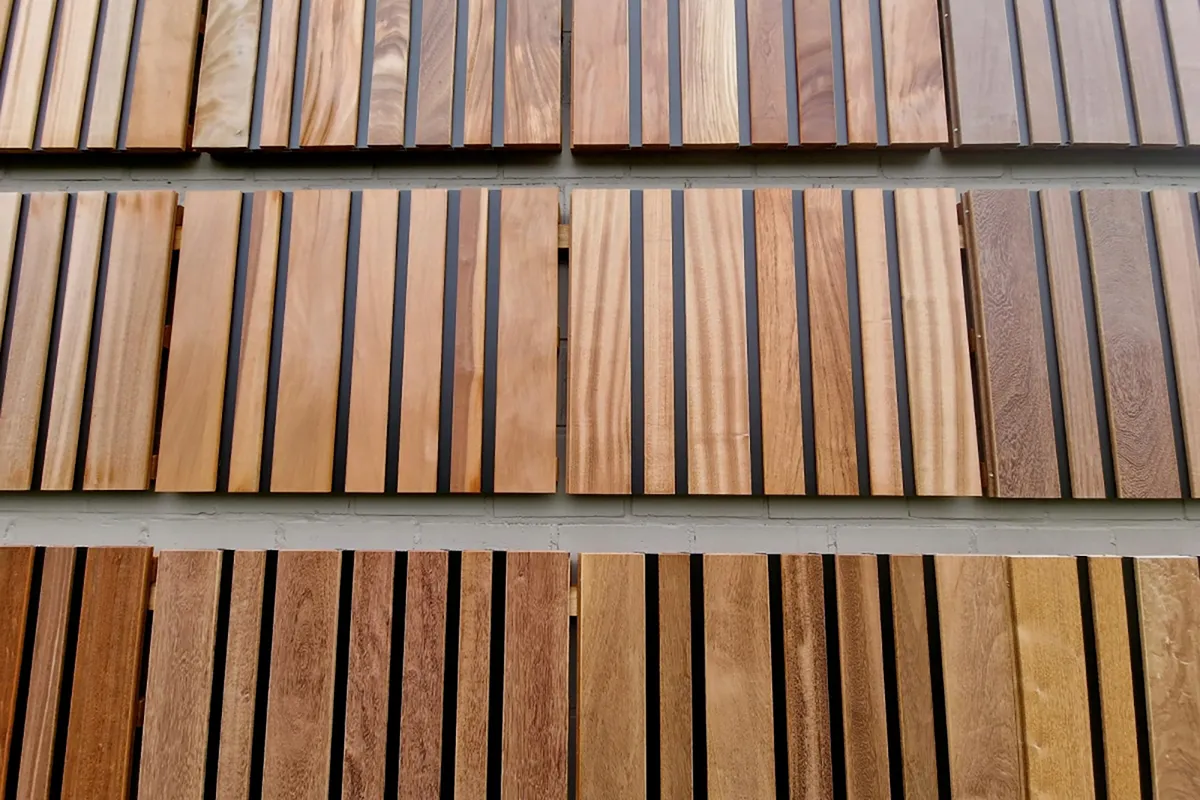
Terminological and technical changes
One notable change is the terminology, with ‘Accelerated Weathering’ replaced by ‘Artificial Weathering’. “The word ‘accelerated’ suggested that it was a faster but equivalent simulation of natural ageing,” says Steven Paulussen. “But research shows that this is not the case, because the impact is fundamentally different. So ‘artificial weathering’ is the more accurate term.”
One significant technical change is the removal of the Cone Calorimeter test (ISO 5660-1) from the list of permitted test methods. Steven Paulussen says: “The test is useful for small-scale studies, but it measures far too few variables to support reliable conclusions about the durability of fire retardants in exterior applications.” As the test was also often combined with Artificial Weathering, the margin of error was doubled. “It isn’t representative, so it’s right to remove it.”
In its place, at least two large-scale SBI tests (EN 13823) are now required: one before and one after ageing. Manufacturers can choose between natural ageing (EN 927-3) and the artificial alternative. “It’s important to note that different façade profiles can produce different results,” explains Steven Paulussen. “A flat board behaves differently from a ribbed one. The installation direction, horizontal or vertical, also matters. So there’s no scope for generalisation.”
The terminology has also been aligned with the logic of durability: whereas the previous standard referred to the ‘Service classes’ in Eurocode 5, the new version now uses the ‘Use classes’ in EN 335. “A logical change,” says Steven Paulussen. “Timber is now assessed according to its actual use, not just its structural context.”
No more vague descriptions
Perhaps the most clarifying change is the removal of all references to ‘service life’. The previous version allowed manufacturers to describe service life in vague terms, leaving even experts confused. “You would read statements such as: ‘The fire retardant does not leach out, but its effect diminishes at the same rate as the ageing process.’ Just try to work out from that whether the fire classification is retained.” Steven Paulussen says clarity is essential: “The SBI test states in black and white whether a product achieves a reaction-to-fire classification or not. If performance drops significantly, it fails, full stop. You can’t disguise that with poetic wording.”
The new standard also requires the ‘Classification report’ to specify what maintenance is needed, which product to use and at what intervals. “Without the Cone Calorimeter, realistic results are now emerging for certain products,” says Paulussen. “That means maintenance must be specified and communicated.”
At the same time, the standard emphasises that manufacturers are free to choose their own test method, but in the event of a dispute, Natural Weathering in accordance with EN 927-3 is the benchmark. “And it’s cheap, too,” laughs Paulussen. “You leave the timber outside for a year and Mother Nature does her work.”
However, he also sees potential pitfalls. “Mandatory maintenance for exterior applications could make timber less attractive. There is a risk that architects will turn to scarcely regulated alternatives such as composites, which are designed to resemble timber but do not have to comply with this standard.” His message is clear: “Keep choosing timber. Good regulation provides certainty!”
Question about this story? Ask your question
Keep following this
Get an email when a new story is published. No account needed.
- SubjectFire safety