“Timber construction still has plenty of room to grow in our country”
Text Wouter Polspoel, Tim JanssensImage Pexels
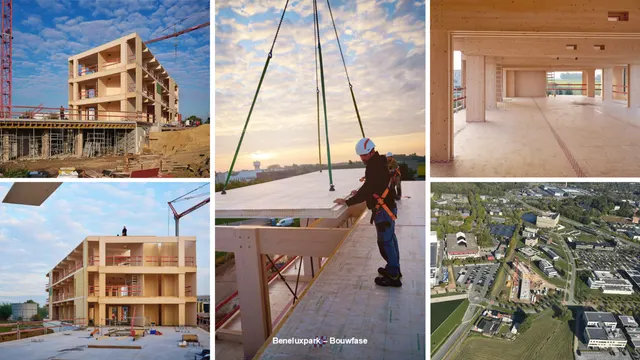
Timber construction is steadily gaining importance in Belgium. This centuries-old, sustainable building method has enormous potential, but many contractors and architects still lack the know-how to make the most of it. That is one of the many interesting conclusions to emerge from a fascinating interview with Bruno Deraedt, founder and architectural engineer at BAST architects & engineers and lecturer in regenerative design at KU Leuven, and Catherine De Wolf, assistant professor at ETH Zürich, co-founder of the Circular Engineering for Architecture research group and of Swiss timber processing and construction company Anku. “Building up expertise in timber construction is a major challenge in our country, particularly if we want to move towards larger-scale projects.”
Is choosing timber construction an ideological choice, or does it always depend on the context?
Bruno Deraedt: “As far as I’m concerned, designing and building in timber is the ideologically right choice. It’s a matter of principle. We only depart from that position if there’s a reason why it isn’t possible. When we took this stance 15 years ago, at the founding of BAST, our main argument was timber’s renewability. Today, it’s more that timber fits perfectly with the philosophy of circular construction.”
Catherine De Wolf: “In my view, you should use the right material in the right place and in the right way. Buildings made of steel and/or concrete therefore have their place too. Above all, I believe every building should be designed for reversibility.”
What do you see as the main benefits of designing and building with timber?
Bruno Deraedt: “Timber is lightweight, making it easy to work with and well suited to temporary structures. You also don’t need many tools to build with timber, and it’s good for people’s health too. A timber building, for example, naturally helps regulate humidity. Aesthetically, I don’t think any other material can match timber for the detailing it allows, and when it’s left exposed indoors, it creates a warm look and feel. I also see the adaptability of timber structures built with dry connections as a major advantage. From a construction perspective, it’s much easier to install insulation without thermal bridges and to achieve airtightness. Finally, a timber construction project can be completed faster, because so much is prefabricated and there are no drying times to factor in.”
Catherine De Wolf: “If the project requires little engineering and the timber elements come from sustainably managed forests, it also has a small carbon footprint. That said, I don’t think you can simply claim that timber has a lower environmental impact than concrete or steel. On the other hand, timber buildings are generally easier and cheaper to repair than buildings made of concrete or steel.”
Does timber construction have any drawbacks?
Catherine De Wolf: “Timber is a natural material, which means it moves. You need to account for that in your design. It can also start to rot if it comes into contact with moisture that can’t escape, and it discolours in sunlight, unless it has been treated against this. I don’t see discolouration as a problem, though. On the contrary, I love how chalets in Switzerland turn black over time due to the weather, which also helps protect the timber.”
Bruno Deraedt: “In my view, a major drawback, though not one inherent to the material itself, is the lack of expertise in timber construction in our part of the world. I still see timber buildings suffering damage from moisture and, to a lesser extent, settlement. Of course, the same issues arise in concrete buildings, but timber is a little more susceptible. That leaves very little margin for error in the design of a timber building, making good site supervision essential.”
Are there any particular challenges associated with timber construction?
Bruno Deraedt: “In Flanders, for now, it’s mainly smaller projects that are built in timber. The timber construction sector is starting to move towards larger-scale projects, but I’ve noticed that larger contractors still lack the right know-how. Building up expertise in timber construction is therefore a major challenge in our country.”
Catherine De Wolf: “I think the same applies to designers. I still see too many projects where the decision to use timber isn’t made early enough in the design process, which ultimately means the building isn’t as good as it could be. Things may have changed since I was a student, but I still think architecture students aren’t taught enough about designing in timber. That’s why I take my students on study trips to places such as Japan, which has a centuries-old tradition of timber construction.”
Is the initial investment in timber construction higher?
Bruno Deraedt: “That’s often claimed, but if you know from the very start of the design process that the building is to be made of timber, and design accordingly from the outset, the investment cost will be little different from that of a conventional building. If you have to convert a design in steel or concrete into a timber design, however, you’ll obviously incur a significant additional cost.”
Will a timber building last less long than one made of masonry, concrete or steel?
Catherine De Wolf: “That’s a misconception. If the building is designed with its materials in mind, there shouldn’t be any difference. There are timber churches dating from the 13th century that are still standing today, while concrete buildings just 20 years old are ready for demolition. Design, knowledge of the material, construction methods, maintenance … it all plays a part.”
Bruno Deraedt: “In the Netherlands, many homes have been built on timber piles for centuries, and they’re still standing today. In many old buildings, you can also often find timber elements that are much older and have already had a first life elsewhere. In other words, circular construction is nothing new.”
Is a timber building inherently circular?
Bruno Deraedt: “No. If you don’t use demountable connections, you’ll never be able to take the building apart. What’s more, nailed connections aren’t always reversible either. Ring-shank nails, for example, can’t be removed from timber without damaging it.”
Catherine De Wolf: “Exactly. And if the timber doesn’t come from sustainably managed forests, it’s hard to call the building circular.”
Can a timber building be made completely fire-safe?
Bruno Deraedt: “Absolutely. In some cases, it’s even safer than other structures. When timber chars, it forms a protective layer around the inner wood, preventing structural problems or delaying their onset, so the building remains standing for longer.”
Catherine De Wolf: “Exactly. Why do we put timber on the fire? Because it burns for a long time. Personally, I’d feel safer in a timber building in the event of a fire than in one made of concrete or steel. There are fire safety requirements for timber buildings, and you just have to follow them. Then there’s no problem.”
How do you see timber construction developing in the future?
Catherine De Wolf: “Demand for timber buildings is growing. I get the impression that they’re being appreciated in a new way. I predict a bright future for timber construction.”
Bruno Deraedt: “I agree. Scaling up and sharing expertise seem to me to be the first priorities. The rest will follow naturally …”
This article was previously published on Houtconnect, an online B2B platform for timber construction.
Question about this story? Ask your question
Keep following this
Get an email when a new story is published. No account needed.
- SubjectTimber construction