











A sustainable partner for ecological building solutions
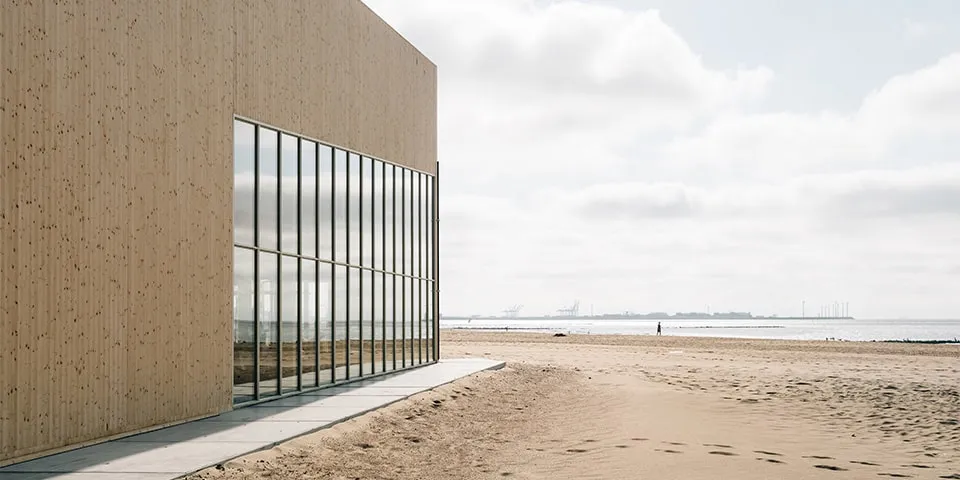
The construction industry is facing a number of major challenges. Although the market is booming today, contractors are unable to enjoy it because of the high rate of errors associated with traditional construction methods. “Using CLT can prevent many problems and therefore has enormous potential,” says CLT specialist CLT-s.
CLT stands for Cross Laminated Timber. Planks of sustainably managed pine are bonded side by side to form ‘single layers’, which are then glued together crosswise using formaldehyde-free adhesive, so that the grain of each single layer runs perpendicular to the next. This process produces a dimensionally stable ‘master panel’, which can be machined using a CNC machine (cutting, milling, drilling, etc.). The panels are suitable for floors, walls and other load-bearing elements, and their load-bearing properties vary according to their thickness and composition.
As cross-laminated timber is dimensionally stable, less desirable properties such as shrinkage and expansion perpendicular to the grain are eliminated.
As cross-laminated timber is dimensionally stable, less desirable properties such as shrinkage and expansion perpendicular to the grain are eliminated. This also makes CLT suitable for wider applications such as high-rise construction. It can replace a building’s entire traditional load-bearing structure (homes, offices, residential care centres, student accommodation, hotels, schools, shops,
industrial complexes, etc.).

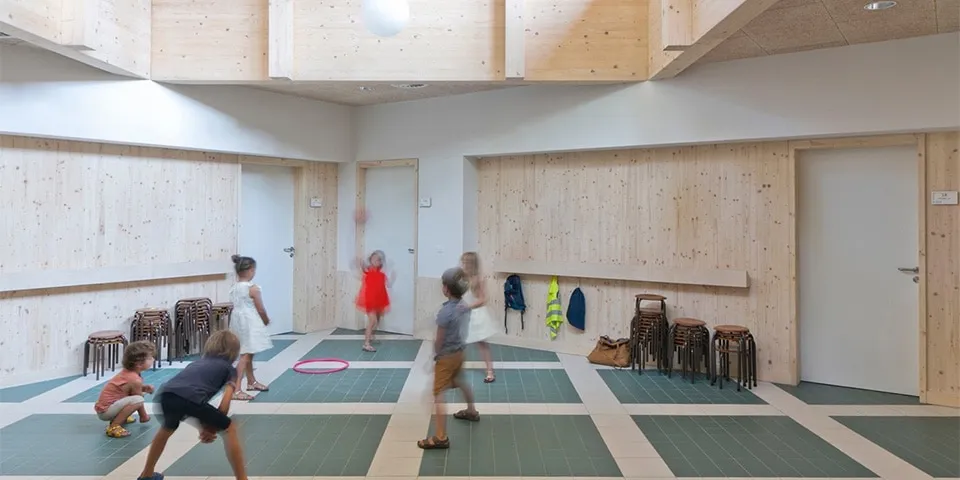
A CLT childcare centre in Brussels.
A host of benefits
By combining CLT with BIM, CLT-s offers a revolutionary answer to the many challenges facing the construction sector today. It is a sustainable, CO2-negative material that can be used in a circular way to build an exact replica of what is modelled virtually in BIM. As the construction process is reduced to assembly, projects are completed up to 60 % faster. Fewer workers are also needed on site.
Through lean construction, CLT-s creates a structure to which other elements can be added more easily (windows, building services, etc.). The beneficial effects of CLT on EPB performance and insulation are now widely known, but it also allows construction on less load-bearing ground and can be used to add floors to existing buildings.
The Parkklassen at Groenendaal primary school in Merksem.
Sustainable and circular
CLT-s panels always carry FSC and PEFC certification. This makes the origin of the timber fully traceable. The pine is harvested in Austrian and Scandinavian forests, where forest management has been a science in its own right for centuries. Forest growth consistently exceeds harvesting, resulting in a positive balance overall. Because trees absorb so much CO2 and produce oxygen during their lifetime, timber is a CO2-negative building material, even when production and transport emissions are taken into account.
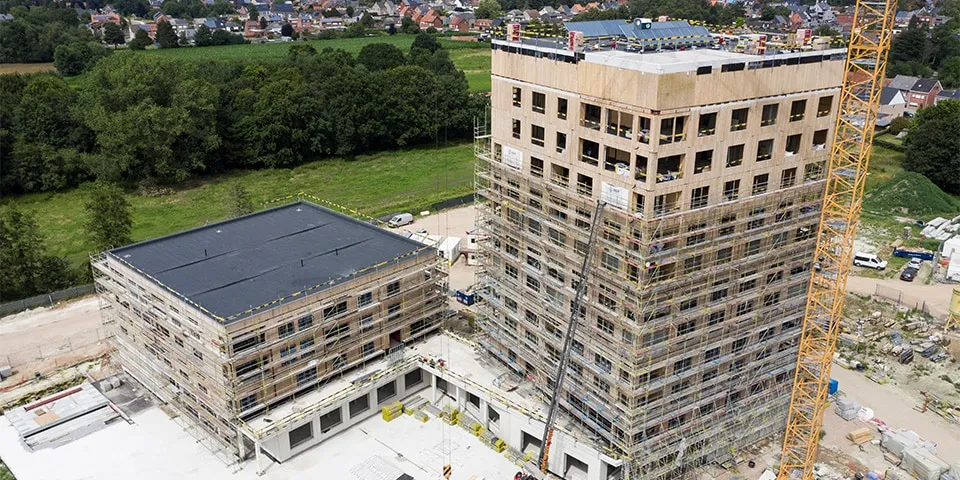
The Astor project in Geel.
The CLT panels are also all assembled dry on site. They can be dismantled in the future and reused for other applications. Soon, all panels will be fitted with an RFID chip, allowing them to be identified not only during production and construction, but also providing information for building management and applications after dismantling. This will make it possible, among other things, to find out what loads each panel has supported and what future applications it may still be suitable for.
Question about this story? Ask your question
Keep following this
Get an email when a new story is published. No account needed.
- SubjectGeneral







