











Accidents at work in the construction and installation sector continue to fall: safety efforts are paying off

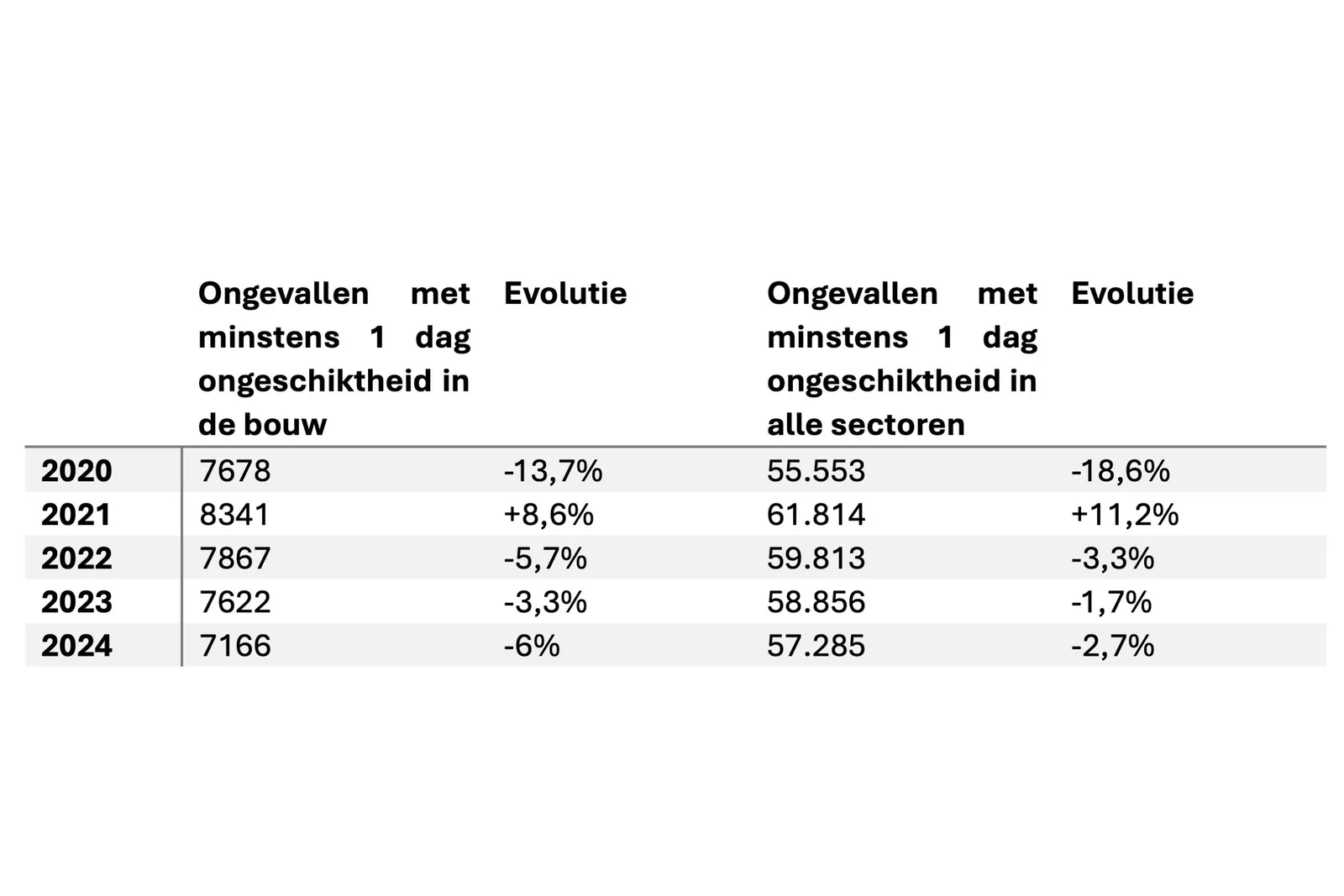
The number of accidents at work in the construction and installation sector resulting in at least 1 day of incapacity for work fell by 6 per cent in 2024, according to an analysis by construction federation Embuild based on the latest figures from the Federal Agency for Occupational Risks (FEDRIS). With 7,166 accidents at work, the construction sector is continuing the positive safety trend of recent years. The construction and installation sector is performing significantly better than the economy as a whole: the total number of accidents at work across all sectors fell by just 2.7 per cent over the same period. “For years, construction has outperformed the economy-wide average on safety. That is the result of consistent efforts, and we intend to continue them,” says Niko Demeester, CEO of Embuild.
In 2024, there were 7,166 accidents at work in the construction and installation sector resulting in at least 1 day of incapacity for work. That is 6 per cent fewer than in 2023, when there were 7,622 accidents at work in the sector. By comparison, across all sectors of the economy, the number of accidents at work resulting in at least 1 day of incapacity for work fell by just 2.7 per cent year on year.
Niko Demeester, CEO of Embuild: “Every accident at work is one too many, which is why we remain firmly committed to improving safety on site. The construction and installation sector rightly invests heavily in safety, and those efforts are clearly paying off. The mandatory 8-hour basic safety training for everyone working on a site, which we introduced in 2023, plays a crucial role.” Anyone who fails to ensure that workers complete the training risks being issued with a formal report of an offence. This applies not only to the self-employed worker or subcontractor, but also to the main contractor if it emerges that they have not adequately monitored the chain. This measure will further reduce the number of accidents at work in the years ahead, particularly as the recently concluded sectoral agreement of the Joint Committee for the Construction Industry (PC 124) provides for mandatory refresher training in basic safety, to be completed no later than ten years after the initial training.
Growing digitalisation in our sector is also helping to create a safer working environment. Drones, for example, are increasingly being used to avoid having to work physically straight away in more dangerous areas of homes and buildings, and to identify all potential hazards. BIM software also helps detect risks and dangerous scenarios in advance. AI applications are also making working conditions safer and helping to manage risks proactively, including through advanced monitoring and real-time adjustments to safety protocols. Finally, improved safety equipment and growing awareness among employers and workers are making sites safer.
Embuild continues to work towards even better safety on construction sites. The construction federation is calling for more accurate statistics on accidents at work in the sector. The current FEDRIS figures do not include accidents involving self-employed workers and posted workers. Embuild wants these accidents to be recorded as well, so that a full picture of the safety situation can be obtained. The federation also wants safety to be listed as a separate item in all public contracts, with that cost excluded from competition, so that there is no temptation to cut safety measures in order to submit a cheaper tender.
Question about this story? Ask your question
Keep following this
Get an email when a new story is published. No account needed.
- SubjectGeneral







