











Circular veneer cut from the right cloth
Text Philippe SelkeImage Bulo
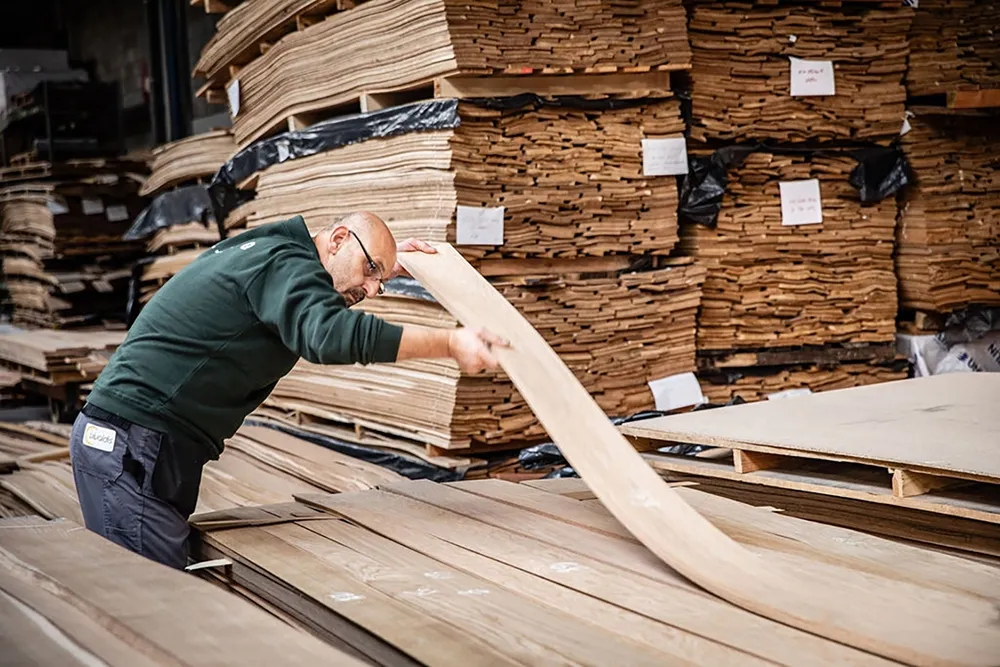
Natural resources are under pressure, and timber is no exception. Material scarcity, the need to preserve biodiversity and climate change are driving us to seek solutions that can replace our linear economy with a circular model in which the concept of waste no longer exists. Bulo and its sister company Bosq have understood this well and recently unveiled several solutions for producing 100% circular veneer. Louis Busschop, representing the third generation at the helm of Bulo and director of Bosq, explains them in more detail.
In 2006, Bulo took over Leysen Wood Trading (LWT), which subsequently merged with the manufacturing company Van Vaek Meubelen. At 64, Bert Leysen, former head of LWT, is still active at Bosq. Louis Busschop: “Bert has a wealth of knowledge and is something of a mentor to me. When I noticed that our veneer operations were generating increasing amounts of wood waste, I asked him to help think of a solution.” Timber is still treated as a standard product, even though every tree is unique. Standardised dimensions for timber used in construction generate huge quantities of offcuts, despite their having the same intrinsic value as the finished product. Until now, Bosq has used this waste as fuel for the heating boilers of one of its suppliers, a devaluation that is increasingly difficult to justify today. So it has developed two solutions to prevent this happening in future.
Edge-grain veneer
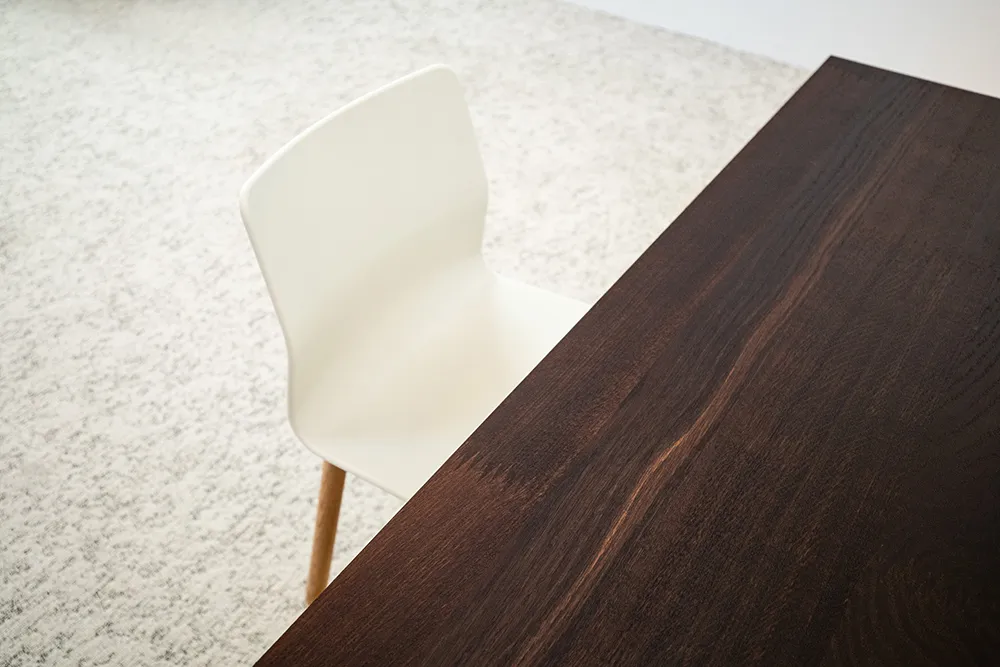
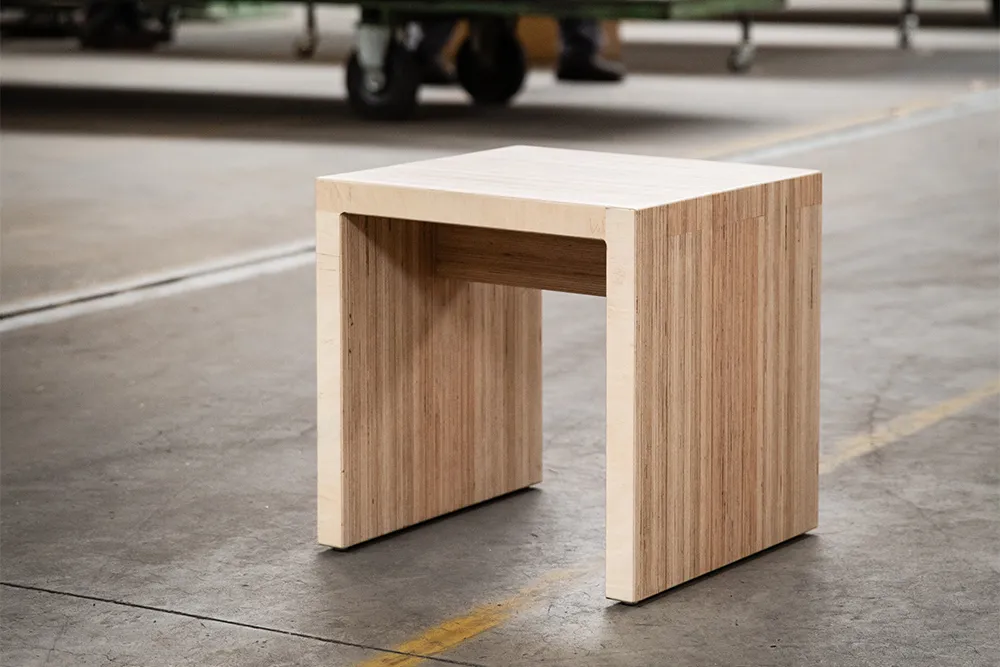
Edge-grain veneer is made from waste timber glued together on edge to form a single block. The fineline blocks are then sawn into veneer sheets 2 mm thick. The appearance of the sheets depends on the materials used, allowing for project-specific, bespoke applications. Edge-grain veneer made from birch plywood is available as a standard stock item from Bosq. Louis Busschop: “This is an interesting solution, for example when a building is being renovated or demolished. Solid timber from the existing building can be salvaged and turned into veneer, which can then be used in the client’s new project, for instance. We used this approach to make veneer panels from old solid oak shelving for a library in Mechelen.”
Adapted finger-jointing technique
But Bosq’s creativity does not stop there. To address the issue of panel lengths, which rarely match the standard dimensions of the raw materials, Bosq has developed a finger-jointing technique that makes it possible to reuse short pieces of waste timber. This solution, known as WoodSaver, produces 1.4 mm-thick veneer that lends itself to a wide range of finishes, including brushing and sanding. Louis Busschop: “Finger-jointing is not new. It has long been used in the solid timber sector, but we have adapted it for veneer production so that the timber retains its intrinsic value. Customers can choose between two options: Silea (Finnish for serene), where there is no colour difference between the finger-jointed elements, and Muuten (Finnish for change), where the colour difference is clearly visible. These products therefore refer directly to Finland, a country rich in forests and a leader in environmental awareness.” Louis Busschop cites a project for an optician in Antwerp, whose architect wanted to work 100% circularly. The visible finger joints were an advantage for him and illustrate the environmental commitment he shares with the client.
FSC-certified timber
The timber used by Bosq is always FSC-certified and comes mainly from European and American forests. The harvesting of exotic species such as teak has been declared illegal by CITES, leading to the establishment of teak plantations to compensate for the loss of natural forests. Bosq will therefore henceforth use only teak from FSC-certified plantations.
Question about this story? Ask your question
Keep following this
Get an email when a new story is published. No account needed.
- SubjectGeneral







