











“Construction schools must help promote the sector’s new image”

In Flemish secondary education, enrolment in the construction study area fell from 4,290 in 2013-2014 to 3,631 in 2016-2017. That amounts to a loss of 659 pupils in just four school years (15%). Enrolment in the Wood study area also fell by 393 pupils over four years. At the same time, the construction industry is facing a sharp rise in vacancies. Since 2014, the number of unfilled vacancies for construction workers has more than doubled. Now that secondary school enrolment is rising again, the Flemish Confederation of Construction (VCB) is calling for a major modernisation of secondary construction education.
The Department of Education publishes an annual statistical overview of the secondary school population by study area. The statistics show that enrolment in the construction study area, with its focus on structural work, is falling year on year. The decline is so steep, at 15% in just four years, that more and more schools are struggling to keep their structural work courses running. The provision of dual training in structural work is also at risk because pupil numbers are too low.
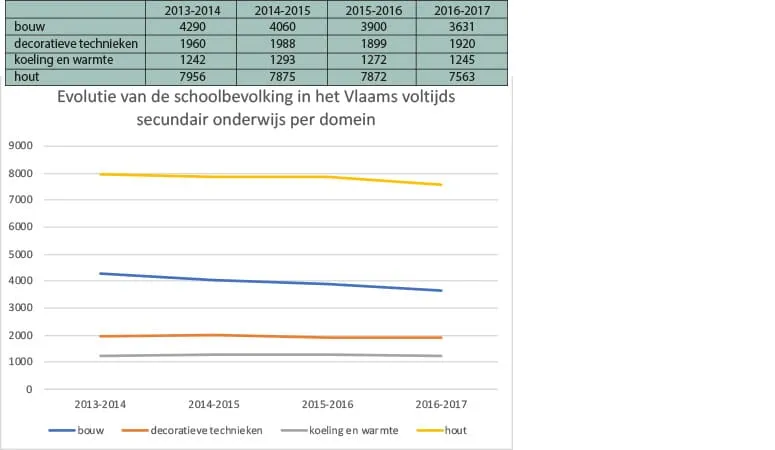
Enrolment in the Wood study area is roughly twice that in construction education focused on structural work. But numbers have fallen there too, particularly in the 2016-2017 school year. This study area is nevertheless important to construction because it produces not only furniture makers but also joiners. Although HVAC companies are playing an increasingly important role in the construction industry, there has been no increase in pupil numbers in this area. It also has the lowest enrolment of all the study areas relevant to construction. Nor is there any growth in decorative techniques, which includes training for painters.
Many more vacancies
At the same time, we have seen a huge rise in vacancies at Flemish construction companies in recent years. In June 2018 alone, for example, VDAB received 826 vacancies for construction workers. In June 2014, the figure was just 462. VDAB also recorded 2,646 unfilled vacancies for construction workers in June 2018, compared with just 1,032 in June 2014. In short, more vacancies are being notified and they are becoming harder to fill. The number of jobseekers in construction has also fallen sharply, from 21,304 in June 2014 to 13,753 in June 2018. Meanwhile, the number of construction workers in Flanders has stabilised at around 90,000 to 91,000. The largest age group among construction workers is now 50 to 54. Large numbers of construction workers will therefore retire in the coming years.
The construction industry has been modernising rapidly in recent years. The construction process is becoming ever more complex, requirements such as energy performance and acoustic comfort are growing increasingly stringent, and the range of materials and components is expanding. In addition, a host of technological developments are making construction faster to industrialise and automate, while accelerating the integration of technology: GPS guidance, 3D printing, virtual reality, the use of drones, geothermal energy and heat networks, smart homes and smart mobility … The challenges are immense, as are the technological opportunities.
Construction as an innovative technology integrator
VCB is convinced that this evolution should persuade young people to choose construction training and a career in the industry. However, construction’s modernisation has yet to make a sufficient impression on young people and their parents. VCB is working enthusiastically to promote construction’s more modern image. But construction schools, too, need to embrace this new image. They must update their workshops and curricula to reflect the sector’s new reality, rather than perpetuate the traditional image of, for example, the bricklayer, painter and plumber. Following the reform of Flemish secondary education, construction courses have all become part of the STEM study area (Science, Technology, Engineering and Mathematics). They should therefore convey the fact that, as a technology integrator par excellence, construction is a clear leader in this field.
Text and images: VCB
Question about this story? Ask your question
Keep following this
Get an email when a new story is published. No account needed.
- SubjectGeneral







