











Construction workplace accidents falling twice as fast as the economy-wide average
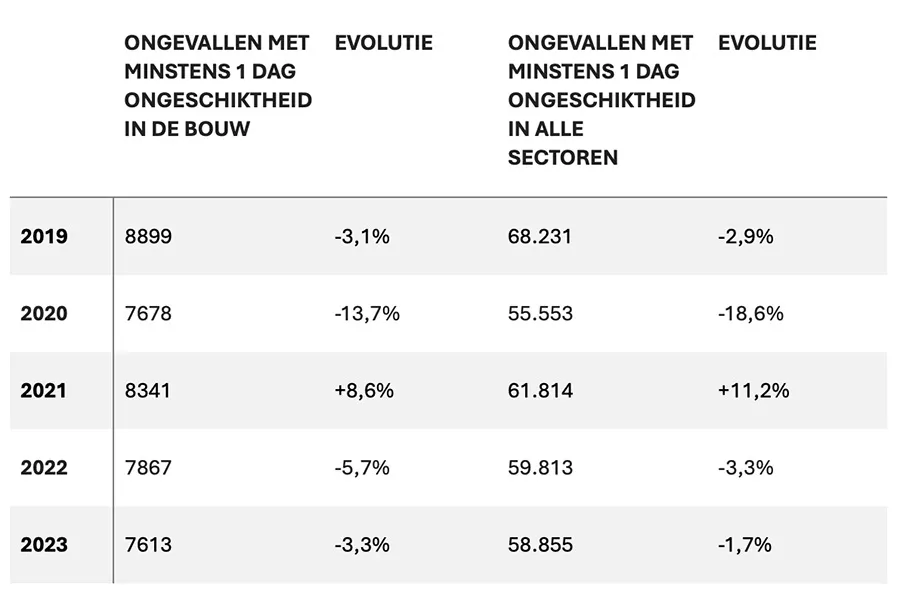
The number of workplace accidents in the construction and installation sector resulting in at least 1 day of incapacity for work fell by 3.3% in 2023, according to the latest figures from the federal occupational risks agency FEDRIS. That decline is twice as large as the fall in workplace accidents across all sectors combined (down 1.7%). “Although we are making good progress on safety, there is still room for improvement in our sector,” says Niko Demeester, CEO of Embuild. “The basic safety training, which has been compulsory for everyone on site since 2023, certainly helps, but the growing use of digital technology in the construction and installation sector is also making the whole process safer.”
In 2023, the number of workplace accidents in the construction and installation sector continued to fall, by 3.3% to be precise. In fact, there were slightly fewer workplace accidents in the sector in 2023 than during the 2020 Covid year, when sites were shut down for an extended period due to lockdowns. Moreover, the fall in workplace accidents in construction was almost twice as large as the decline across all sectors combined.
Niko Demeester, CEO of Embuild: “We want the number of accidents in our sector to fall even more sharply. That is why basic safety training is such a good thing. Since 15 April 2023, everyone working on a construction site has been required to complete 8 hours of basic safety training. This is a measure that Embuild itself proposed in its safety plan. Anyone who fails to provide this training risks being issued with a formal report of an offence. This applies not only to the self-employed person or subcontractor, but also to the main contractor if it emerges that they have not adequately monitored the chain. This measure will further curb the number of workplace accidents in the coming years.”

According to Embuild, however, policymakers should do more. More detailed statistics on workplace accidents in the sector are needed. Unfortunately, the current FEDRIS figures do not include accidents involving self-employed workers or posted workers. The construction federation is calling for these accidents to be recorded too, so that a complete picture of safety in the sector can be built. Embuild also wants safety to be listed as a separate item in all public contracts, with the cost excluded from competition, so that there is no temptation to cut corners on safety measures.
The construction federation also stresses that the rapid growth in digital technology in the construction and installation sector is already having, and will continue to have, a positive impact on site safety. Drones, for example, are increasingly being used in high-risk areas of homes and buildings, reducing the need for people to work directly in these more dangerous zones and making it possible to identify all potential hazards. The use of BIM software, which enables clear, modelled representations of homes and buildings to be shared among all the construction parties involved, also has a positive impact. The software helps identify risks and dangerous scenarios in advance. AI applications will also help make working conditions safer and manage risks proactively, including through advanced monitoring and real-time adjustments to safety protocols.
Question about this story? Ask your question
Keep following this
Get an email when a new story is published. No account needed.
- SubjectGeneral







