











Experts discuss the city of the future!
Urbanisation, changes in the mobility market and the impact of digitalisation call for a new approach to (sustainable) area development. What will the city of the future look like? What challenges will we face in transforming and renewing urban and village centres, with the aim of making our cities as accessible and liveable as possible? Is transformation the solution?
It is important to deliver sustainable, innovative projects that address today’s societal challenges. Belfius supports projects in built-up areas that contribute to urban and municipal services, helping to guide, finance and deliver them, says Dirk Gyselinck, member of the Belfius Executive Committee. “Our ambition is to make society more sustainable, enabling businesses to grow economically, public authorities to work more efficiently and individuals to enjoy a better quality of life.”
What are the prerequisites for Belfius to support and finance a Smart City project? We believe we can play an active role in bringing public authorities and private companies together around various smart city topics. The focus must therefore be on smart, innovative and sustainable solutions. Projects are also assessed for their economic, environmental and social viability. Four smart audits are carried out: an energy audit, a building audit, an audit to assess the value of the property portfolio and a grants audit. These give local authorities a realistic view of their assets in the context of renovation and the repurposing of their properties. In some cases, European support is also available through the EIB, which helps to tangibly improve citizens’ wellbeing.
Innovation in area development
The repurposing of part of a city should be based on a thorough analysis of its geographical reality, historical character and social context. The public authorities set the broad parameters, both in spatial terms and in terms of the new community they want to create. Higher density creates new needs in terms of infrastructure and public amenities. The economic balance and social ownership of a project are therefore important measures of its success, says Kris Verhellen, CEO, Extensa Group.
How does this translate into partnerships and innovation in area development? Various forms of public-private partnership are possible, for example in delivering new infrastructure, organising public participation and supporting local communities. Public-private working groups can also be set up to develop new public amenities.
Which Extensa project or projects are examples of transforming an area into a sustainable place that provides space for living, working, learning and recreation?
Extensa has two projects currently under way that are examples of area development: Tour & Taxis in Brussels and Cloche d’Or in Luxembourg. Each has its own character and emphasis. Tour & Taxis offers the most diverse range of uses and is also focused to a significant extent on creating strong synergies between its various sub-projects. This approach also helps to give the impressive historic buildings a human scale and a sense of intimacy, laying the foundations for a vibrant city district.
The architect’s role in transformation projects
Transformation is a major challenge for the future: existing buildings offer many opportunities for reuse. Architects and designers generally play an important role in urban transformation projects, according to Francis De Wolf, Director, Urban Planner & Architect-Engineer, BRUT Architecture and Urban Design. A linear process in which the designer is only brought in at the end to draw up a specific project within set spatial, programme and financial parameters rarely delivers the best result. According to Francis De Wolf, Director, Urban Planner & Architect-Engineer, BRUT Architecture and Urban Design, plans and visualisations bring people around the table and prompt them to take a position by showing the possibilities, as well as the consequences, of particular choices.
When can a transformation be considered a success?
In general, you can sense that a project has succeeded when the process has run smoothly, the various stakeholders have achieved their aims and the project has become integrated into the city as intended.
What new initiatives can we consider for the future to give disused buildings and areas a second chance?
I do feel that urban development in Flanders is undergoing a shift. For far too long, we have too readily developed new areas with little ambition. New thinking on mobility, sustainability and housing concepts, combined with a shortage of greenfield sites, seems to be prompting both local authorities and developers to think differently about urban development. More emphasis appears to be being placed on redeveloping existing sites and buildings. Hopefully, the recently approved Beleidsplan Ruimte Vlaanderen can help to drive this process further.
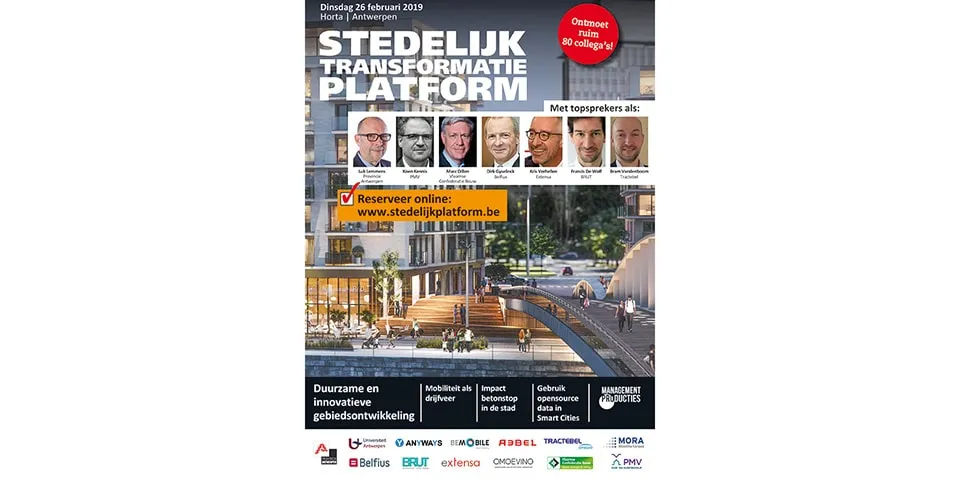
Would you like to find out more? On Tuesday 26 February, hear from leading speakers from Provincie Antwerpen, Extensa Group, Mobiliteitsraad Vlaanderen, Tractabel and Be-Mobile at Stedelijk Transformatie Platform 2019 at Horta Antwerpen. The event will explore the challenges of inner-city area transformations in Flanders. As a loyal reader of Bouwen aan Vlaanderen, you can receive a €50 discount by quoting BAV50, valid until 12 February. Register today and network at the highest level www.stedelijkplatform.be
Question about this story? Ask your question
Keep following this
Get an email when a new story is published. No account needed.
- SubjectGeneral







