











Finding the best way to measure airtightness in a repurposed monastery
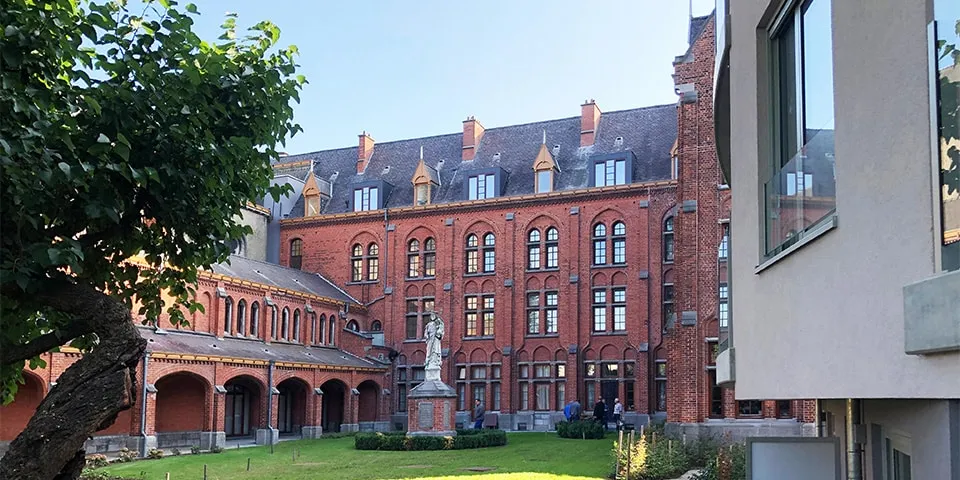
In a nutshell, Residentie ’t Convent is a development of forty accredited assisted-living apartments with tailored services in the restored, repurposed and extended Recolettenklooster in the centre of Halle. This pioneering project shows that protected heritage can also play an important role in contemporary society. However, because the new-build wing is so closely integrated with the existing building, carrying out an adequate airtightness test was no easy task …
The former Recolettenklooster, once home to the Conventual Franciscans, is an integral part of Halle’s distinctive townscape. The imposing building is a listed monument, but fortunately that does not mean it is condemned to remain an ‘empty shell’. On the contrary: the monastery has been sensitively transformed into a complex of forty assisted-living apartments, 28 of them in the restored section and twelve in a new wing. The latter has been built onto the existing complex and connects to the monastery garden.
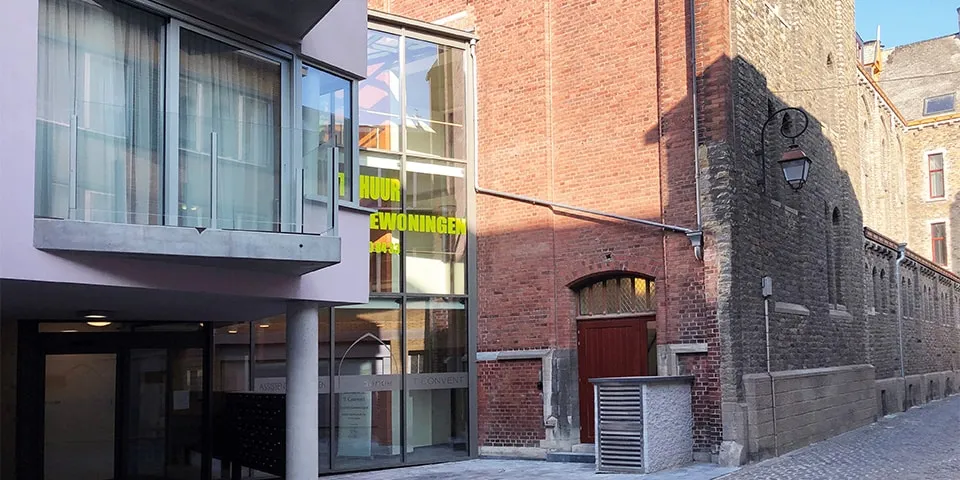
One challenge for the airtightness test was that the old and new sections blend seamlessly into one another, with no clear ‘dividing line’ between them.
No clear division between old and new
Even a complex with such a strong historical identity as Residentie ’t Convent must meet modern standards. That is why specialist Metifix recently carried out a blower door test to determine airtightness in the new-build wing. “One challenge
was that the old and new sections blend seamlessly into one another, with no clear ‘dividing line’ between them. The corridors in the renovated monastery continue into the new-build section, which meant we had to include a large part of the existing volume in our calculations,” says managing director Patrick Brants. “We ultimately recorded a v50 value of 4.63 m³/h.m², which is a good result given the nature of the project. The largest air leaks were located at the junction between the existing and new sections, and around the lift in the restored monastery.”
Additional capacity on hand
Metifix often carries out airtightness tests in senior-living apartments connected to existing buildings, so this was not its first such project. “In situations like these, it is always a matter of working with the client, architect and EPB reporter to find the ideal way to conduct the test, so that you can accurately assess the airtightness of an extension like this. Finding the ‘optimum’ is an art in itself. Fortunately, we now have plenty of experience in this area,” says Patrick Brants. “As we did not yet know exactly what the test area would be, we had extra capacity on hand at Residentie ’t Convent, in the form of four blower door units, each with a relatively high flow rate of 13,500 m³/h at 50 Pa (54,000 m³ in total at 50 Pa). This also meant we could quickly locate any leaks and unwanted airflows. In the end, three units were enough to carry out the airtightness test itself.”
Question about this story? Ask your question
Who worked on it
Residentie ’t Convent in Halle
- luchtdichtheidsmetingMetifix
Keep following this
Get an email when a new story is published. No account needed.
- ProjectResidentie ’t Convent
- SubjectGeneral
- CompanyMetifix







