











First: circular building blocks made without cement… but with CO2
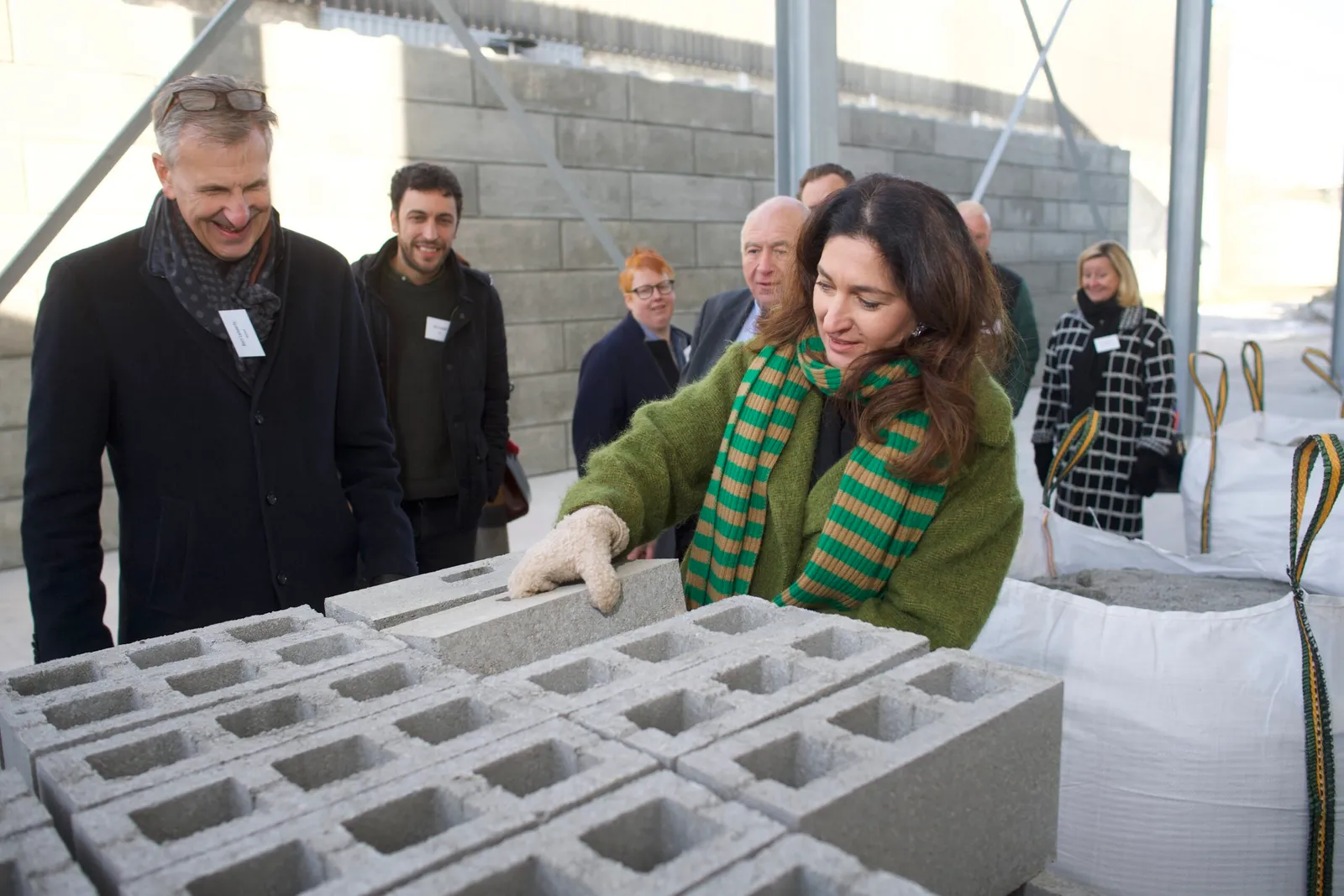
Masterbloc produces forward-looking building blocks using Orbix’s Carbstone technology
After years of research and laboratory work, the first circular building blocks using CO2 as a binder instead of cement are now a reality. Orbix, the zero-waste company based in Genk, and building materials manufacturer Masterbloc in Maasmechelen have succeeded in industrialising Carbstone technology. The Limburg-based businesses are offering numerous sectors a forward-looking alternative to conventional concrete blocks. Contractor Vanhout is currently using these circular blocks to renovate a Cofinimmo office building in Mechelen, which also houses OVAM’s head office.
Carbstone: permanent storage of CO2
Building blocks that absorb CO2 during production rather than emitting it, and also extract and retain CO2 from the air? This is not a vision of the future but a reality: Masterbloc is now producing sustainable internal wall blocks on an industrial scale using Orbix’s Carbstone technology. This marks a new milestone for both companies, which are pulling out all the stops to enable circular construction using by-products from a range of industries.
Orbix’s Carbstone technology, patented back in 2011, uses carbon dioxide to transform steelmaking slag into circular products with added value. CO2 acts as a binder, making cement unnecessary. This is significant, given that cement production is responsible for around 10% of global CO2 emissions. Carbstone technology enables the production of a wide range of CO2-negative, circular building materials, from tiles and pavers to roof tiles, façade bricks and building blocks. The first tonnes of forward-looking building blocks are now coming off the production line at Masterbloc.
Serge Celis, CEO of Orbix: “With stricter environmental standards, rising CO2 emission allowances and the EU’s zero-waste policy, Carbstone offers a host of benefits. The process not only turns metal slag into a value-added product, it also gives the CO2 emitted by businesses a valuable purpose and permanently stores a substantial quantity of it. More and more companies are coming to us precisely because they are looking for a structural solution. Carbstone delivers revolutionary solutions with a negative carbon footprint: more CO2 is absorbed than emitted during materials production. After years of scientific research, including work with VITO, we are proud to be taking our technology from the laboratory to the industrial stage.”
Orbix R&D Manager Dirk Van Mechelen is the godfather of Carbstone technology within the company: “In 2004, we discovered that the finest residual fractions of steel slag harden when exposed to the low concentration of CO2 in the atmosphere. This process is based on the carbonation of certain components in the slag. Following extensive scientific research, this led to a patented technology that accelerates this natural process to turn these fine residual fractions into high-quality building materials. It’s a threefold win: the steel industry’s residual fractions are put to good use, CO2 is removed from the air, and polluting cement production is avoided.”
Circular Carbstone blocks are a highly effective way of reducing emissions of this greenhouse gas. “That’s right, because they make optimal use of carbon capture, reuse and storage, also known as Carbon Capture, Utilisation and Storage (CCUS). What’s more, the blocks can be recycled indefinitely, and Carbstone technology lets us reuse more than just steel waste. Ash from incinerators and crushed concrete can also be combined with CO2 to make building materials. We continue to develop and expand the technology and make it suitable for new applications, so that we can offer a cost-effective, environmentally friendly solution to the CO2 problem,” Van Mechelen adds.
Flemish Minister for the Environment Zuhal Demir: “The construction sector is responsible for 40% of CO2 emissions. It is therefore no surprise that the Flemish Government is looking mainly to construction companies for partners in reducing our emissions. We are increasingly seeing the sector itself wanting to be part of the solution. Pioneering companies such as Orbix and Masterbloc are helping to shape the future. Through technology and development, they are showing us the way towards a more climate-friendly construction sector and a liveable Flanders.”
First production of circular building blocks
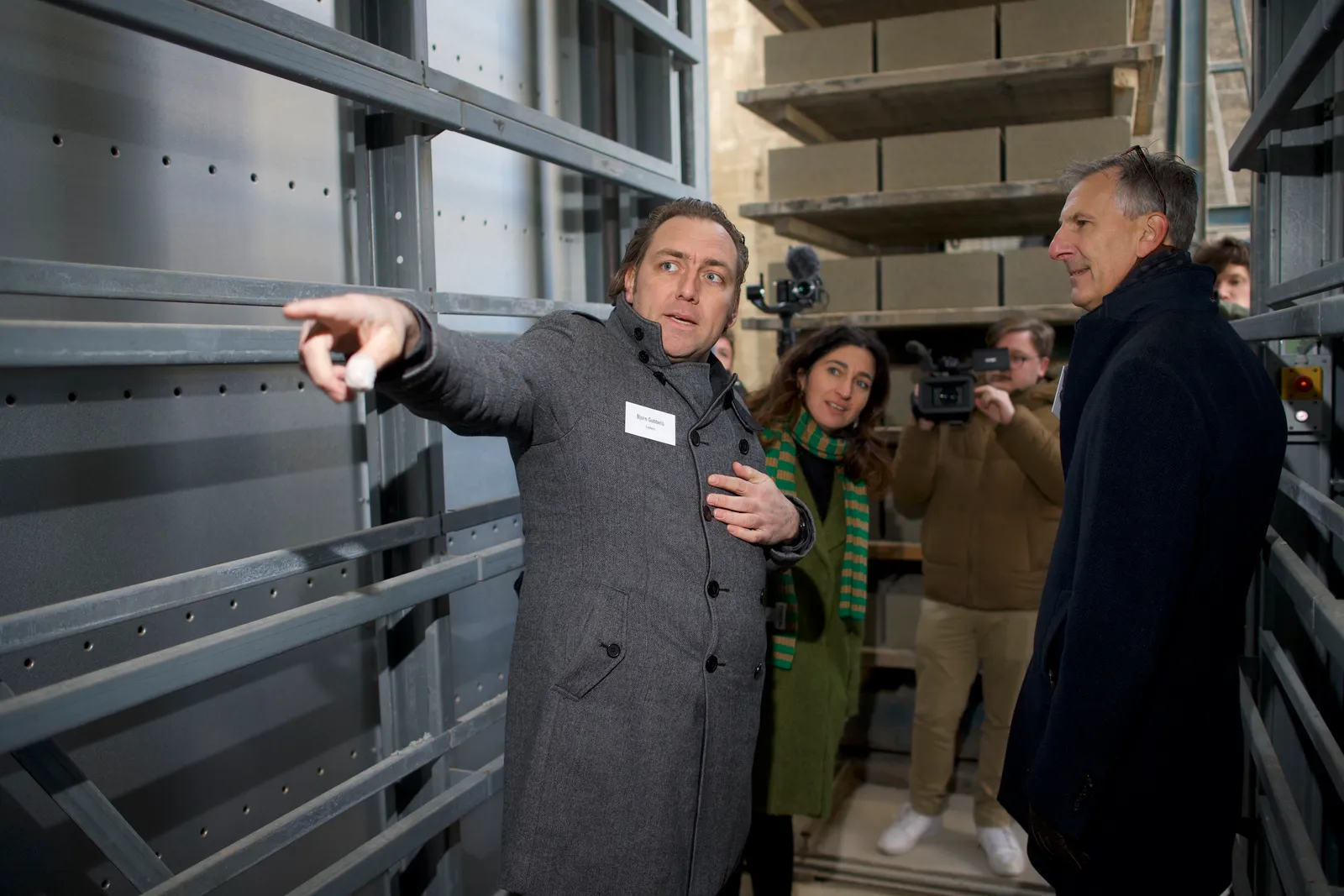
Moving from the laboratory and pilot plant to a production facility marks a major milestone. With its first climate chamber at the Masterbloc factory in Maasmechelen, production currently stands at around 70 tonnes of CO2-bound building blocks per day, equivalent to 15,000 tonnes a year. “But we’ll soon increase that volume by building additional climate chambers,” says CEO Bjorn Gubbels. “What matters is that we can use Orbix’s technology to efficiently turn steel slag into circular building blocks.”
Gubbels sees numerous benefits in this carbonation process. “First and foremost, of course, you help solve the global CO2 problem. Circular building materials cannot eliminate all emissions, but they can contribute to a significant reduction, precisely because cement production is the world’s second-largest source of CO2 pollution. At the same time, Flanders can use its resources more efficiently. Take the sand and gravel that can be recovered from millions of tonnes of steel slag and put to valuable use again. It’s an innovative example of upcycling! Orbix and we have been recovering Aperam’s metal slag in Genk for years. The steel industry is therefore showing considerable interest in the use of Carbstone technology. Finally, building material prices can return to a more normal trajectory, as you can use a price-stable, cement-free product and are no longer dependent on the cement industry.”
It will undoubtedly take some time for the conservative construction market to switch from cement-bound to CO2-bound building blocks. “Of course, you have to convince customers. But that should not be a problem, given the same quality and cost-controlled production, with circularity as an added benefit. And if you ever crush the blocks, all that remains is sand and gravel; the CO2 is locked away for ever. To give you an idea, a single lorry-load of building materials made with Carbstone technology can save as much as 10 tonnes of CO2: 5 tonnes are not emitted because no cement is produced, and a further 5 tonnes are removed from the air and retained by the sustainable blocks.”
Industrialising Orbix’s Carbstone technology was not without its challenges. “It wasn’t always easy, and it required a substantial investment of our own, but I would do it again in a heartbeat. The future potential is simply enormous! With a few manageable modifications, such as a climate chamber for injecting CO2 under pressure, conventional concrete manufacturers with traditional plants can produce these circular blocks. Carbonation itself is a fairly simple process that has been around for more than a hundred years, but until now no one had managed to refine the technique into a high-quality building block. We’re proud to have achieved that.”
First renovation using circular building blocks in Mechelen
Construction group Vanhout is part of the circular, CO2-bound building block milestone, using them to renovate the Cofinimmo office building in Mechelen, which also houses OVAM’s head office. CEO Bert Lenaerts: “We too are proud, of course, to be contributing to this story as a contractor. This is an impressive feat of pioneering work by Orbix and Masterbloc, with CO2 as a proven building block in the fight against climate change. The choice of building materials will only become more important in the future.”
Question about this story? Ask your question
Companies in this story

Keep following this
Get an email when a new story is published. No account needed.
- SubjectGeneral
- CompanyOVAM







