











First large-scale Belgian project using air-purifying façade paint at OKay supermarket chain
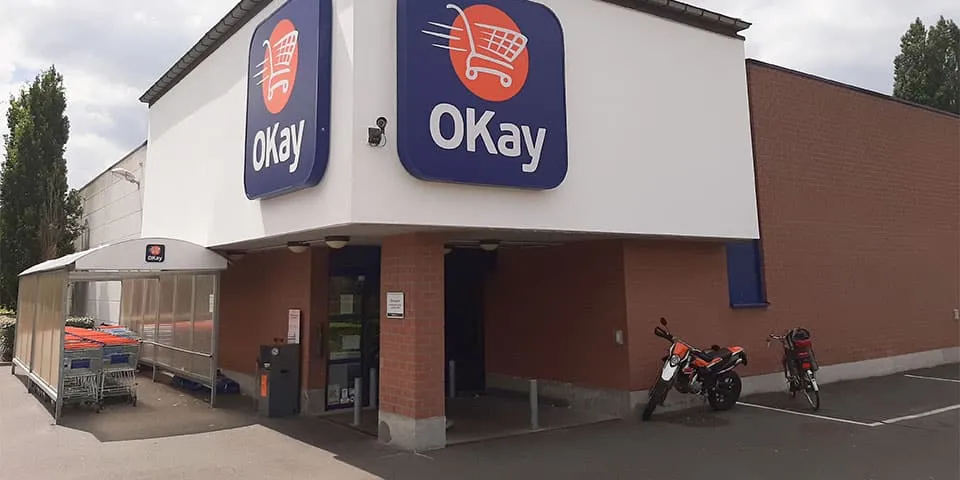
Colruyt Group decided to carry out sustainable renovations at a large number of OKay convenience supermarkets across Belgium.
StoColor Photosan air-purifying façade paint from façade specialist Sto was selected for the sustainable renovation of the façades. The OKay convenience supermarkets are located in village or town centres, where the air-purifying paint is highly effective at neutralising air pollution from local emissions. Covering a total area of 10,000 m², this is also Belgium’s first large-scale project using air-purifying façade paint.
From July 2019, Woutim paintworks set about repainting the existing yellow rendered façades of OKay stores with two coats of white StoColor Photosan paint (RAL 9016). Thanks to the paint’s high coverage, only two coats were needed. In total, 76 branches were given an air-purifying paint coating. The stores are spread across the country, in the provinces of Namur, Walloon Brabant, Hainaut, Liège, West Flanders, East Flanders, Antwerp and Limburg.
Façade paint as part of a sustainable transformation
Colruyt Group’s technical department is making full use of innovative techniques, materials and building systems.
“Sustainable business is in Colruyt Group’s DNA. We now have only low-energy stores and stores that use no fossil fuels, and we are actively experimenting with circular construction. Our ultimate aim is to move towards buildings that are 100% energy-efficient and circular. Sto’s air-purifying façade paint is an important part of this transformation,” says Ivo Van Zandweghe, Head of Sustainable Infrastructure at Colruyt Group.
Colruyt Group approached paint wholesaler Troubleyn, one of its regular suppliers, to find a sustainable façade product with a positive impact on the environment.
“Sustainability is a popular topic, but in our sector it is still a niche market in 2020. I am convinced, though, that it will become the norm in the paint industry in the long term. To reinforce our commitment to sustainability, we deliberately choose partners who share this focus, from paint supplier Sto to contractor Woutim paintworks,” says Peter Troubleyn, Managing Director of Troubleyn.
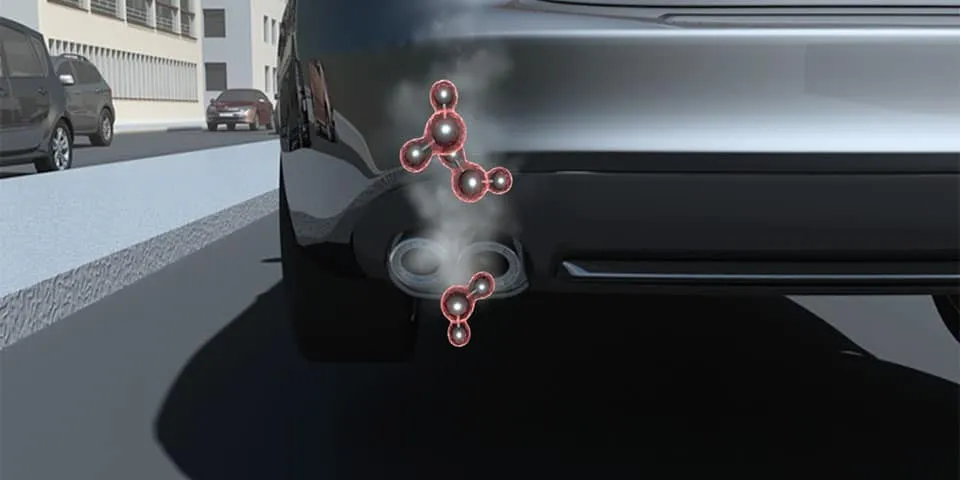
StoColor Photosan reduces NOx and particulate matter
Nitrogen oxides enter the environment through exhaust gases. These nitrogen oxides settle on the photocatalytic surface of StoColor Photosan. When exposed to light, oxygen is activated on the catalyst and the nitrogen oxides are converted into non-toxic nitrate. This process works not only in direct sunlight but also in diffuse light. The nitrate then dissolves in water and is washed off the surface by rain.
“This is made possible by patented Visible Light Catalyst Technology. This innovative technology reduces particulate matter and cleans the air, ensuring a sustained reduction in harmful substances in cities,” says Alexander Rickert, Product Manager at Sto.
Scientifically proven performance
In 2018, researchers commissioned by the Baden-Württemberg Regional Agency for the Environment, Measurements and Nature Conservation carried out a range of tests in both urban and rural settings to calculate the impact of the façade paint. They found that an average home with a façade area of 250 m² painted with StoColor Photosan neutralises the harmful substances emitted by a Euro-6 diesel engine over a distance of approximately 25,000 km. The home therefore purifies the emissions from around 1,640 litres of diesel per year, equivalent to almost 2 kg of nitrogen oxides. Another way to look at it: an average sales representative drives approximately 50,000 km a year. To neutralise those concentrations of nitrogen oxides and ozone in one year, two homes with façades of approximately 250 m² painted with StoPhotosan are enough.
The study therefore shows that nitrogen oxides are converted quickly and in measurable quantities. The large-scale use of photoactive paints is recommended to combat environmental pollution.
“If we apply the study’s results to the OKay project, we can assume that the 10,000 m² of façade area neutralises the harmful substances emitted over approximately 1,000,000 km by a Euro-6 diesel engine,” says Rickert.
Question about this story? Ask your question
Keep following this
Get an email when a new story is published. No account needed.
- SubjectGeneral







