











Greater mobility and more efficient transport in Flanders
Text and images ORI
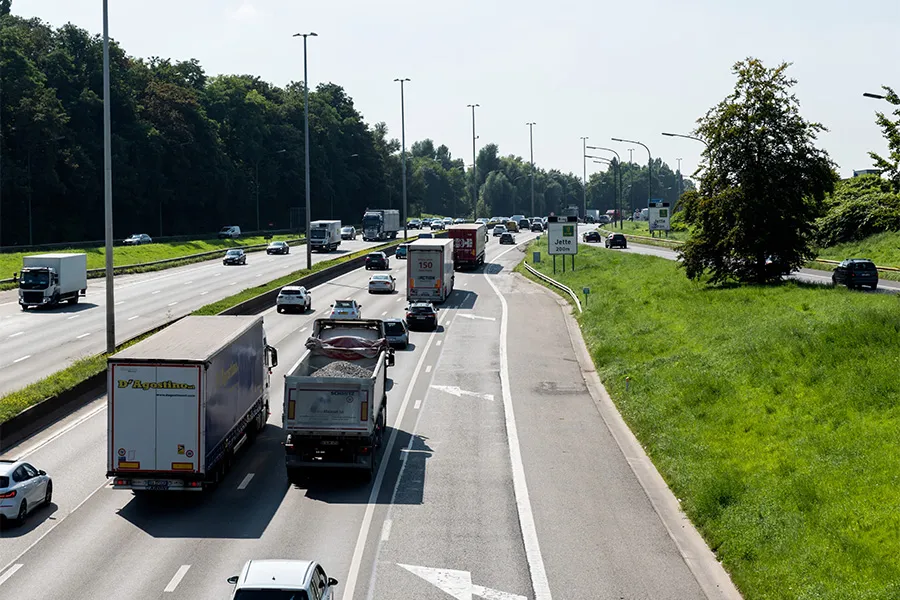
Mobility is essential to economic prosperity and quality of life. With its ports, roads, waterways and rail networks, Flanders enjoys an enviable logistical position in Europe, provided its transport routes offer sufficient usable capacity. From this perspective, the situation is poor, as almost everyone can see on an almost daily basis …
Belgium’s road network is plagued by severe congestion, which the Belgian Mobility Dashboard estimates costs around 1% of GDP annually. The climate crisis also calls for the accelerated decarbonisation of transport, which was responsible for 21.5% of greenhouse gas emissions in 2021, up from 14.4% in 1990. These emissions are largely attributable to road transport, which dominates in Belgium, accounting for 84% of passenger transport and 78% of freight transport, and is responsible for 96% of emissions from the construction sector. Given the expected growth in demand for transport, urgent action is needed.
ORI has a number of recommendations for improving mobility and making transport more efficient. First, it is important to anticipate future needs and update our forecasts, as we are living through a period of rapid change, as demonstrated by the widespread increase in remote working in the wake of the COVID-19 pandemic. Pursuing public investment and reforms that foster more sustainable and resilient growth is essential, despite budgetary constraints at every level of government. The key is to assess the socio-economic impacts of planned measures more rigorously and introduce ex-post evaluations, which are currently far too rare.
For a country such as Belgium, developing coordinated action between the regions and the federal government is essential to a strategy that makes effective use of its own budgetary resources and capitalises on available European funding. It would also be desirable to better align transport policy choices with those in other policy areas. The rapid electrification of the vehicle fleet, for example, requires a substantial increase in electricity generation capacity, interconnectors and distribution network capacity. These decisions cannot wait.
Urban and regional planning decisions also have a clear impact on mobility. Providing sustainable transport links for large property developments and access to waterways or railways for transport-intensive industries are key to improving mobility. This calls for a proactive approach from governments, businesses and developers. At the same time, the optimisation of transport networks is seriously hampered by various sector-specific regulations, which result in complex permitting procedures that create obstacles rather than solutions.
Innovation in transport remains modest. There is much to be gained from more experimentation, as there is no shortage of opportunities for progress, from smart mobility to drones and delivery robots, as well as platooning, charging electric lorries while they are on the move, and so on. Technology also makes it possible to monitor infrastructure more systematically, which is necessary not only to ensure its reliability and safety, but also to reduce long-term maintenance costs.
Finally, transport infrastructure must be adapted systematically to climate change, both new and existing infrastructure. It will need to withstand heatwaves and cold snaps, as well as periods of heavy rain and storms, and even floods or droughts, far better than in the past.
Question about this story? Ask your question
Keep following this
Get an email when a new story is published. No account needed.
- SubjectGeneral







