











Green Deal for a Climate-Resilient Environment launched
Text and images ORI
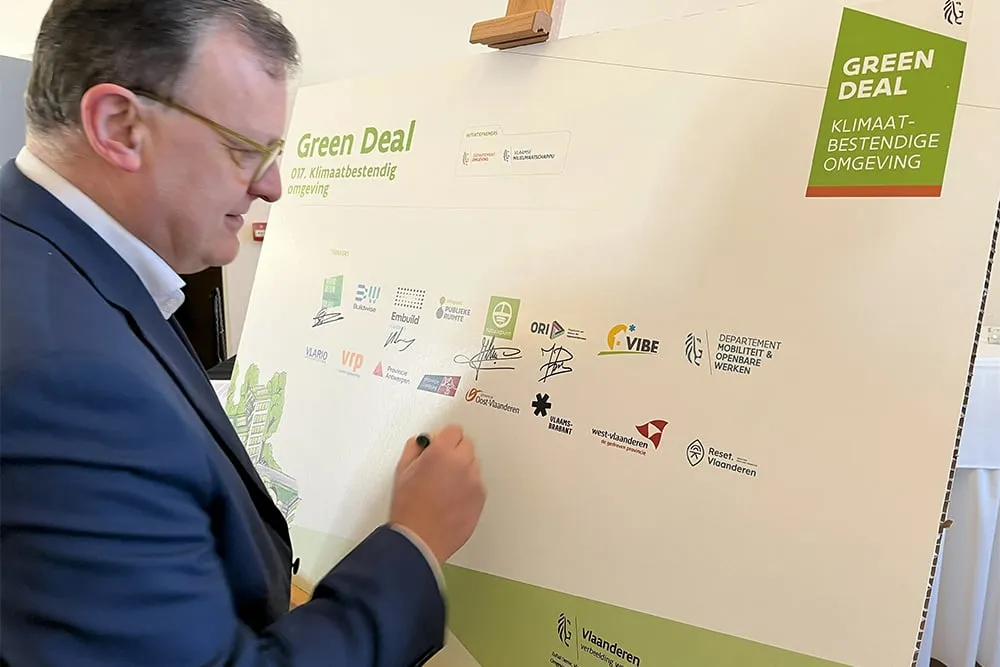
Heat, drought, flooding, rising sea levels … Despite essential efforts to reduce CO2 emissions, climate change is inevitable and its effects are being felt ever more often. The same is true of the decline in biodiversity. These phenomena are closely linked to spatial planning. Measures are being taken and more and more initiatives are emerging on the ground to help Flanders adapt better to climate change. Now is the time to systematise efforts, share knowledge and work together to foster a climate adaptation and landscape mindset.
This is the aim of the Green Deal for a Climate-Resilient Environment (www.klimaatbestendig.be), launched on 18 January 2024 for a period of three years. The project mobilises a broad network of Flemish authorities, environmental organisations and construction-sector stakeholders involved in the various aspects of spatial development, to work together, scale up examples of good practice and translate them into effective climate-resilient policies.
Various aspects will be examined, including urban planning, the design of public spaces, and the resilience of buildings and infrastructure … Other topics, such as training, integrated collaboration, policy impact and climate justice, will also be addressed.
ORI is an enthusiastic partner in this Green Deal. Its role is to mobilise engineering consultancies to contribute their expertise across these various dimensions, and specifically to facilitate the Climate-Resilient Infrastructure focus group together with the Department of Mobility and Public Works. Several consultancies have already signed up to
take part.
Infrastructure is essential to the functioning of our society and economy. It forms the physical foundation that supports many of our activities and has a long service life. It is important to assess climate risks properly, both when designing new projects and when managing existing infrastructure. Various solutions are available to prevent these risks, depending on the context: nature-based solutions, suitable materials and sizing for the conditions expected, protective measures or simply more frequent maintenance. Alongside making infrastructure climate-resilient, the challenge is also to develop infrastructure that contributes to the resilience of the natural and built environment. Engineering consultancies also have much to offer in this respect.
Question about this story? Ask your question
Keep following this
Get an email when a new story is published. No account needed.
- SubjectGeneral







