











Growth in the number of construction companies almost comes to a standstill

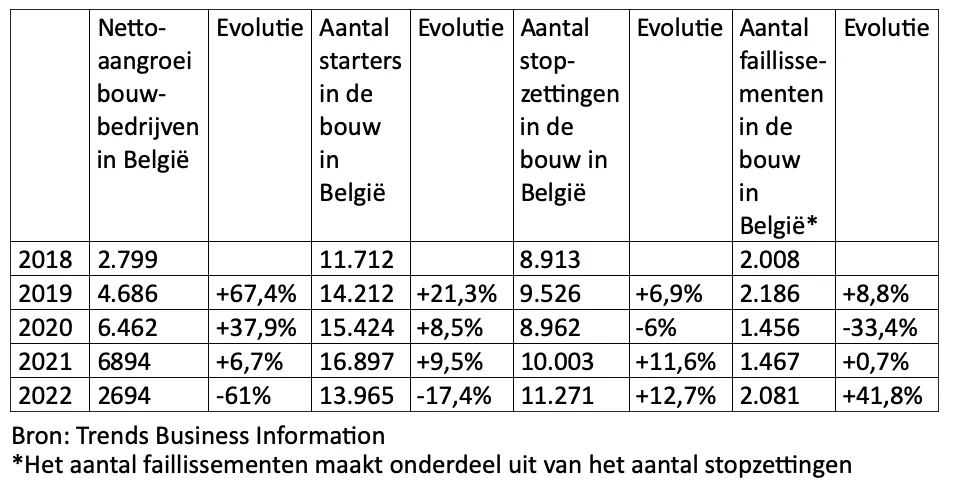
The number of new businesses in construction rose sharply each year between 2018 and 2021, but this trend came to an end in 2022, according to an analysis by construction federation Embuild based on figures from business information provider Trends Business Information. At the same time, more construction companies ceased trading or went bankrupt last year. On balance, however, the number of construction companies still rose slightly: at the end of 2022, there were 162,619 self-employed people and companies active in construction in our country. “During the coronavirus years of 2020 and 2021, there was plenty of work in construction, and many construction companies also received substantial support through coronavirus measures. Since early 2022, the economic situation has deteriorated considerably and the coronavirus support measures have also been phased out. As a result, we are seeing fewer new businesses in construction and more closures or bankruptcies,” says Niko Demeester, CEO of Embuild.
2022 was not an easy year for Belgian construction companies. An analysis by construction federation Embuild based on figures from Trends Business Information shows that last year the number of new businesses fell by almost a fifth, while the number of closures rose by 13%. Bankruptcies accounted for most of the increase in closures, rising sharply by 41%.
In 2022, 73.6% of all new businesses were established in Flanders, 7.2% in Brussels and 17.2% in Wallonia, the figures from Trends Business Information also show. These figures have remained stable compared with the previous three years. In terms of closures, Flemish construction companies accounted for 64% of all closures in the Belgian construction sector in 2022, while 12% and 21.5% of all Belgian construction companies that ceased trading were in Brussels and Wallonia respectively. The increase in the number of closures in Flanders is notable, as the figure had fluctuated around 55% in recent years. In 2022, 55% of bankrupt construction companies in our country were Flemish, while 22% were from Brussels and 23% from Wallonia.
In 2022, 21% of construction companies in our country started up in general residential construction, putting it well ahead of electrical installation work (13%), joinery (9%), specialised construction activities (6%) and painting (5%). Last year, closures peaked in exactly the same sectors. This is unsurprising, as these are construction sectors with particularly high levels of competition. The top five construction subsectors for bankruptcies in 2022 were also almost identical, although roofing replaced painting.
Business dynamics in construction remain slightly positive
The higher number of new businesses in the sector during the coronavirus years of 2020 and 2021 was primarily due to the fact that construction came to a standstill for only a very short time during the pandemic. Construction was the first sector in which trade unions and employers reached a sector agreement to resume work. Demand for construction and renovation work also rose sharply during that period. In addition, there were various coronavirus support measures, such as the moratorium on bankruptcies, the bridging right, and deferrals of payments to the National Social Security Office and the tax authorities. These not only provided a degree of stability for existing construction companies, but also attracted more new businesses by reducing the risks involved in starting up.
Niko Demeester, CEO of Embuild: “All those support measures disappeared in 2022, after the coronavirus crisis ended. At the same time, the economic situation deteriorated sharply last year as a result of the war in Ukraine, soaring inflation and the energy crisis. Business confidence fell last year, as did consumer confidence. In a sector such as construction, which operates on low margins and profitability, this change has an immediate impact on the number of new businesses, closures and bankruptcies. On balance, however, the number of construction companies is not falling, so business dynamics in construction remain slightly positive.”
We will need to invest heavily in the coming years to make our housing stock climate-neutral and renew our infrastructure. To keep these investments affordable for individuals, governments and investors, ongoing support measures are needed, such as the reduced 6% VAT rate on demolition and reconstruction, solar panels, solar water heaters and heat pumps, including after 2023. The construction sector also urgently needs lower labour costs to remain competitive. This will enable us to make the investments society needs. In turn, that will stimulate business dynamics in construction in the coming years.
Question about this story? Ask your question
Keep following this
Get an email when a new story is published. No account needed.
- SubjectGeneral







