











How businesses can keep their energy costs under control: the role of solar panels, batteries and sustainable buildings
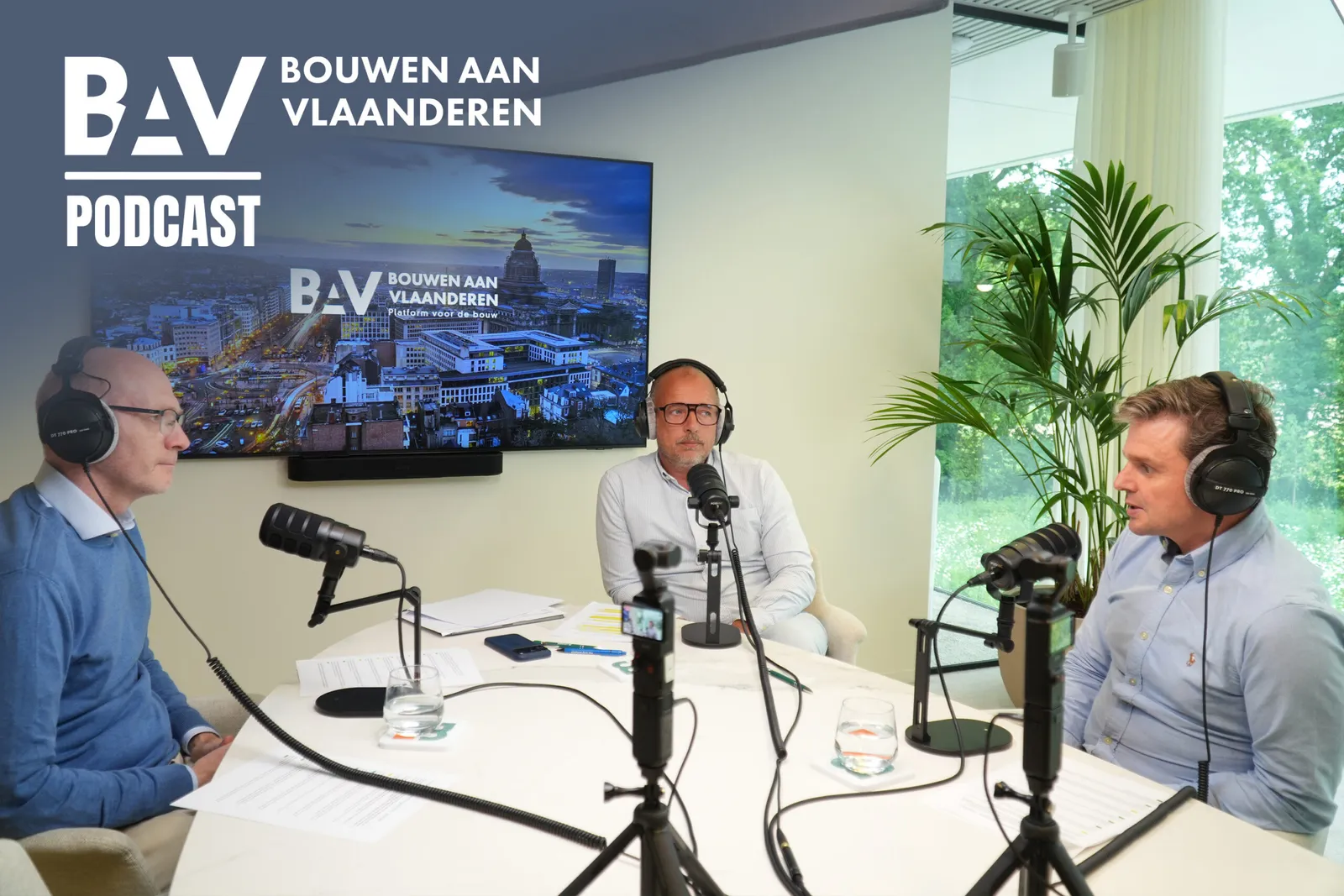
Geopolitical tensions, rising energy prices and stricter regulations are prompting businesses to rethink their energy use and buildings. But which investments are delivering a real return today? In this episode of the Bouwen aan Vlaanderen podcast, Björn Crul, Wim Eelen (CEO of Argona’s Energy division) and Bart Vanrutten (CEO of Argona’s Roofing division) discuss the impact of solar panels, battery storage, roof renovations, charging infrastructure and energy management. They look at how businesses can control their energy costs, better protect themselves against grid congestion and make their buildings fit for the future at the same time.
Full transcript
All chapters (23)
- Introduction to the discussion and presentation of the guests
- Geopolitical tensions and their impact on energy investments
- Response from residential customers
- Lessons from the 2022-2023 energy crisis
- Sustained interest in sustainability
- Deferred investment and the impact on roof renovations
- Mandatory solar panels for large energy consumers
- Tighter regulations and investment pressures
- When does battery storage make sense?
- Battery storage as a response to grid congestion
- Why combine roof renovation with solar panels?
- Higher demands on modern industrial roofs
- The importance of a long product warranty
- Do businesses choose quality or price?
- Complex EV charging infrastructure as an end-to-end solution
- The importance of an energy management system
- EMS automation and reliability
- Generating additional returns through energy markets
- Multiple revenue streams from battery storage
- EPC for non-residential buildings
- An integrated approach to sustainable buildings
- Final advice for businesses
- Closing remarks
Introduction to the discussion and presentation of the guests
Björn Crul Hello, listeners, and welcome to this new Bouwen aan Vlaanderen podcast. Geopolitical tensions, volatile energy prices and stricter regulations are affecting how businesses view their energy use and buildings today. What considerations do they weigh up? What do they want to invest in, and what is the best approach? My name is Björn Crul, and today I’m discussing this with Wim Eelen, CEO of the Energy division at the Argona group of companies, and his colleague Bart Vanrutten, CEO of the Roofing division. Welcome, both of you. Bart, let me start with you. Argona is a group of six companies, the oldest of which has been around for 40 years. Could you briefly outline what the group encompasses today?
Bart Vanrutten Argona is essentially a one-stop partner for the innovative sustainability upgrade of buildings. We currently have 40 years’ expertise in roof insulation and waterproofing, installing solar panels and battery storage with smart controls, as well as an electrical engineering division that includes relighting. We want to expand further into other complementary activities so that we can offer the complete building envelope, roof and walls. Another example is medium-voltage substations, which may be needed for large solar and industrial battery storage projects. The aim is to become a one-stop shop for clients looking to make their buildings more sustainable, with a single point of contact and one party responsible.
Geopolitical tensions and their impact on energy investments
Björn Crul Let’s turn to current affairs, Wim. The conflict in the Middle East. Energy and sustainability have suddenly shot back to the top of the priority list for many businesses. Are you seeing that among your clients too? And is it mainly about energy costs in the immediate term?
Wim Eelen We’re certainly seeing it among our clients. This type of crisis always leads to a surge in enquiries and orders. On the one hand, it’s about prices, of course, because every business is trying to keep costs under control. But on the other hand, I think people are now also realising that it’s strategically vital to decouple a large part of your energy costs from geopolitics or decisions over which you have no control. That’s why investments in battery storage or a solar project are ideal: they allow you to lock in a large part of your energy bill at a fixed price and so become less dependent on the volatility of the market.
Read the full transcriptCollapse transcript21 chapters remaining
Response from residential customers
Björn Crul You also have residential customers. How are they responding at the moment?
Wim Eelen That’s right. We have a fairly sizeable residential division. Those customers react very quickly. You really notice that whenever something happens in the world, the inbox is practically full of enquiries every day. Businesses take a little longer. It takes time for the effects to feed through to their energy bills, and that is often what prompts them to take action and address these issues.
Lessons from the 2022-2023 energy crisis
Björn Crul This isn’t the first time we’ve faced an energy crisis. That was the case four years ago too, following Russia’s invasion of Ukraine. Did you see the same phenomenon then, with a sudden increase in attention?
Wim Eelen We certainly did, and even more so, because energy bills rose exponentially more at the time, for both gas and electricity. We’re seeing the same phenomenon now, but to a lesser extent. We also need to remember that a huge number of solar installations were installed in 2023. Those customers can only invest once, of course. Customers who did so then are no longer looking or needing to invest in a solar installation again today.
Sustained interest in sustainability
Björn Crul So a crisis creates a peak in demand. Naturally, interest then tails off once the crisis is over. But can we say that businesses are gradually learning lessons from this?
Wim Eelen Interest does tail off a little, but demand for sustainable products remains, crisis or no crisis. We also need to be realistic: sustainability has become a loaded term for most businesses, but ultimately the economics matter too. I think few customers invest solely on sustainability grounds, particularly now that the ESG agenda has been somewhat toned down in Europe. In most cases, they look at the economics. And regardless of whether there is a crisis, certainty over energy bills always remains a priority for a business.
Deferred investment and the impact on roof renovations
Björn Crul So the business case needs to stack up. Bart, I’ve heard from a number of SME leaders that they do want to improve sustainability, but are postponing it for now because the economic climate is more challenging. What obstacles are you hearing about from clients?
Bart Vanrutten If a roof is leaking like a sieve, the client will still replace it. That’s only logical, even in difficult economic times. So those projects are still going ahead. What I am noticing, though, is that in 2026 clients are starting to put the brakes on preventive roof renovations because budgets are unavailable. They are letting the situation deteriorate until five past twelve, rather than acting at five to twelve. That is very dangerous.
Björn Crul I assume that makes it more dangerous and more expensive too.
Bart Vanrutten Exactly. As a result, we encounter situations where the renovation costs more because the client has waited far too long. We can no longer work on the existing roof and have to remove sections of it. The sharp rise in insulation prices since April is making matters worse. We sometimes find ourselves in a situation where a client wants to place an order based on a quote we issued in February, for example, but we have to say that we can no longer honour that price because insulation prices have risen so sharply. If the roof renovation is not urgent, we have already had clients say, “I’ll just wait until 2027.” Wim, do you have anything to add, specifically about solar panels and batteries?
Wim Eelen With solar panels and batteries, I’m also seeing the economic climate make businesses more cautious about capex investments. That’s actually contradictory, because now is precisely when you should be making that investment. For solar panels, average payback periods today are four to five years. In other words, if you don’t invest, within four to five years you will have paid the same amount to your energy supplier as you would have spent on your own solar installation. It’s a shame that these kinds of investments are being deferred. But we are seeing capex come under pressure, particularly at larger companies.
Mandatory solar panels for large energy consumers
Björn Crul In that sector specifically, large energy consumers are also required to install solar panels on their roofs. That requirement has been in force since 1 April this year. Is it having an effect? Are you seeing anything yet?
Wim Eelen The 1 April requirement was actually the deadline by which the installations had to be in place. That deadline has already been postponed several times. I think the original date was July 2025. It was pushed back to give businesses more time to comply. So the biggest wave of investment is already behind us. There are still businesses that are not complying with the requirement today, though. They risk a fine, and it is no small amount. The fine is now actually higher than the cost of the investment. The requirement is also being tightened further, again in 2030 and then once more towards 2035. So this is an ongoing issue.
Tighter regulations and investment pressures
Björn Crul Which is good news for you, I assume.
Wim Eelen It certainly is. Government buildings are also subject to stricter requirements than ordinary businesses. There was also a proposal to extend the requirement to businesses with lower energy consumption, from 1 gigawatt-hour onwards, but I get the impression it has been put on the back burner because of the economic downturn. For now, they don’t want to impose additional investment requirements on businesses when the economic climate is already more challenging.
When does battery storage make sense?
Björn Crul Generating your own PV power is one thing, but to make the most of it, you now practically have to consider battery storage. For a long time, batteries were very expensive, perhaps even a luxury product. What types of businesses would find one a worthwhile investment today?
Wim Eelen Any type of business with a sizeable rooftop PV installation and high self-consumption can certainly benefit from a battery project. Of course, a typical SME, where the doors open in the morning and close again in the evening, with a few lights on during the day and little other consumption, has less need for a large battery installation. Batteries are particularly interesting for businesses with their own production, cooling and heating systems, and processes where demand and supply can be shifted.
Battery storage as a response to grid congestion
Björn Crul It can also be a solution for businesses facing grid connection issues. We all know that grid capacity is a real bottleneck in a number of regions. Businesses are struggling to get a new connection or increased capacity from the grid operator. Is combining solar panels with a battery a good solution, or do you need more?
Wim Eelen It’s actually the perfect solution. We used to know grid congestion only in the Netherlands. We spent years laughing about it, but it has also become very common in Flanders over the last one to two years. You see various figures reported in the press. They range from 1,800 businesses on a waiting list to 800 or 200. The numbers vary, but in any case, many businesses are currently unable to expand because they cannot get the capacity they need, or even build new business premises.
We are currently working on a number of projects where this is a real issue, and where combining a battery with a solar PV project allows us to ensure that these businesses can continue operating as normal. These are very different cases. The focus is not so much on ROI or payback periods, but on whether a business can produce or not. This is by no means a distant prospect. If you look at the maps published by Elia and Fluvius, you can clearly see where the grid congestion is. The maps are mostly red. Battery flexibility is the perfect solution.
Why combine roof renovation with solar panels?
Björn Crul Bart, let me come back to you. You often provide an end-to-end solution in which installing PV panels goes hand in hand with roof renovation. Why is it so important to link the two?
Bart Vanrutten When we renovate a roof, we hand over a new roof in perfect condition, ready for the solar panels to be installed in a second phase. Companies that only install solar panels do not always realise the impact of damage they fail to report. Repairing that kind of damage takes us ten minutes. But locating damage on a roof completely covered in solar panels can take days or even weeks.
Our solar panel installation teams are well aware of this because they are part of a group that also works on roofs. What is more, clients can be sure that, if a problem does arise, they have a single point of contact and one party responsible. After all, they ordered both the roof renovation and the solar panels from Argona.
Higher demands on modern industrial roofs
Björn Crul Roofs are serving an ever-growing number of functions today. As you mentioned, they accommodate solar panels, building services and other installations, and offices often have a green roof as well. What does this mean in practical terms for the demands placed on a modern industrial roof?
Bart Vanrutten I have noticed that in recent years, even at the design stage, more consideration has been given to future loads, such as solar panels, building services and green roofs, which may be installed on the roof in the short or medium term. The roof is increasingly seen as additional floor space, used to house equipment and accessed more frequently for maintenance of building services and solar panels.
As a result, clients and architects are placing increasing importance on durable roof waterproofing, backed by a product warranty. This gives them the assurance that the waterproofing will last longer than the installations on the roof.
The importance of a long product warranty
Björn Crul One of Argona’s key strengths is that you have a solution for every industrial roof, whether it is a new-build or renovation project, a flat roof or a special structure. Your range also includes a synthetic roof membrane with a product warranty of twenty-five years. That certainly sounds very appealing.
Bart Vanrutten Thanks to that twenty-five-year product warranty, the expected lifespan of the equipment installed on the roof, such as solar panels and building services, is shorter than that of the roof waterproofing. This gives clients and architects the assurance that the roof will not need to be renovated again before the installations reach the end of their service life.
We should not underestimate this. A manufacturer offering a twenty-five-year product warranty is not merely confident that the roof waterproofing will last twenty-five years. They are one hundred per cent certain that it will last thirty to thirty-five years. That is longer than the lifespan of solar panels, building services and similar equipment.
Do businesses choose quality or price?
Björn Crul Are business leaders quick to embrace this kind of long-term thinking? Do they have preferences for particular materials, or do you sometimes have to persuade them to look beyond the initial cost?
Bart Vanrutten We need to distinguish between the renovation and new-build markets. The renovation market is fairly straightforward, because the decision-maker is usually also the owner of the building. Owners generally take a long-term view when considering solutions. That is also why ninety per cent of the roof renovations we carry out use a 1.8-millimetre Protan roof membrane with a twenty-five-year product warranty.
By contrast, a 1.5-millimetre Protan roof membrane is installed on eighty per cent of new-build projects. This is because most new-build projects are carried out by main contractors. They tend to focus on price and limit themselves to their ten-year statutory liability period.
Complex EV charging infrastructure as an end-to-end solution
Björn Crul Let me come back to you, Wim. We have discussed investing in a new roof combined with solar panels. We also talked about the benefits of combining this with battery storage. Then, of course, there is the EV charging infrastructure market, where you also have expertise. What kinds of EV charging projects is Argona carrying out today?
Wim Eelen Argona specialises mainly in more complex projects. We can of course install a single charging point for one vehicle at an SME. But once several vehicles are involved, there are plenty of installation companies and electricians who can do that too.
We make a difference when we can combine charging with other assets. When we can integrate a battery, charging points and an energy management system, we specialise in proper charging hubs, DC chargers and larger projects. A typical example is a transport company with fifty trucks that wants to switch to electric vehicles. These are fairly complex projects. They involve medium-voltage upgrades, infrastructure works, modifications to distribution boards and increased power capacity. There is much more to it than simply mounting a charging point on a wall and connecting it. That is where our expertise lies. For example, we might install one hundred and twenty charging points in an underground car park. That is quite different from installing a single charging point.
The importance of an energy management system
Björn Crul To get the best possible return from a complex system that combines on-site energy generation, storage and charging infrastructure, you now need an energy management system. How does such a system work in practice? How does it improve returns?
Wim Eelen An energy management system really is the heart of the installation. Without it, you are going nowhere. If you want to use flexibility behind the meter and connect your business to controllable assets, you really need one.
An EMS is a fairly complex system. On the one hand, it assesses the business’s energy needs and uses AI and machine learning to forecast demand for the following day. At the same time, it is connected to the energy markets, particularly when combined with batteries: the day-ahead and imbalance markets. This allows it to determine at any time of day what is most advantageous: consuming energy on site, storing it, drawing it from the grid or controlling the company’s own installations. It is, in effect, the beating heart of the entire system.
EMS automation and reliability
Björn Crul To what extent is this automated today?
Wim Eelen It is currently fully automated. I do want to stress the importance of a good EMS, because there are now a great many EMS systems on the market. Many start-ups and companies claim to have found the perfect solution.
But it is important, and this is why we consciously opt for quality and durability, to work with companies we are confident will still be around in ten or twenty years. If we implement an EMS today and that partner ceases trading, goes bankrupt or disappears for some other reason, we have a real problem. All the assets are programmed and integrated with it. You cannot simply pull the whole system apart and start again.
Generating additional returns through energy markets
Björn Crul You mentioned the markets earlier. We are talking about flexibility, the imbalance market and day-ahead trading. What opportunities do these offer businesses investing in their energy supply and battery storage?
Wim Eelen The markets you describe are mainly relevant to battery investments. When we calculate a client’s return on investment, we first look at how to optimise on-site consumption. That is logical. If you generate more energy than you need, you can store it in the battery and use it yourself later.
The day-ahead market is an additional opportunity. Energy suppliers have to tell Elia by eleven o’clock each day how much energy they will need the following day. This is used to determine the price of electricity for the next day. Wind generation, solar generation and industrial production are all taken into account.
This means you already know today what energy will cost tomorrow. You can therefore plan ahead and charge your battery when electricity is cheap, especially when solar generation is low. You can then use that electricity when prices are high.
To give you an idea, this is particularly pronounced in summer. Electricity is cheap or even negatively priced around midday. Sometimes you even get paid to charge your battery. In the evening, prices can rise to twenty to twenty-five euro cents per kilowatt-hour. That is very attractive.
It can also be worthwhile in winter, when solar generation is minimal and the battery is not automatically charged with surplus solar power. In that case, it may make sense to charge the battery overnight at a low rate and use the energy at the business in the morning.
The day-ahead market is one part of the picture. Then there is the imbalance market. It was particularly popular two years ago, but has since cooled considerably. This is mainly due to the Picasso effect, which links the imbalance markets of different European countries. In the past, price fluctuations in Flanders were much greater.
The imbalance market is a market where you do not know the energy price in advance. You only find out the price at the time. This is because supply and demand are constantly out of balance. Algorithms can be used to charge or discharge the battery very quickly in response to the market. Price differences are much greater there. One exceptional example was when the energy price rose to around three thousand euros per megawatt-hour.
Multiple revenue streams from battery storage
Björn Crul So these are things you can also respond to with a battery?
Wim Eelen Absolutely. The imbalance market is the icing on the cake, not the cake itself. We also always look at peak shaving when considering battery storage. A large part of energy costs is determined by peak demand and the capacity tariff.
We often see a small number of brief peaks pushing up grid costs for an entire year. Analysis and batteries make it fairly easy to address this and smooth out those peaks. There are therefore several revenue streams for a battery. It is the combination of all these factors that makes it a sound investment.
EPC for non-residential buildings
Björn Crul Bart, today we’re talking about making investments in sustainable buildings and renewable energy pay off. That’s exactly Argona’s core business. It’s becoming increasingly important for businesses to have sustainable buildings, not least because regulations are getting stricter all the time. There is now also an energy performance certificate system for non-residential buildings, similar to the one we know for homes.
Bart Vanrutten That’s right. An EPC for non-residential buildings has been mandatory since 2025, although very few people know that yet. I think much more needs to be communicated about it. The more widely known this obligation becomes, the greater its positive impact will be on the sale and rental value of non-residential buildings. Once we reach that point, there will also be greater support for making those buildings more sustainable.
An integrated approach to sustainable buildings
Björn Crul Which, I assume, will ultimately also affect energy consumption.
Bart Vanrutten Absolutely. It’s clear that businesses need a comprehensive approach to making the right investments at the right time and future-proofing their buildings.
Björn Crul As a group, you of course have all the necessary expertise in-house, but what does a project like this look like in practice? And how do you stand out in such a competitive market?
Bart Vanrutten As mentioned in the introduction, we want to become a one-stop shop for clients looking to make their buildings more sustainable. But not by acting as a general contractor that uses subcontractors and has to add a margin on top. We make sure we have the expertise and technicians in-house for all those individual activities. That means we don’t need to add an extra margin to each separate activity, unlike a general contractor. This allows us to offer our clients a highly competitive package covering the whole project.
Final advice for businesses
Björn Crul We should start wrapping up. I have one last question for both of you. If you could give our listeners one final tip or piece of advice, what would it be? Bart?
Bart Vanrutten Even though these are certainly not easy times, I always say: nothing is as good as it seems, but nothing is as bad as it seems either. It’s precisely in difficult times that businesses with a clear vision and strategy come out on top.
The past few years have once again shown that everyone should be aiming to reduce their energy consumption. This can be done in part by improving the insulation of buildings, but businesses also need to become more energy-independent. They can do that by investing in solar panels and battery storage. Argona can help with both.
Wim Eelen I’d like to echo what Bart said. Don’t put off sustainable investments, not only for environmental reasons, but for financial ones too.
Investing in solar panels and battery storage makes it possible to lock in a fixed price for a large part of your energy bill for the next twenty-five to thirty years. To give you an idea, the levelised cost of energy for these investments is around three to four euro cents per kilowatt-hour. That is considerably lower than the current market price.
This makes your business more resilient and competitive in difficult and uncertain times, when we are highly dependent on geopolitical tensions over which we have little influence. So my advice is: don’t put off your investments and get in touch with Argona.
Closing remarks
Björn Crul Wim and Bart, thank you for this conversation.
Wim Eelen Thank you, you’re very welcome.
Björn Crul That’s all for this Bouwen aan Vlaanderen podcast, dear listeners. Thank you for listening, and be sure to visit bouwenaanvlaanderen.be for more inspiration.
Keep following this
Get an email when a new story is published. No account needed.
- SubjectGeneral







