











International VELUX Awards 2018 ceremony: the emotional high point for the Belgian students!
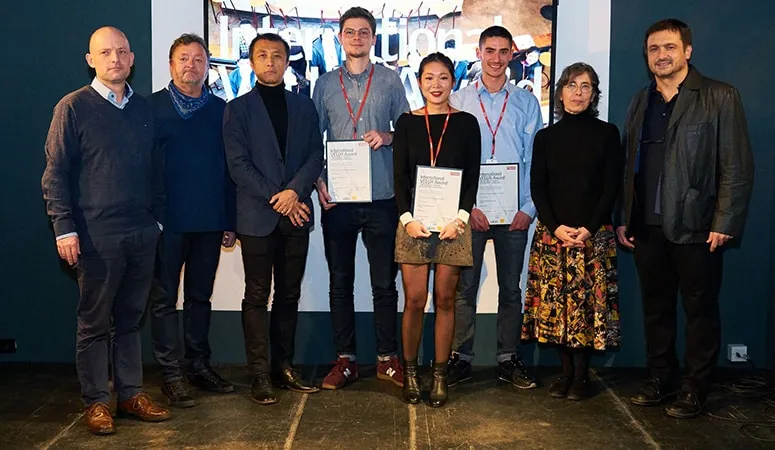
The world’s best architecture students were celebrated on 29 and 30 November during the World Architecture Festival in Amsterdam. Among them was a team from the Faculty of Architecture at UCLouvain (LOCI), which presented the project ‘Cover To reveal’. Our students and their tutor did not win the grand prize, but had an extraordinary experience.
Friday 30 November 2018, 12.20 pm, World Architecture Festival in Amsterdam. Brice Lemaire, Xiaolan Vandendries and Julien Obedia present their project ‘Cover to Reveal’ to the jury of the International VELUX Award for Students of Architecture (IVA).
The pressure is on, with five big names on the jury: Carme Pigem (RCR Arquitectes, Spain, 2017 Pritzker Prize laureate), Rick Joy (Rick Joy Architects, United States), Li Hu (OPEN Architecture, China), Sasa Begovic (3LHD, Croatia) and Martin Pors Jepsen (Vice President of VELUX’s Innovation Centre, Denmark). The students can count on the presence and support of their tutor, Gérald Ledent, in the room.
The aim of ‘Cover to Reveal’ is to offer a solution to desertification by developing a tarpaulin concept that covers plots damaged by intensive agriculture, creating a shaded space so that the soil can regenerate thanks to moisture captured by the fabric.
One striking fact: two of the finalist projects address the problem of desertification. Overall, the students’ projects demonstrate a strong social and environmental commitment.
One of the distinctive features of the competition organised by VELUX is that students must be guided by a tutor in their approach. This enables them to take their thinking further, as tutor Gérald Ledent explains: “The tutor must help students filter their proposals so that the most compelling one is selected.”
For him, the competition gives students the opportunity to “show what they are capable of and prove themselves, develop their analytical skills and their communication skills (graphically, but also in writing and speaking), and work outside the usual learning patterns. To be confronted with different expectations and different questions.”
The three Belgian students made a very good impression with their oral presentation, even though, as they themselves point out, “the presentation to the jury was the emotional high point of these 4 days”.
The jury ultimately selected ‘Light Forms Juggler’ by Anastasia Maslova and ‘Road to Light’ by Yuhan Luo, Di Lan, Yuan Liu and Yusong Liu as the overall winners of this edition of the IVA. The Belgian team soon overcame its disappointment and looks back on a very enriching experience:
“We encountered different approaches to architectural education, which broadened our horizons. We learnt a great deal over those few days by talking to students, jury members and the various people involved,” says Brice Lemaire.
The winning projects: daylight to shape and light the way
‘Light Forms Juggler’ (Daylight to shape) by Anastasia Maslova, from Kazan State University of Architecture and Engineering in Russia, won in the ‘Daylight in Buildings’ category after impressing the jury by raising pertinent questions about the form of the buildings we design today.
“This project illustrates a meticulous exploration of daylight in buildings in relation to the urban scale,” the jury said.
“It demonstrates a highly architectural approach and raises a whole range of interesting questions.”
This project invites us to look at architecture in a new way. Insufficient lighting in buildings is currently a major problem, despite the abundance of daylight. Hence the question: how can buildings be shaped to capture as much natural light as possible?
The project proposes giving buildings and their openings a different shape, since rectangular forms limit the amount of light entering a space. It also analyses different forms that maximise the penetration of natural light and studies the shadows cast by buildings.
In the ‘Daylight Investigations’ category, ‘Road to Light’ (Lighting the way) was the overall winner. The project was recognised for its thorough development, its basis in a real problem and its proposal of a simple, practical solution.
“It is a simple solution that changes the lives of children in remote rural areas. Presenting small samples of local materials encourages optimism, growth and reflection,” the jury said.
The project, devised by students from Tianjin University in China, addresses a very basic need: a safe route between communities. The lack of roads and electricity in the mountainous regions of rural China can make getting to school very dangerous for children, especially when they have to walk home in the dark.
The team proposes incorporating a small quantity of fluorite, an affordable material, into the paths. The stones’ bright colours will glow for several hours at night after absorbing sunlight during the day. For example, all of China’s provinces have large fluorite mines, and the simple processing of raw stones for use as paving material ensures the project is economically viable in poor rural areas.
Both teams received their awards in the presence of the other winners in the professional architecture categories at the closing ceremony of the World Architecture Festival in Amsterdam on 30 November.
Question about this story? Ask your question
Keep following this
Get an email when a new story is published. No account needed.
- SubjectGeneral







