











Jan De Nul Group 2019: Solid performance provides a broad foundation
Diversification of activities contributes to solid financial performance
As in previous years, 2019 remained a challenging year for international dredging activities. Market conditions showed no substantial recovery in public or private investment. The offshore segment, however, saw a sharp increase in activity. The offshore renewable energy market continues to grow at a rapid pace. Nor is this market confined to Europe: Jan De Nul Group is also building wind farms in Taiwan and soon in the United States. The group’s civil engineering activities are holding up well, supported by a strong property market and several major infrastructure projects. The environmental division, the smallest of Jan De Nul Group’s business units, continues to perform steadily.
Jan De Nul Group once again exceeded annual revenue of 2 billion euros in 2019. EBITDA amounted to 342 million euros, or 16.84% of revenue, placing the company among the sector’s top performers. Jan De Nul Group continues to stand out for its exceptionally strong balance sheet, with equity of more than 2.9 billion euros, resulting in a solvency ratio of no less than 68%. The group also has a substantial liquidity position, with a net cash surplus of 465 million euros.
Jan De Nul Group continues to live up to its reputation as a major investor, closing 2019 with a total investment value of more than 700 million euros in newbuild vessels under construction. Following the addition of the offshore jack-up installation vessels Vole au vent and Taillevent to the fleet in 2015 and 2018 respectively, Jan De Nul Group ordered a third next generation installation vessel in 2019, Voltaire. This vessel will be able to install wind turbines up to 270 metres tall, making it unique in the market. At the end of 2019, Les Alizés, a floating installation crane vessel, was added to the fleet. Les Alizés is equipped with a main crane with a lifting capacity of 5,000 tonnes and an equally impressive lifting height. Both vessels are due to enter service in 2022. Following delivery, Voltaire will immediately begin work on the construction of the Dogger Bank offshore wind farm in the United Kingdom. The order for both vessels confirms Jan De Nul’s confidence in the future of this market.
Jan De Nul Group is therefore maintaining a consistent course, combining a sound financial position with targeted investment. This is paying off, with the order book standing at 3.4 billion euros at the end of 2019.
ACTIVITIES IN 2019
The maritime dredging and offshore sector remained the cornerstone of Jan De Nul’s activities in 2019, accounting for 77% of the group’s total revenue.
In 2019, Jan De Nul Group was involved in major coastal protection projects, including in Benin, where it was responsible for the design and construction of an offshore breakwater to protect against coastal erosion. Jan De Nul Group also carried out port dredging works. In India, it helped deepen and widen the access channel to Jawaharlal Nehru Port in Mumbai. In Mauritania, Jan De Nul dredged to deepen and widen Nouadhibou, a major iron ore export port. In Argentina, the port of Quequén was dredged to a depth of -15 metres. In Vietnam, Jan De Nul Group carried out dredging for the port facilities of Long Son Petrochemicals Complex on Long Son Island, and in Qatar for the extension of the access channel to Old Doha Port.
The offshore division was once again involved in the construction of several offshore wind farm projects in Europe and beyond. In Belgium, Jan De Nul Group completed Northwester 2, and in Germany, Trianel Windpark. Outside Europe, specifically in Taiwan, Jan De Nul Group built two offshore wind farm projects: Changhua and Formosa 1 Phase 2. Jan De Nul Group was also responsible for the cable installation works on the Northwester 2 and Formosa 1 Phase 2 contracts. In 2019, Jan De Nul Group secured the Formosa 2 project. Construction of this offshore wind farm, with a total capacity of 376 MW and 47 Siemens turbines rated at 8 MW each, will begin in 2020. The installation of offshore wind turbines in the United States is in full preparation and will be carried out in 2020.
The offshore division also provided general offshore services, including the construction of a landfall in Italy and Albania for a subsea trans-Adriatic pipeline, as well as trenching and rock installation works for a pipeline for the BP Tangguh Expansion Project in Indonesia. In Hainan, China, Jan De Nul Group carried out rock installation works to protect a power cable between the mainland and Hainan Island. Jan De Nul Group carried out the same works in Korea to protect a power cable between the islands of Jeju and Jindo.
Accounting for 20% of total revenue, civil engineering activities remain a stable and consistent part of Jan De Nul Group. Its wide range of civil construction and maintenance projects is highly diverse, including residential buildings, school infrastructure, healthcare facilities, road infrastructure, viaducts, quay walls and locks. In Belgium, Jan De Nul Group helped renovate the Leopold II tunnel in Brussels. In the Netherlands, the Beatrixsluis in Nieuwegein was successfully completed, while in Luxembourg City, Jan De Nul Group renovated and widened the historic Pont Passerelle.
Envisan, the environmental division of Jan De Nul Group, focuses on environmental technology solutions. Its activities remain stable at 3% of total revenue. To support these environmental activities, the group owns and operates six treatment and recovery centres in Belgium and France. As in previous years, the environmental division works closely with the maritime and civil engineering divisions, and in particular with the group’s project developer, PSR Brownfield Developers, which specialises in the redevelopment of brownfield sites.
HIGH SOLVENCY AND NO NET DEBT
Jan De Nul Group maintained its high solvency position in financial year 2019, with a ratio of 68%. Equity increased from 2,859 million euros in 2018 to 2,941 million euros in 2019, thanks to a sustained policy of retaining all profits.
Jan De Nul Group has had no net debt since 2014. This is quite unique given the group’s strong investment DNA. Its net cash position increased further in 2019, reaching 465 million euros (376 million euros in 2018). This solid balance sheet is a major asset for Jan De Nul Group in the context of economic volatility, future investment and competitive strength.
REVENUE BY GEOGRAPHICAL REGION
Although the world is its market, Jan De Nul Group continues to have a strong presence in Europe: 45% of revenue in 2019 was generated on the European continent. However, the group’s activity grew fastest in Asia and the Middle East. The region’s share of revenue increased from 18% in 2018 to 27% in 2019. This increase was mainly driven by the construction of three major offshore wind farms in Taiwan. Jan De Nul Group was also active in the Americas (17%), Africa (7%) and Australia (4%) in 2019.
ORDER BOOK GROWS TO 3.4 BILLION EUROS
Customers continue to value the diversity of Jan De Nul Group’s expertise. This was reflected in the order book holding steady, and even increasing slightly, from 3.3 billion euros at the end of 2018 to 3.4 billion euros at the end of 2019. Jan De Nul Group’s order book includes the following major projects:
- In Ecuador, Jan De Nul Group signed the concession in 2018 for the deepening and maintenance of the 95 km-long channel to the port of Guayaquil. Jan De Nul Group completed the deepening dredging works in 2019, after which the 24-year maintenance and operation period began.
- At the port of Takoradi, Ghana, Jan De Nul Group is responsible for a further port expansion on behalf of Ibistek. In Benin, Jan De Nul is building an offshore breakwater and reinforcing beaches through sand nourishment to protect the coastline from erosion. In early 2020, Jan De Nul Group completed maintenance dredging at the port of Maputo, Mozambique, on behalf of the Maputo Port Development Company. Jan De Nul Group will also remain active in Mozambique in 2020, carrying out dredging works in Palma for the development of an LNG terminal.
- The offshore division also has a geographically diverse order book. In Denmark, Jan De Nul Group won the contract to transport and install offshore wind turbines at the Kriegers Flak offshore wind farm. Jan De Nul Group also signed its first offshore wind contract in France, where the group will be responsible for transporting and installing 80 offshore wind turbines at the Saint-Nazaire offshore wind farm. The offshore installation vessel Vole au vent is currently making its way to the United States for the Virginia Coastal wind farm.
In April 2020, Jan De Nul Group and its partner signed contracts to supply and install high-voltage cables that will connect the Dutch offshore wind farms Hollandse Kust Noord and Hollandse Kust West Alpha to the onshore electricity grid. The offshore installation works will take place in 2022-2023.
- In Taiwan, Jan De Nul Group successfully completed construction of the Formosa 1 Phase 2 offshore wind farm, with a capacity of 120 MW, in 2019. Jan De Nul Group is now hard at work on its second wind farm there: Changhua Offshore Wind Farm, with a capacity of 109 MW. Jan De Nul Group is responsible for the design, fabrication and installation of the foundations, the installation of the wind turbines, and the supply and installation of the cables. Installation works will take place in 2020, followed by a 5-year maintenance period.
Jan De Nul Group’s third offshore wind farm in Taiwan, Formosa 2 Offshore Wind Farm, will comprise 47 Siemens turbines rated at 8 MW each, with a total capacity of no less than 376 MW. Jan De Nul Group is acting as EPCI contractor, responsible for the design, supply and installation of jacket foundations and subsea cables. Construction will begin in 2020 and the wind farm will be operational by the end of 2021.
Formosa 2 wind farm is located 3.8 to 9.5 km off the coast and 40 nautical miles from the port of Taichung, in Miaoli County (north-west Taiwan). Formosa 1 Phase 2 wind farm was built by Jan De Nul Group in 2019 and is located next to Formosa 2. Changhua wind farm lies further south.
In planning Formosa 2, Jan De Nul Group will be able to draw on its experience with these neighbouring offshore wind projects, as well as its European experience with offshore wind projects in Belgium, England, Sweden, Denmark, Finland and Germany. - In Belgium, construction of the country’s largest hospital, the Grand Hôpital in Charleroi, got under way with a ground-breaking ceremony in 2019. The 145,000 m² hospital complex is being built on a 17-hectare site and will have a total of 900 beds. It is due to open in 2024. In 2019, Jan De Nul was also awarded the Constitution contract as part of a consortium. The project includes the construction of the Toots Thielemans and Lemonnier, metro stations, as well as 575 metres of underground tunnels. Preparatory work is in full swing and construction is due to start in the second half of 2020.
- Together with its partners, the environmental division launched the largest remediation project ever undertaken in the Port of Antwerp in 2019: Fort Filips. This heavily polluted ruin will be encapsulated with an impermeable wall and capping layer. A raised flood defence will better protect the port area against flooding.
A MAJOR INVESTMENT PROGRAMME WITH SUSTAINABILITY IN MIND
Jan De Nul Group is maintaining its current investment programme to keep its fleet modern. The programme spans the group’s various segments and aims to maintain or expand market share, with a focus on climate-friendly technology.
The focus is on replacement investment in small and medium-sized dredgers, and expansion investment in vessels for the offshore wind sector.
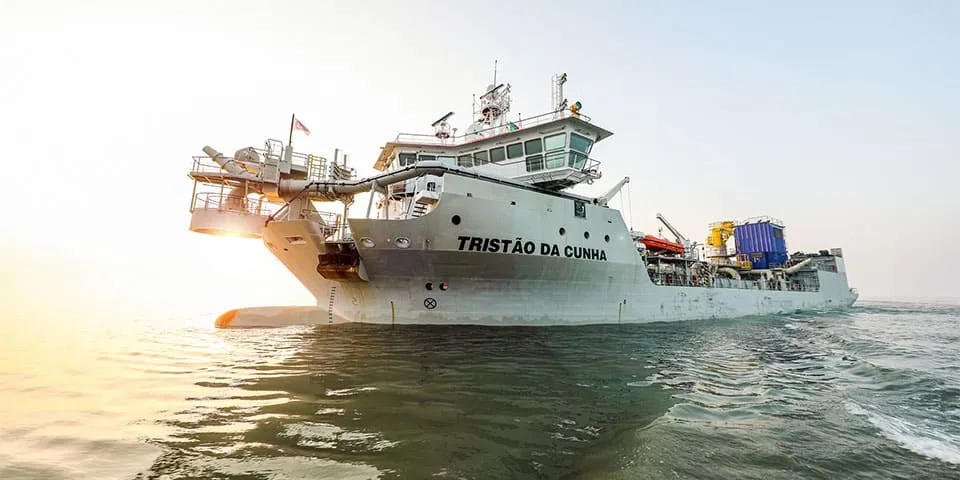
- In March and April 2019, Keppel Shipyard in Nantong, China, delivered the three 3,500 m³ trailing suction hopper dredgers Afonso de Albuquerque, Diogo Cão and Tristão da Cunha. The vessels are currently operating in South America, Europe and the Far East.
- In 2019, the Keppel Offshore & Marine shipyard in Singapore delivered the 6,000 m³ trailing suction hopper dredger Sanderus. Its sister ship Ortelius is due to follow in mid-2020.
- In December 2019, Jan De Nul launched the 18,000 m³ trailing suction hopper dredger Galileo Galilei at the COSCO shipyard in Dalian, China. The vessel is due for delivery during 2020.
- In October 2019, Jan De Nul Group acquired the vessel Willem van Rubroeck in Croatia with the highest bid at a public auction. Jan De Nul Group had ordered this cutter suction dredger from the Uljanik shipyard several years earlier. The latter was declared bankrupt in 2019. Ownership of the unfinished vessel was ultimately transferred to Jan De Nul Group in February 2020. The vessel was moved to the Remontowa shipyard in Poland in April 2020, where work to complete it will continue. The vessel is expected to enter service in 2021.
- In April 2019, Jan De Nul Group ordered a large offshore jack-up installation vessel, Voltaire, from the COSCO Shipping Heavy Industry shipyard in China. This jack-up vessel will be fitted with a main crane with a lifting capacity of more than 3,000 tonnes and will be able to operate in water depths of more than 80 metres. It will be capable of installing the next generation of very large offshore wind turbines. Construction is currently still at the engineering stage. Actual construction is due to start in May 2020. The vessel is expected to be delivered by 2022.
- At the end of 2019, Jan De Nul ordered another large crane vessel, Les Alizés. The vessel will be built by China Merchants Industry Holding Co. Ltd. at its shipyard in Haimen. Les Alizés will have a crane with a lifting capacity of 5,000 tonnes, a deadweight capacity of 61,000 tonnes and a deck area of 9,300 m². The vessel will enable Jan De Nul Group to install large, heavy foundations for wind turbines in deep water. Delivery is scheduled for 2022.
Les Alizés and Voltaire are complementary vessels. This investment responds to the global trend in the offshore wind energy sector towards installing ever larger wind turbines. The latest generation of turbines can stand more than 270 metres tall, with blades up to 120 metres long, and rest on foundations weighing up to 2,500 tonnes.
Like the new trailing suction hopper dredgers, Voltaire and Les Alizés will be equipped with an ingeniously designed in-house filtration system to eliminate harmful substances from their exhaust gases. This exhaust gas filtration technology meets the stringent European EURO STAGE V emissions requirements for land-based machinery and inland waterways.
This will make both vessels the first seagoing installation vessels in the world with extremely low emissions (Ultra-Low Emission vessel, or ULEv). Both vessels will also receive a Cleanship NDO7 label and a Green Passport EU label. The first label confirms that the vessel monitors and minimises its wastewater and all other residual waste. The second means that all materials and hazardous substances are identified during the construction phase, to facilitate the vessel’s recycling at the end of its life. Both certificates are issued by an independent specialist body.
GREEN FINANCING
Les Alizés and Voltaire will primarily serve the renewable energy sector and are equipped with an advanced emissions treatment system. These investments therefore qualify for a green loan.
To finance the two investments, Jan De Nul Group signed a green loan agreement on 5 July 2019 with a consortium of five banks led by KBC Bank (the consortium comprises KBC Bank, BNP Paribas Fortis, ING Luxembourg, Rabobank and Belfius Bank).
This is Jan De Nul Group’s first green syndicated loan.
The green loan was structured in accordance with the ‘Green Loan Principles’ drawn up by the Loan Market Association (the industry association representing banks, lawyers and other financial parties). Their aim is to encourage investment in green projects by providing banks and companies with guidelines on the characteristics of a green loan.
In addition to this green loan of 300 million euros, a long-term revolving credit facility of 250 million euros was also established with the same consortium of banks.
COVID-19
At the time of publication, the world is facing the consequences of COVID-19. The effects of this pandemic are not reflected in the 2019 financial results. Jan De Nul Group is doing everything possible to safeguard the health and safety of its employees worldwide, optimise its cost structure and maintain its excellent working capital position. As mentioned above, a committed Green Term Loan was set up in 2019 to finance the major investments in vessels planned for the coming years. In addition, Jan De Nul Group has an excellent balance sheet profile and an order book of 3.4 billion euros.
Question about this story? Ask your question
Companies in this story
Keep following this
Get an email when a new story is published. No account needed.
- SubjectGeneral
- CompanySiemens







