











Piled embankments on low-bearing-capacity ground
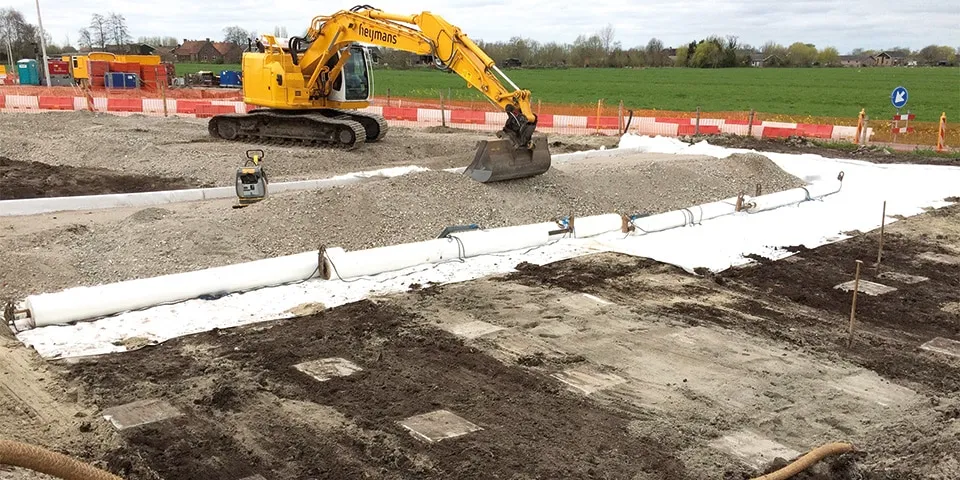
Building roads, railways or embankments on low-bearing-capacity ground is a common challenge. Using a geosynthetic as internal reinforcement within the soil mass prevents failure and limits differential settlement. What about overall settlement? If the ground does not have sufficient bearing capacity, additional support will be required. For infrastructure projects, a piled embankment is the solution for raising the ground using a limited number of piles.
Pile cap
A cap is placed on top of each pile to increase its bearing area. Typical pile cap dimensions are 0.75 x 0.75 x 0.45 m. Since the cap has a larger surface area than the pile head, the distance to be spanned between piles is reduced.
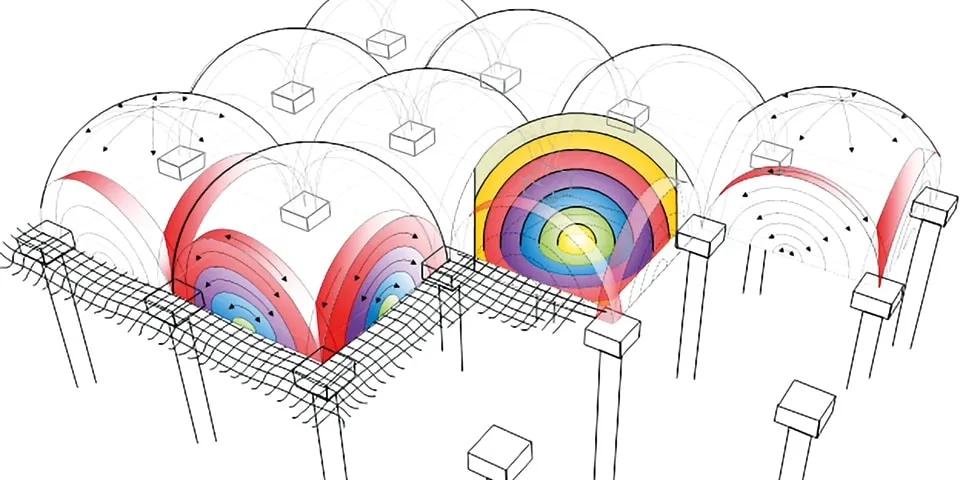
Piled embankments work through arching. As with the vaults in a cathedral, the forces acting on the structure are transferred to the supports. (Image: Suzanne van Eekelen, Deltares)
Granular mattress
A strong, low-deformation geotextile or geogrid is rolled out tightly over the pile caps. Standard rolls typically measure 5 m x 100 m. A carefully planned layout is required, as the roll widths and their positioning must be selected to ensure sufficient anchorage through friction once the fill has been placed. Since the geosynthetic has a limited width and therefore does not provide continuous strength in the transverse direction, a second geosynthetic layer is laid at right angles to the first. The two layers are placed in contact with each other, or alternatively a layer of granular material is placed between them. Marco Hazenkamp of TenCate, who has around 15 years’ experience in this field, stresses the importance of the layout plan, as complex geometries often arise, for example where the embankment meets bridges. Ideally, during the design phase, the pile pattern should be determined so that it matches the dimensions of the reinforcement layers. It is important to be well prepared for the installation, with the correct roll lengths and widths and a layout plan clearly marked out.
Arching
A piled embankment works through arching: the mattress transfers the load towards the piles, which in turn transfer the forces to the ground. Once the fill has been placed and compacted, and the earthworks embankment, road foundations and asphalt have been laid, little or no residual settlement occurs after the road is opened to traffic.
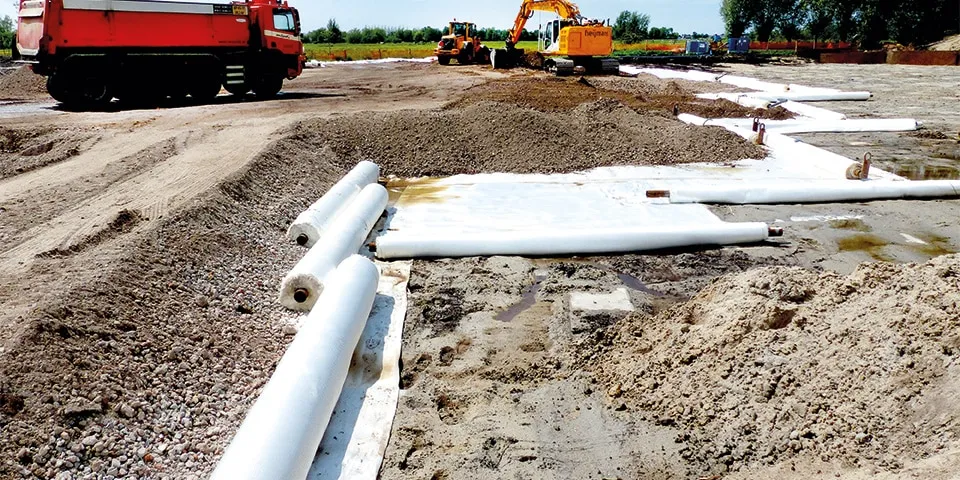
Two layers of geotextile (or geogrid) are laid at right angles to each other to ensure high strength in both principal directions.
Advantages of piled embankments
Steven De Maesschalck of Texion points out that, thanks to the effective distribution of loads to the ground and the strength of the geosynthetic, lateral movement is also prevented. The piles can therefore be driven a considerable distance apart, resulting in savings for the client.
Designing a piled embankment
For advice and calculations, free of charge and using a specially developed calculation programme, contact [email protected]
Question about this story? Ask your question
Keep following this
Get an email when a new story is published. No account needed.
- SubjectGeneral







