











Precast concrete artwork for Beaufort 2021
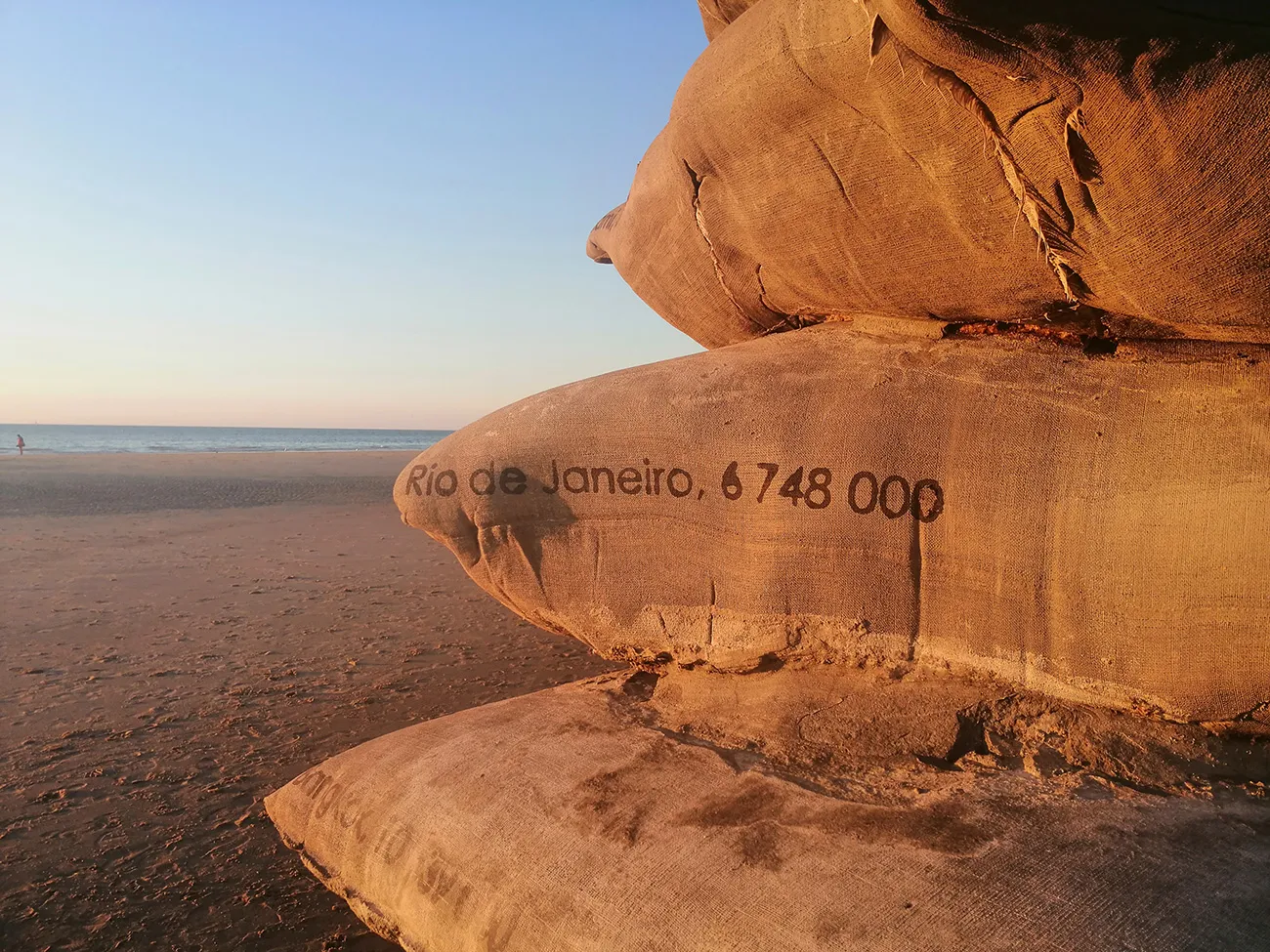
Along the Belgian coast, visitors could admire the artworks featured in the ‘Beaufort 2021’ triennial during the summer of 2021. One of the most talked-about works was ‘Pillage of the Sea’, an impressive example of precast concrete.
“The site was accessible for only 6 hours a day, between high and low tide, making off-site fabrication of the artwork the obvious choice”
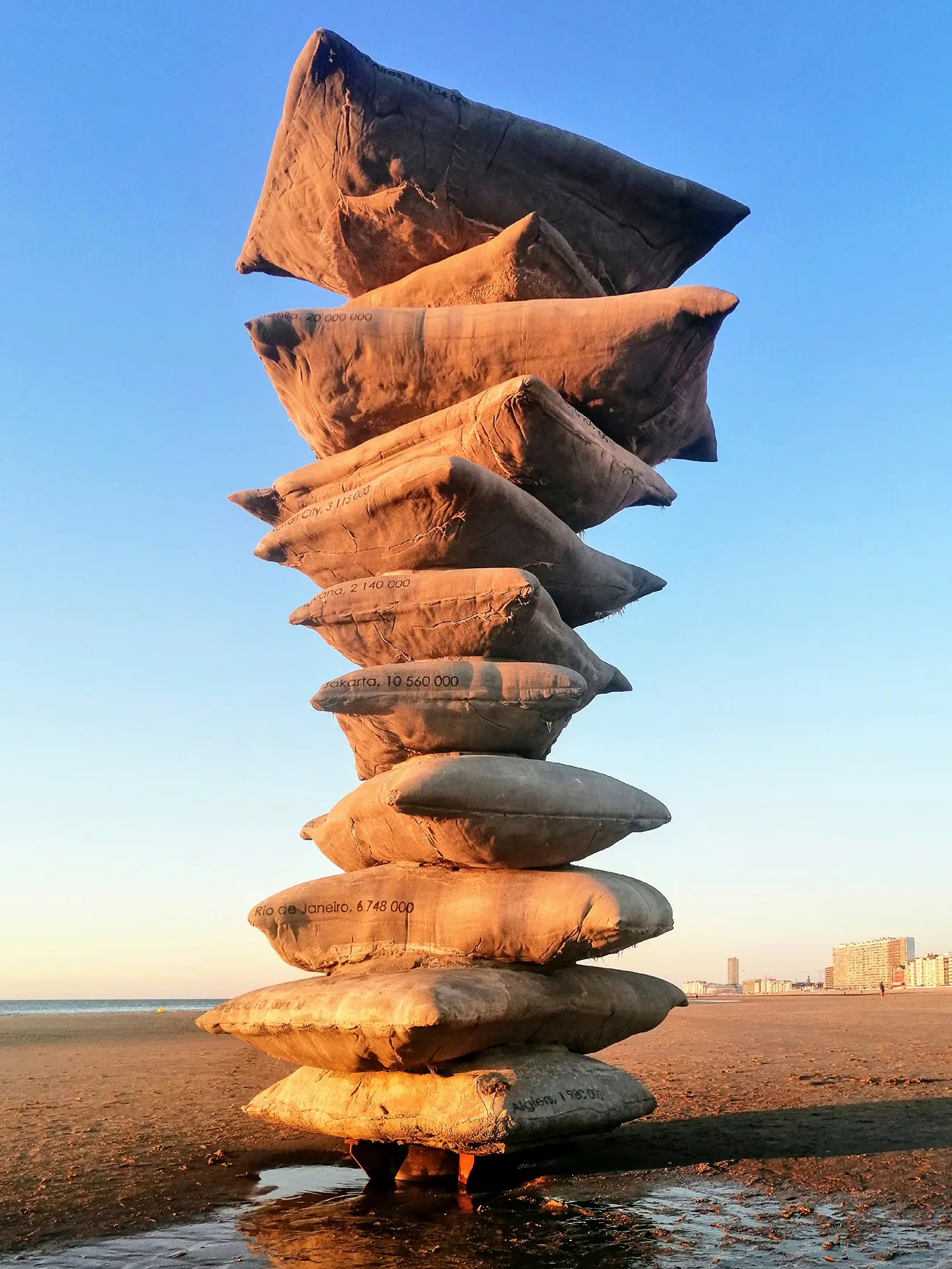
Next to the breakwater in Bredene stood an enlarged ‘stone cairn’, a small tower of stacked stones. It served as a landmark for walkers, while also referencing the spiritual significance of stacked stones in many ancient cultures. The stack was created in the form of a tower of sandbags, with global warming as its central theme. Together, they form an imaginary dyke against rising sea levels. Each bag represents a city at risk of being flooded as a result of climate change, according to its elevation above sea level. The size of each bag reflects the population. In other words, the sculpture is a visual gauge of climate change. The artist sought an eco-friendly material that could also withstand the harsh marine conditions.
Extensive research and experimentation
To produce ‘Pillage of the Sea’, artist Barbara Rosa worked with precast concrete manufacturer Enjoy Concrete. As a project of this kind is not part of the Veurne-based company’s day-to-day production, the manufacture of the elements was preceded by extensive research and experimentation. While the first trials produced a rather inorganic form, the final result is an attractive, seemingly natural stack of filled sandbags, also known as ‘fatherland bags’.

Experiments with polymer concrete ultimately proved unfeasible. However, a low CO2 footprint remains very important to the artist. This demand is growing ever louder, including from the public and the public sector. The formwork material consists of a bed of recycled sand and made-to-measure jute. The achievable formwork pressure was determined empirically in advance. This ecological material is excellent to work with, thanks to its combination of tensile strength and stretchability.
High technical complexity, artistic character
The elements were produced in alternating sequence to ensure that each ‘sandbag’ fitted naturally onto the one below. A 15-metre-long steel tube serves as the foundation and central axis. Eleven concrete elements, each with an off-centre opening, were slid onto it. The site was accessible for only 6 hours a day, between high and low tide, making off-site fabrication of the artwork the obvious choice.
It is no surprise that this artwork was nominated in the ‘Outstanding’ category of the FEBE Elements Awards. On the one hand, it combines technical complexity with artistic character; on the other, it shows that concrete is ideally suited to thinking outside the box. Concrete also makes it possible to create forms and structures that are unconventional yet still have a very familiar appearance. The jury recognised ‘Pillage of the Sea’ as a highly original application of precast concrete with considerable landscape value. It conveys a powerful message to viewers in an inventive way. The technical challenge was considerable: the artwork had to withstand not only the impact of the sea and salt, but also be assembled between high and low tide. The use of jute bags and self-compacting concrete gives the whole structure a natural appearance and makes it resistant to the specific conditions.
Question about this story? Ask your question
Keep following this
Get an email when a new story is published. No account needed.
- SubjectGeneral







