











Preventing buildings from overheating?
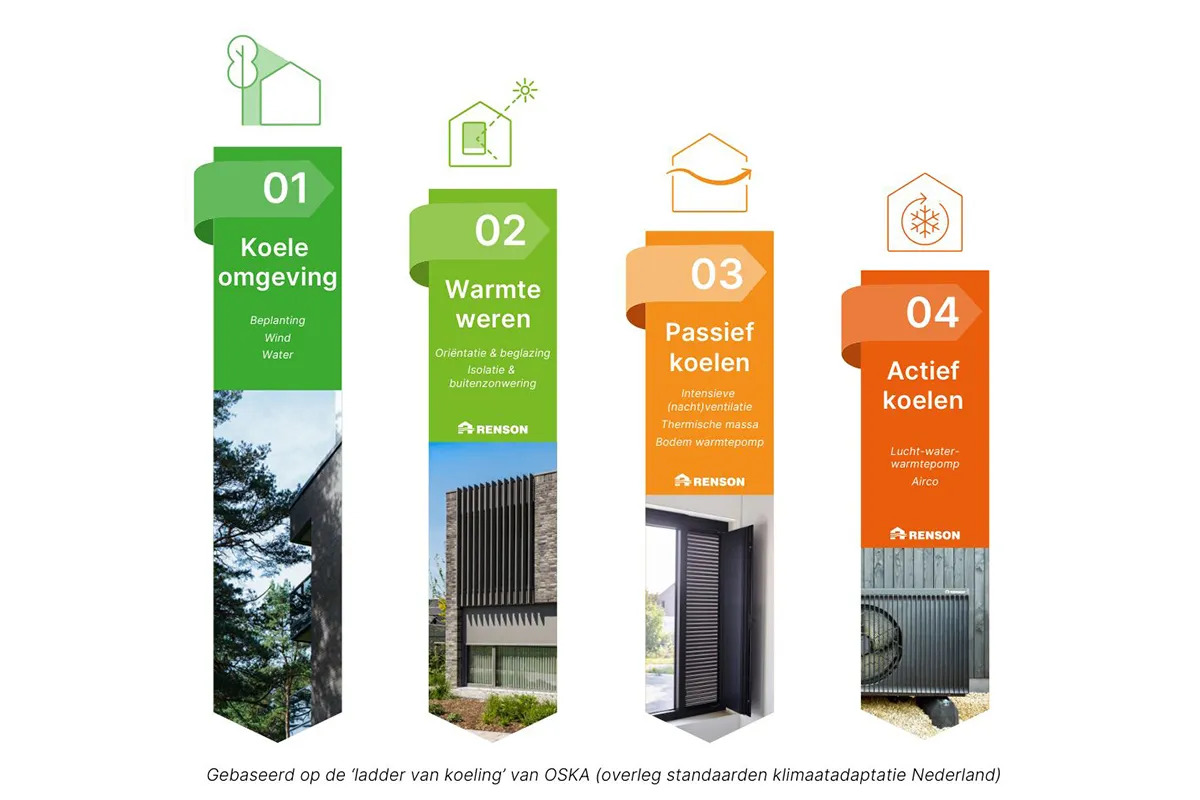
The Cooling Ladder as a guide to heat-resilient building design
A recent study by KU Leuven and archipelago architects shows that it is 5 minutes to 12 when it comes to anticipating overheating in Belgian homes. It finds that, if the climate warms by a further 3°C, almost all Belgian homes will face overheating from 2063 onwards.
With the cooling season potentially lasting up to two months a year, and with a major impact on Belgians’ comfort, health and energy consumption, overheating is no problem for the future. It is a challenge we face today, and it starts with smart building design. Fortunately, the Cooling Ladder, a framework developed by the Dutch OSKA (Overleg Standaarden Klimaatadaptatie), offers 4 steps towards sustainable, future-proof buildings. Follow them in the right order, and overheating won’t stand a chance, while cooling can be just as sustainable and energy-efficient as heating in winter.
1. Create a cool environment
Look beyond the building itself. Green and blue spaces help keep the immediate surroundings of homes cool, laying the foundations for comfortable indoor temperatures. Planting, water features, open spaces between buildings, … all help create a comfortable indoor climate.
2. Keep the heat out (before it gets in)
As an architect, you can make a real difference at the second rung of the ladder, with smart building design. This means considering everything from the building’s orientation and glazing to limiting solar heat gains through the glass with strategic shading and effective external solar shading.
An overhang, Renson external solar shading such as subtly integrated screens, as well as architectural features such as canopies or Loggia sliding panels, all do the job brilliantly. Renson also offers a suitable solution for every application, with products for vertical glazing, glass-to-glass corner windows, rooflights, Velux roof windows, … A bonus: the Fixscreen minimal is also a perfect fit for minimalist windows. Finished in the same colour as the joinery and/or integrated into the façade, screens now have very little impact on its appearance.
3. Cool passively
Is heat still getting inside? The first step is to tackle it with passive techniques, such as night cooling through burglar-resistant, insect-proof grilles integrated into the windows. At night, cooler outdoor air then ‘flushes’ through the home, lowering the temperature of the thermal mass by a few degrees by the following morning.
Passive cooling techniques can make a welcome difference, but they are no magic solution. That is why solar shading and passive cooling need to go hand in hand. In any case, the key is to anticipate indoor heat build-up as much as possible.
4. Active cooling as a last resort
During extreme heat or prolonged hot spells, especially when temperatures drop very little at night, active cooling may still be advisable. An air conditioning unit or a heat pump can therefore be useful, but only as a last resort to deal with peaks.
Looking for more expert tips on preventing overheating? Read the full expert report here.
A business enquiry for Renson? Get in touch
Companies in this story
Keep following this
Get an email when a new story is published. No account needed.
- SubjectGeneral
- CompanyRenson







