











Revised quality framework for more sustainable cement types with alternative compositions
Sustainability is a sine qua non in today’s construction sector. Cement manufacturers are also embracing the trend, developing increasingly eco-friendly products with alternative compositions and recycled raw materials. Unfortunately, standards are lagging slightly behind, and European harmonisation and CE marking are not currently possible. Fortunately, alternative solutions are available to incorporate new cement types into the Belgian quality framework. We asked ir. Martin Croon, Certification Expert & Auditor at BE-CERT, for an update on cement certification.
The cement sector is also constantly evolving, with change happening at breakneck speed. New cement types and products are springing up all over the place. Aligning standards with innovative developments in construction practice is always a challenge. The pressing need for eco-friendly products, the current shortage of raw materials and the standstill in standardisation have heightened tensions. This prompted the European technical committee for standardisation to decide to introduce a new standard. “In the past, cements could only be certified under EN 197-1, but the revision of that standard has been postponed indefinitely. Thanks to the introduction of the new standard, EN 197-5, it is now possible to certify new cement types. This is without CE marking, however, as the new standard has not yet been harmonised at European level. To ensure that their use is nevertheless covered by an appropriate quality framework, we decided to include these new cements in the BENOR regulations, without any reference to CE marking. This has now been done, and our neighbouring countries, Germany, the Netherlands, France and others, are taking the same approach,” explains Martin Croon.
Greater freedom to develop
The new EN 197-5 standard proactively addresses the shift towards increasingly sustainable cement types (CEM II/C-M and CEM VI). “There is no difference between the EN 197-5 and EN 197-1 standards in terms of performance requirements,” says Martin Croon. “What distinguishes the new cements covered by EN 197-5 from the more traditional types covered by EN 197-1 is that manufacturers have greater freedom to adapt the composition of their products to the availability of raw materials from other industries, whether recycled or not. In other words, a wider range of alternative raw materials can be used. In short: less dependence, more options! That does not, of course, mean manufacturers are not required to follow certain guidelines. Under the BENOR mark, they must define the composition of their products and may subsequently deviate from it by no more than 5%. So there is still a clearly defined framework to guarantee the quality of these new cement products.”
ATG and NeoCem
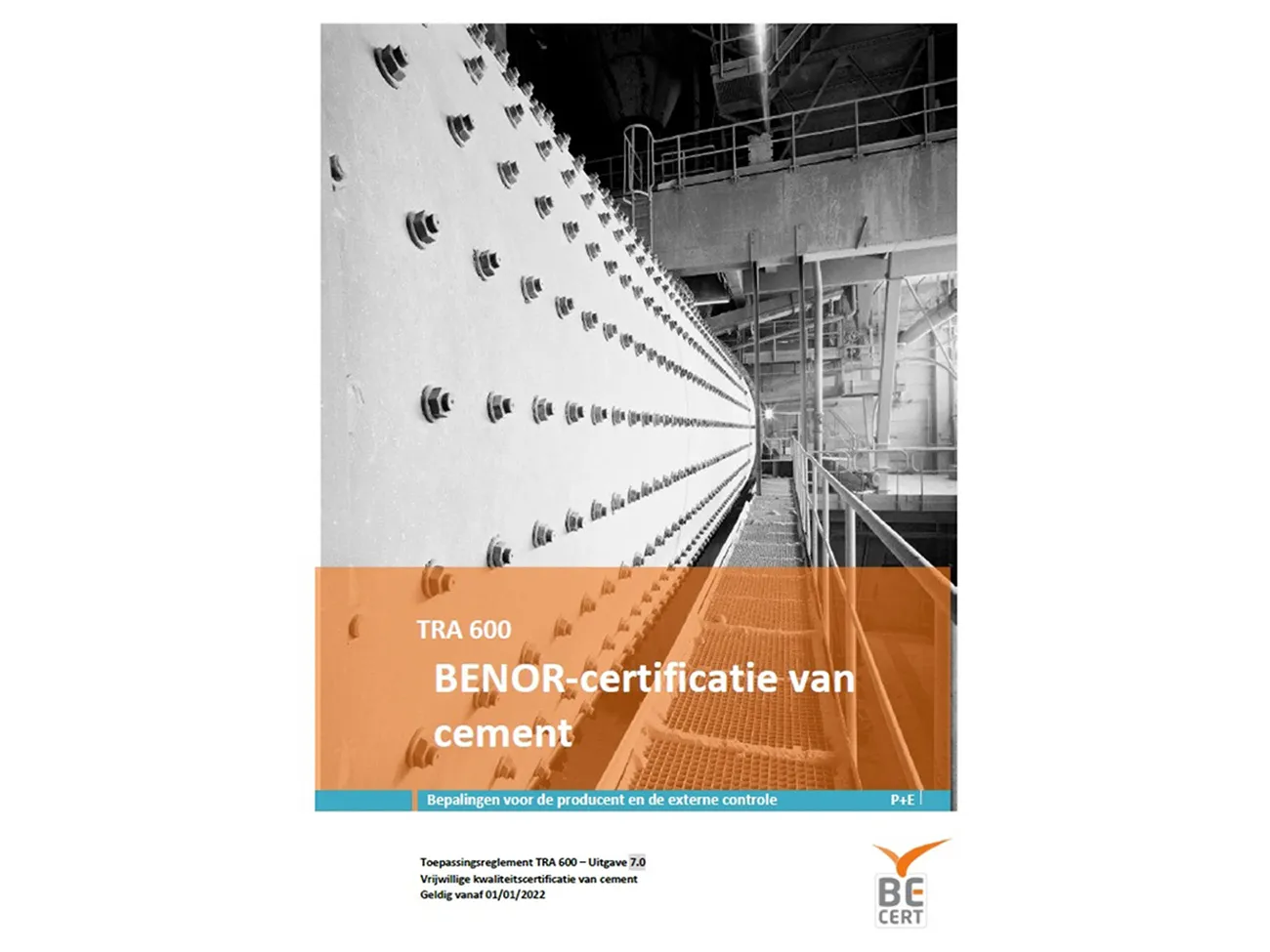
The specific suitability of cements for particular uses must also be determined within the BENOR framework, so that they can be used effectively in construction. The rules for this are set out in the concrete standard NBN B 15-001. However, the new cements have not yet been included in that standard. “Fortunately, there is an alternative solution: these cements can undergo an initial test programme under ATG, together with certification. This makes it possible to establish experimentally which suitability class these new products belong to and whether any additional requirements are needed for their use,” says Martin Croon. “This is only a temporary measure, pending the results of the NeoCem project, which proactively addresses the development of new cement types covered by EN 197-5. As part of this project, suitability classes are being determined collectively on the basis of extensive research. Once the project is complete, they will be included in the tables of the concrete standard NBN B 15-001, and manufacturers will no longer need to apply for an additional ATG.”
Strong interest
The regulations for the certification of new cement types have been in force since 1 January 2022. “The response from the sector has been very positive,” says Martin Croon. “This is mainly because, given the current market situation, it is very difficult to obtain some raw materials. Having the option of different compositions and greater freedom to develop products is therefore a real advantage. Many manufacturers are also eager to support circular construction by introducing new cement types. So far, we have received three applications to certify new cements, but interest extends further. Manufacturers need a little more time to adapt their production and bring their products into line with the new standard, so we expect to receive many more applications soon!”
All information about certified products and the regulations is available at: https://extranet.be-cert.be/.
Een zakelijke vraag aan PROCERTUS? Get in touch
Companies in this story
Keep following this
Get an email when a new story is published. No account needed.
- SubjectGeneral
- CompanyPROCERTUS







