











Safety Pavilion, Knokke | Safety pavilion becomes a work of art
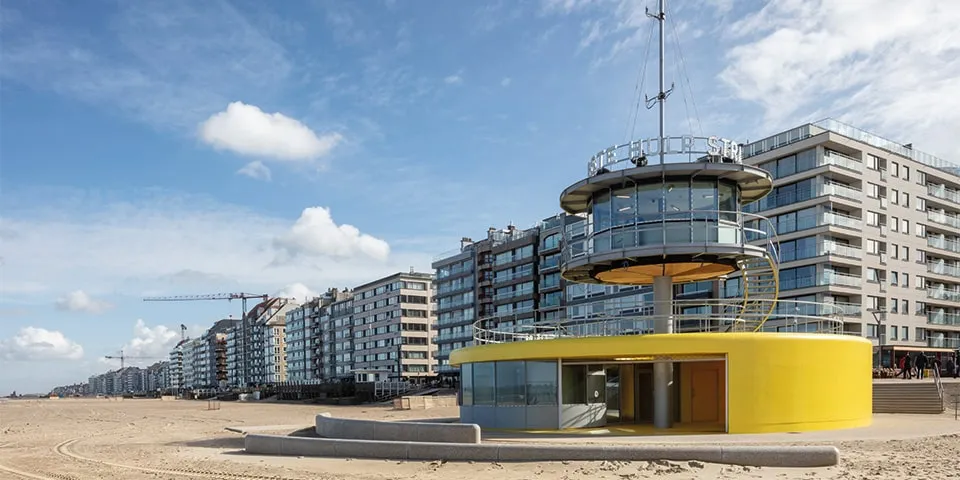
Knokke is doing everything it can to uphold its reputation as a prestigious seaside resort. And it is succeeding remarkably well. Even the new safety pavilion has become a true work of art. The highly creative design has resulted in a real eye-catcher that also serves a public function.
Every summer, hundreds of lifeguards are on hand to ensure that the thousands of tourists on our coast can enjoy the sea in safety. Unfortunately, things sometimes go wrong, so a nearby first-aid and coordination centre is no unnecessary luxury in such cases. The Knokke municipal council thought so too, and in 2016 decided to invest around one million euros in building such a facility. “The aim was to bring together several functions,” says Joke Vermeulen, managing director of Compagnie-O Architecten. “The client also wanted to incorporate a ‘crow’s nest’ into the structure: a transparent space three metres above the ground, giving the lifeguards a 360° view of the 11-kilometre coastline. There also had to be a room for the police and a waiting area with a reception desk. The design was eventually expanded to include a break and meeting room for the lifeguards, as well as public toilets. As the safety pavilion is only operational during the summer months, Knokke wanted a design that would prevent the building from looking lifeless and abandoned during the rest of the year. At the same time, in summer it had to stand out as a recognisable beacon of safety. The concept we developed together with Dutch visual artist John Körmeling and general contractor Van Tornhout proved perfect for meeting all these requirements.”
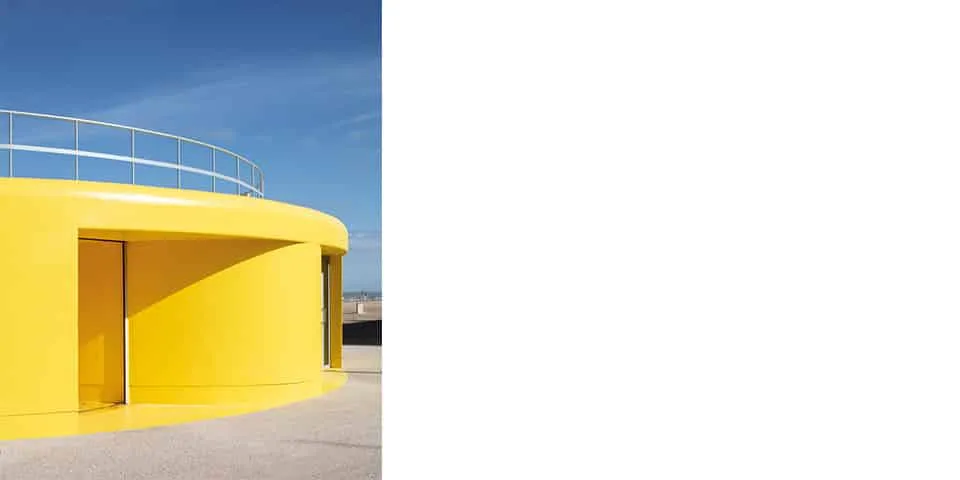
The exterior was given a bright yellow polyurea coating: the international colour of the lifeguard services.
Built to withstand the elements
This is certainly not a safety pavilion of the kind we are used to seeing on the Belgian coast. It is a fully circular, single-storey structure, with full-height glass doors at the front. “The pavilion is built around a steel frame with timber battens and sheet material,” says Alain De Groeve, managing director of Van Tornhaut, which delivered the project. “The exterior was finished with sheet material and cement render, after which the whole structure was given a layer of polyurea: a fast-curing synthetic coating also used on ships. It is the ideal solution for a building that has to withstand salt, sand and wind. Nevertheless, it did cause us some headaches, as it was not straightforward to combine the coating with the cement correctly.” Joke Vermeulen adds: “We did not have to look far for the colour: bright yellow is the international colour of the lifeguard services, chosen for its visibility. The safety pavilion also fits perfectly with the 12 yellow-orange lifeguard stations the city purchased last year.”
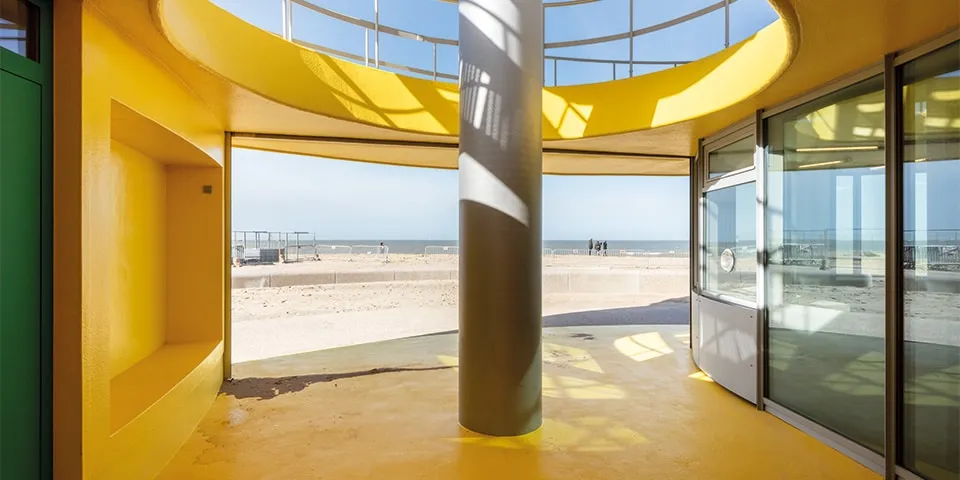
The crow’s nest is a separate structure with its own foundations and a steel pylon as its supporting structure.
Crow’s nest as a separate structure
The roof of the safety pavilion has been designed as an open public reception and waiting area. A steel spiral staircase, following the line of the steel balustrade, leads up to the crow’s nest. “This is a separate structure with its own foundations, including a central pylon that supports it and continues, with a varying cross-section, up to the 11-metre-high mast,” explains project manager Thomas Van Caenegem.
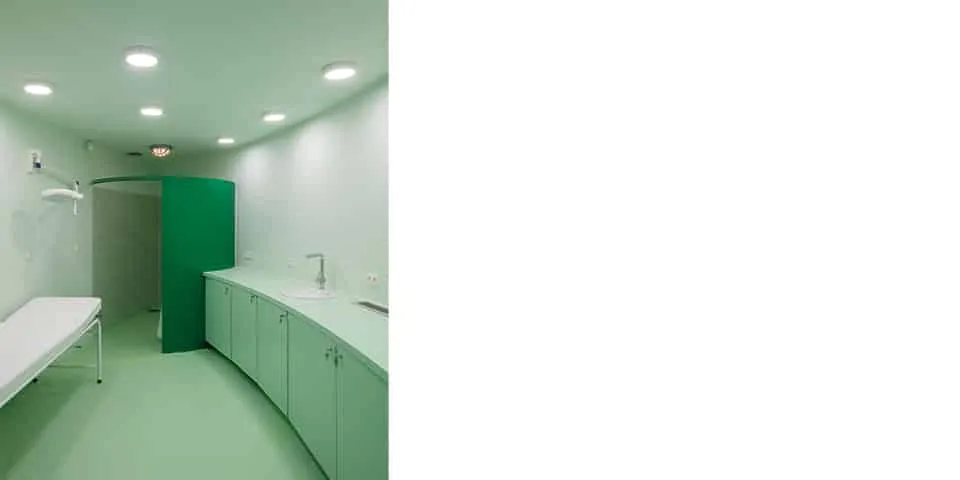
The safety pavilion incorporates, among other facilities, a first-aid room.
An architectural work of art too
At the architects’ recommendation, the safety pavilion was built not on the seawall but on top of an old bunker on the beach, which now serves as a shelter. Joke Vermeulen:
“This brings the cornice level with the horizon, directing the view from the seawall out to sea. The site was also a real source of inspiration: we wanted to create something that referred to the Second World War, but in a positive way. It is our architectural tribute to peace.”
“The safety pavilion has become a true work of art, from a construction point of view too,” continues Thomas Van Caenegem. “Translating the designers’ ideas into reality was a major challenge. We also had to work in extremely difficult conditions. Sand gets everywhere, and the damp climate made it difficult for the materials to dry. But where there’s a will, there’s a way: with plenty of creativity and perseverance, we got it done. The result is a perfect calling card on the seawall of Belgium’s finest seaside resort.”
Question about this story? Ask your question
Who worked on it
Veiligheidspaviljoen in Knokke-Heist
- architectCompagnie-O Architecten
- main contractorVan Tornhout
- contractorVan Tornhaut
Keep following this
Get an email when a new story is published. No account needed.
- ProjectVeiligheidspaviljoen
- SubjectGeneral
- CompanyCompagnie-O Architecten
- CompanyVan Tornhout
- CompanyVan Tornhaut







