











Stedelijk Transformatie Platform offers a glimpse of the city of the future
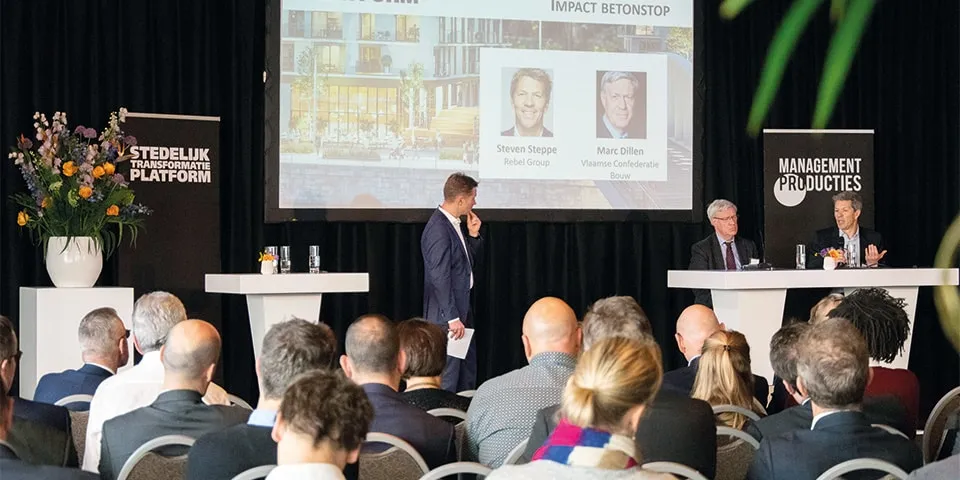
More than eighty decision-makers attended the first edition of Stedelijk Transformatie Platform in Antwerp on Tuesday 26 February. Experts shared their vision of the city of the future and explained how, in their view, we can move towards future-proof, carbon-neutral and accessible cities. “The concrete stop is not a turning point in spatial planning in Flanders, because there are already many innovative projects showing us the way,” they said.
Increasing urbanisation, changing mobility and the growing influence of digitalisation call for a new approach to (sustainable) area development. What challenges will we face in transforming and renewing urban and village centres? Can such transformation really provide an adequate solution, or would it be better to start afresh? And should the role of government be more supportive than directive? These were some of the questions discussed at Stedelijk Transformatie Platform, an initiative by Management Producties, which brought together a host of interesting speakers.
Projects with a positive impact
One of the speakers was Luk Lemmens, Provincial Executive for Spatial Planning and Mobility at Provincie Antwerpen. “The most sustainable energy is energy that is not used,” he emphasised once again. A look at leading projects such as Blue Gate Antwerp and De Nieuwe Stad in Oostende
showed that high-quality urban densification takes the creation of open space into account.
“These projects have a positive impact on residents, neighbourhoods and nature in the city because they put accessibility, collective added value, a new quality of place, sustainable mobility and spaces for people to meet at the heart of their approach,” was the conclusion.
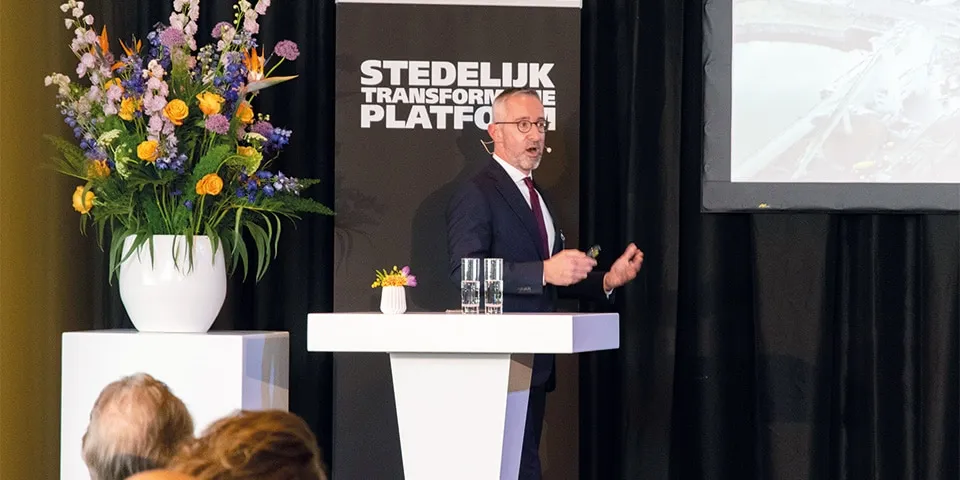
Kris Verhellen (Extensa): “Economic balance and a sense of social ownership within a project are also important measures of its success.”
Repurposing based on thorough analysis
“The repurposing of part of a city should be based on a thorough analysis of its geographical reality, historical legibility and social context,” suggested Kris Verhellen, CEO of Extensa Group. “Greater density creates new needs in terms of infrastructure and public amenities. Economic balance and a sense of social ownership within a project are therefore important measures of its success. Tour & Taxis in Brussels and Cloche d’Or in Luxembourg are textbook examples of ambitious area development in this respect.”
A turning point and a change in mindset
Francis De Wolf of BRUT Architecture and Urban Design reflected on the (crucial) role of the architect in urban transformation projects and said that urban development is at a turning point. “For far too long, we have too readily developed new areas with little ambition. New thinking on mobility, sustainability and housing concepts, together with the scarcity of greenfield sites, seems fortunately to be bringing about a change in mindset. Redevelopment of existing sites and buildings is gaining fresh impetus!”
Question about this story? Ask your question
Keep following this
Get an email when a new story is published. No account needed.
- SubjectGeneral







