











Successful groundwater recharge under challenging conditions
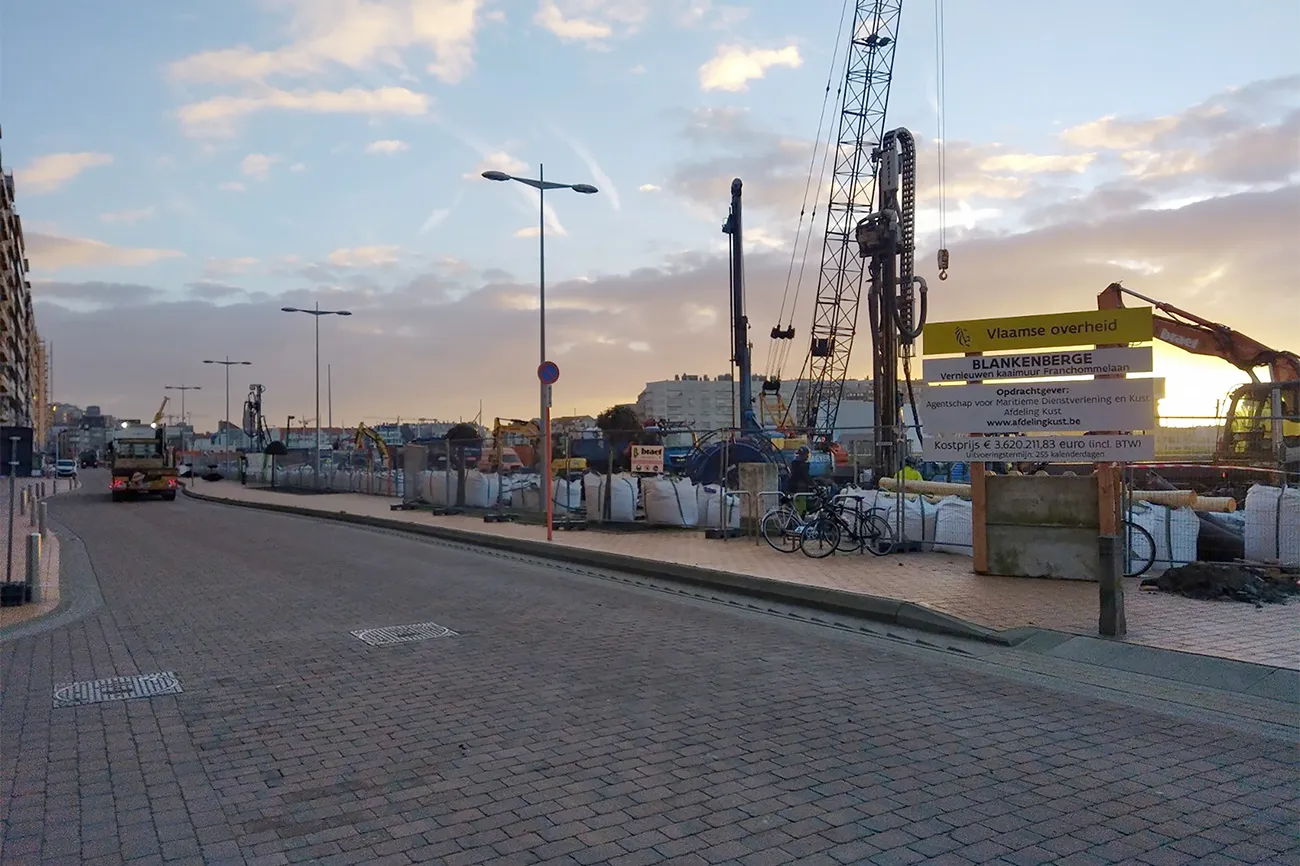
In Blankenberge, the second phase of the new quay wall at the marina, on the Franchommelaan side, is being built on behalf of the Agency for Maritime and Coastal Services. The works form part of ongoing efforts to protect the centre of Blankenberge from storm surges from the sea. G. Smeyers, a company based in Zandhoven, was appointed to carry out the challenging dewatering works.
The project was awarded to Braet, a company based in Nieuwpoort. The works mainly involve constructing a temporary protective wall in the marina, demolishing the existing quay wall, including extracting the existing pile foundations, and building a new quay wall consisting of an anchored sheet-pile wall. The new quay wall is being built on the same site as the old one.
The existing quay wall had to be demolished and its foundation piles extracted in dry conditions. This required lowering the groundwater level. The specifications stated that both the dewatering study and the application for the required dewatering permit were the contractor’s responsibility. As soon as the contract was awarded to Braet, it contacted G. Smeyers to handle the entire dewatering operation, from preparing the dewatering study and submitting the permit application to carrying out the dewatering works.
Alternative construction method
The excavation was designed to be half-open, with a sloped excavation on the landward side. To demolish the existing quay wall and extract the foundation piles, the groundwater had to be lowered to 0.00 TAW. An initial preliminary study quickly identified a number of issues: groundwater levels are affected by the tides, fluctuating between +4.00 TAW at high tide and +1.50 TAW at low tide. “This is clearly a pressure dewatering situation, with a considerable radius of influence on the surrounding area expected,” says G. Smeyers. Settlement calculations indicated that lowering the groundwater to 0.00 TAW could cause settlement of 5 to 12 cm at the excavation, with settlement of up to 2 cm expected at distances of up to 200 metres from it. A known groundwater contamination was also located within the dewatering zone of influence.
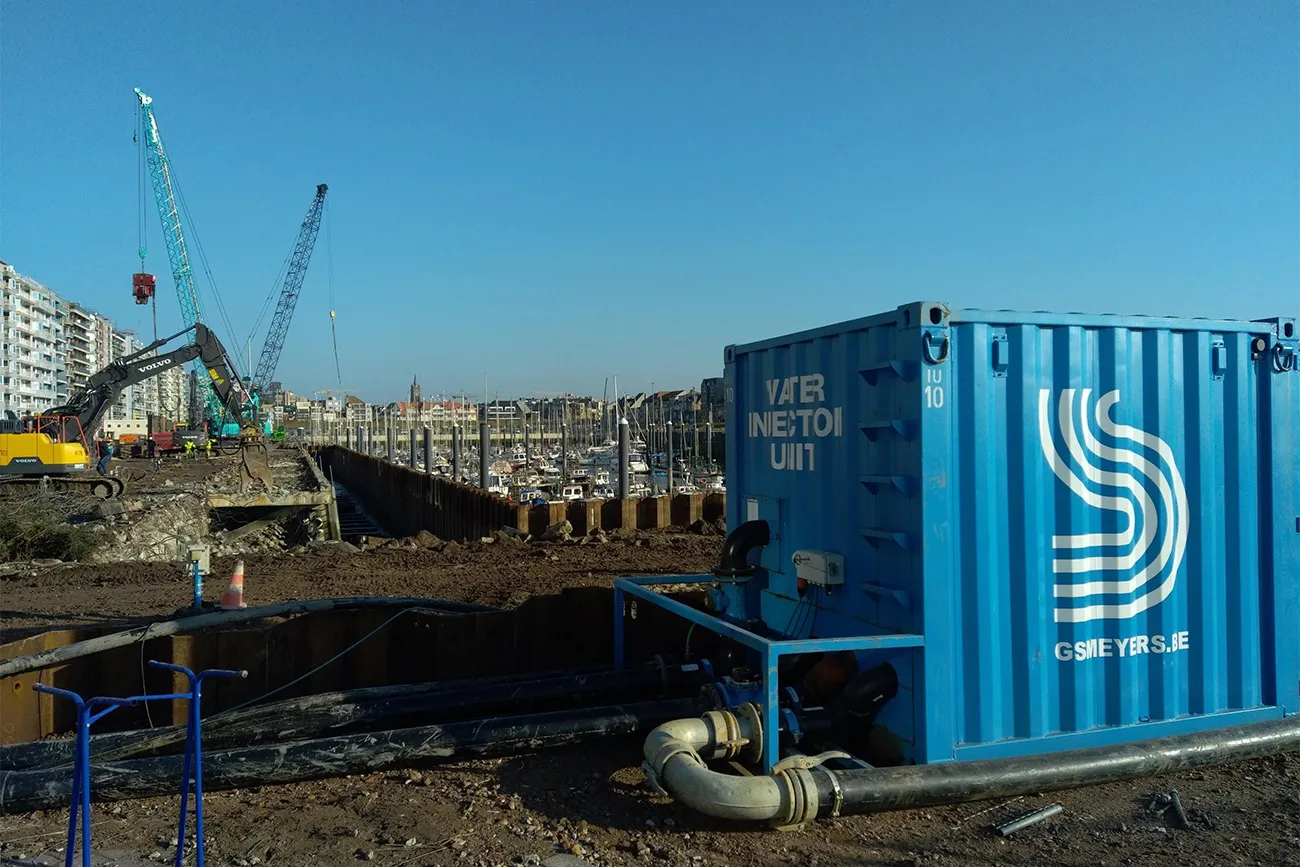
A class 2 permit is always required for this type of dewatering. Following consultation with the client authority and in agreement with contractor Braet, G. Smeyers developed an alternative construction method. The excavation was enclosed around its entire perimeter, and an additional sheet-pile screen was driven on the landward side to a level of -12.00 TAW, the same depth as the sheet-pile screen in the marina protecting the excavation. Within the fully enclosed excavation, shallow extraction wells were used to dewater the site, while ensuring that the groundwater could be pumped ‘without aeration’.
In addition, a groundwater recharge screen was installed at the Franchommelaan and running parallel to it. This ensures that groundwater levels outside the excavation, near the buildings, never fall below the low-tide level. Finally, an extensive monitoring system was installed to continuously record water levels both inside and outside the excavation, as well as the volumes pumped. All parties involved can also access this data online.
Major reference project
The advantage of this construction method was that recharge dewatering significantly reduced the impact of dewatering on the surrounding area, greatly reducing the risk of damage to neighbouring buildings, or eliminating it altogether. Recharge dewatering also substantially reduced the net volume of water pumped, meaning the works could be authorised under a class 3 notification, which requires only a simple acknowledgement. This saved a considerable amount of time and meant that the dewatering system could be installed shortly after work began.
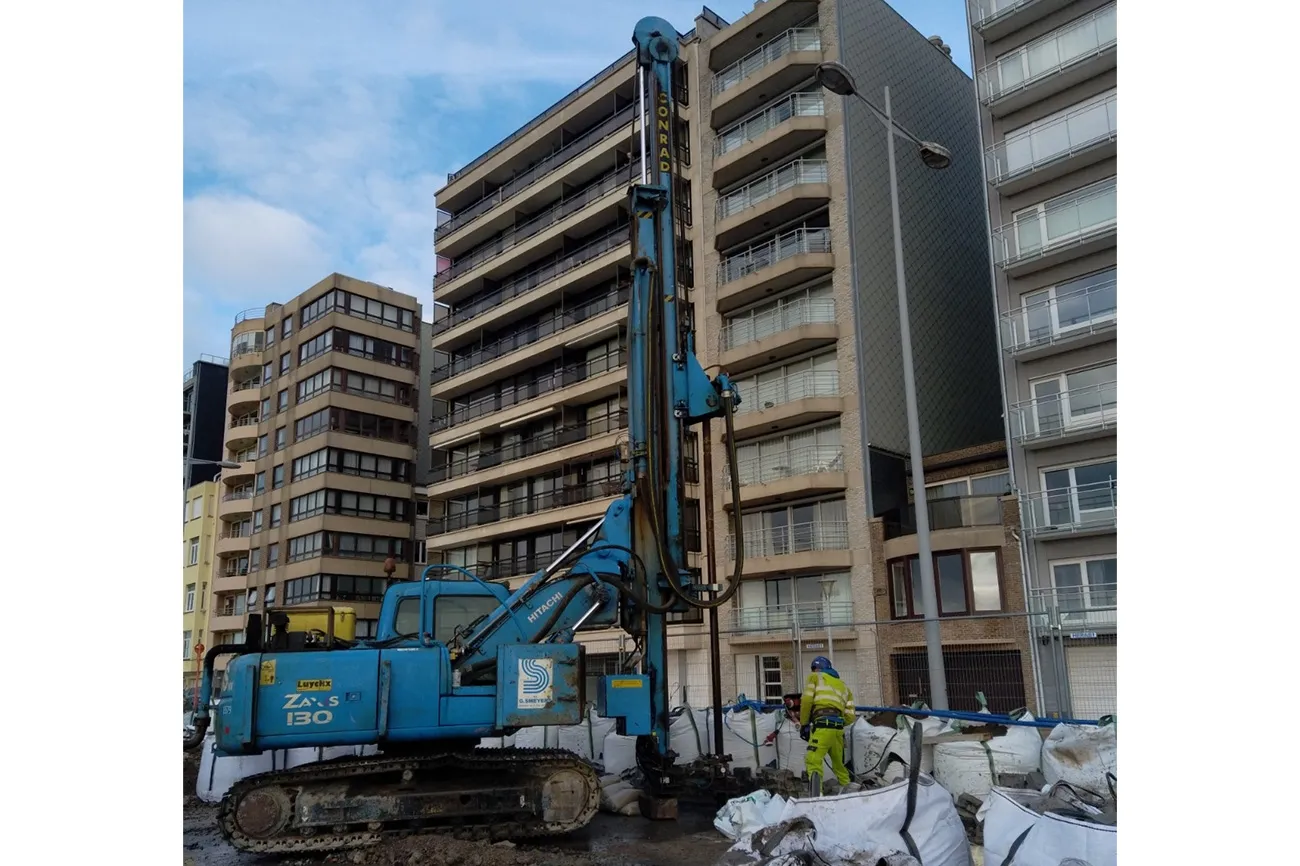
The dewatering system is now operational and is comfortably achieving the intended results. This project is an important reference for G. Smeyers, as it is the first time a large-scale recharge dewatering system has been successfully implemented in a groundwater layer affected by the tides. “This was the first project on which G. Smeyers worked with Braet. The entire process, from design and the dewatering study to carrying out the works, was consistently marked by a very constructive and pleasant collaborative atmosphere,” the company says.
Een zakelijke vraag aan G. Smeyers N.V? Neem contact op
Bedrijven in dit verhaal

Blijf dit volgen
Bij een nieuw verhaal krijg je een e-mail. Geen account nodig.
- OnderwerpGeneral
- BedrijfG. Smeyers N.V







