











The Pen | Véronique Claessens, Director of the Spatial Planning Department at the City of Genk
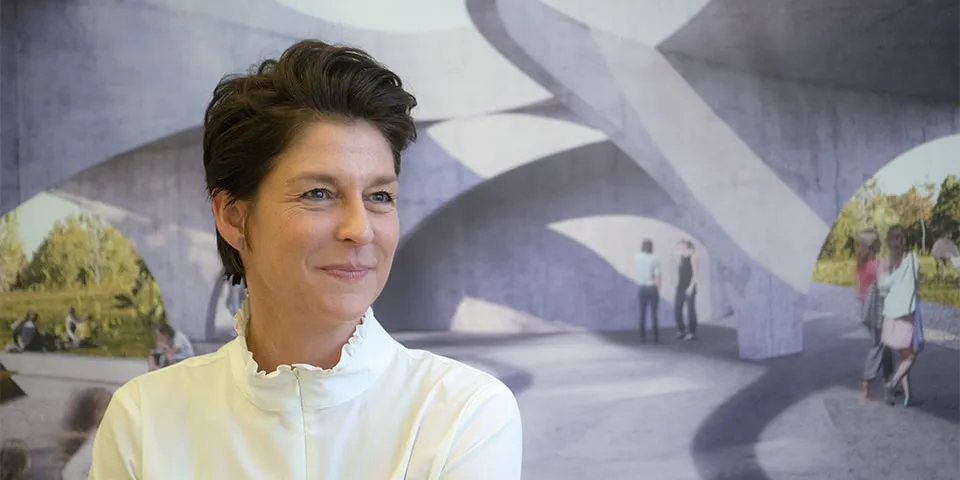
Old and contemporary icons shape the city
Genk is unlike other cities in Flanders. It is not a historically grown, concentric city with a densely built-up centre like Antwerp, Leuven or Hasselt, for example. Genk emerged in the twentieth century, on the foundations of the coal mines. Urban development followed the logic of an industrial employer which, alongside the factory, also provided all the facilities its employees needed: garden suburbs, schools, churches, hospitals and shopping streets. And so Genk grew, in fits and starts, in different places each time.
This atypical history and dispersed structure called for a distinct spatial approach, in which urban sites, densely built-up neighbourhoods, open spaces, wide roads, forests, villa developments and industry sit alongside and among one another. This urban development model for Genk is set out in the concept of the ‘raster city’.
A raster city that thrives on solid foundations of respect for its history and heritage. I believe that the city has become more valuable and attractive thanks to its mix of old and contemporary architectural masterpieces, combined with strong programmes. Our city has taken shape through the integration and repurposing of icons from its industrial past.
I therefore advocate preserving heritage. This is no easy task, least of all in an opinion piece for the construction sector. Contemporary energy and comfort standards work against it. All too often, financial considerations also carry considerable weight. Government financial support is insufficient, and the procedures are burdensome. But I urge us to keep making the effort. Because when the traces of the city’s past are erased, so too are the stories that have made it what it is today. All too often, landmark heritage is replaced by new-build projects that never match the quality and significance of what stood there before.
Just as heritage tells the city’s stories, today we must build the stories of tomorrow. Public-sector clients and everyone working in construction: it is our responsibility to help shape the city as a complex cultural and social mechanism. This is a serious task, and therefore not optional, casual or quick.
What contribution does my project make to the city? How can I integrate the historical and cultural and social context into my project? And what added value does my project offer residents? Property developers, architects, investors and banks: embrace your social responsibility!
Please dare to build icons again, icons that have meaning, tell a story and stand the test of time. Icons are not just striking buildings by star architects, though I do not rule those out, but also projects that matter to the city’s sociocultural organism. Icons are projects developed with the utmost care for urban, architectural and cultural quality, so that they fit the DNA of residents, the city’s profile and its morphology. Icons help build a resilient future.
It is first and foremost the task of public-sector clients in cities, and I am happy to include myself, to continue championing urban and cultural sustainability. I advocate structural cooperation between all those involved in urban development, with roles, responsibilities, rights and duties open to discussion. It is our task to preserve the city’s qualities, integrate its heritage and help create a resilient city grounded in its sociocultural identity.
The pen is passed to Bart Aerts, partner at Leidsman.
Question about this story? Ask your question
Keep following this
Get an email when a new story is published. No account needed.
- SubjectGeneral







