











The place behind the mirror
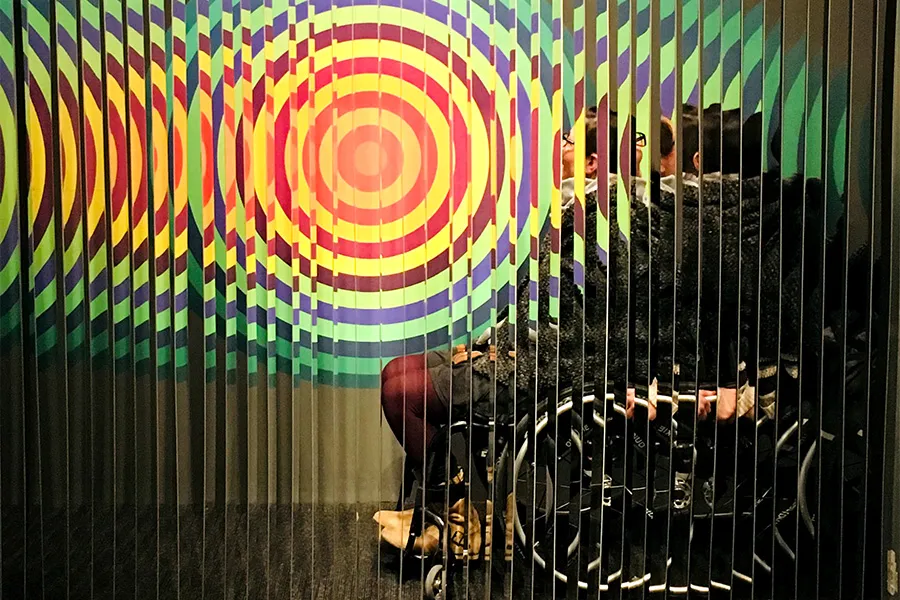
I usually can’t see my reflection. My wheelchair brings me close to the mirror, but it hangs too high for me. With my eye level considerably lower than that of most standing adults, I stare instead at a lifeless wall. The wall does not reflect me. I cannot see myself, and I cannot be seen either. Like a mirror, buildings absorb what they see, what they recognise as their own, figuratively speaking. Buildings reveal who I am and how others see me without a word being exchanged. Sometimes I am in a building, but not part of it. I do not recognise myself in it. Most days, I don’t see my reflection. Except sometimes, when I do.
When we talk about mirrors, we are often more fascinated by the relationships that take place than by the object itself. We tend to trust it to reflect us truthfully as we are; it gives back what it has received. Buildings are a special kind of mirror. They reflect social values. They are not empty, blank or neutral containers made of brick, concrete, wood or glass, but coded artefacts laden with associations that make social values tangible. Buildings speak to me too. They tell me in no uncertain terms who is, and who is not, considered and valued. As a wheelchair user, the place I am literally given in the world leads me to question my place in the world figuratively. I often find my way through architectural uncertainty. Hostile thresholds say ‘you don’t belong here’, an entrance ‘round the back’ hints at hidden shame, and mirrors hung at certain heights whisper ‘not for you’.
But times are changing. Architecture has the potential not only to reflect social values, but to change them too. Buildings are beginning to reveal people who have remained largely hidden and bring them into the light and fresh air. The entrance to Museum M in Leuven quietly announces ‘we’ve thought of you’; beneath the dome of La Cité Miroir in Liège, I am immersed in the city’s history; and Mechelen’s system of bridges and floating docks illustrates how the city is there for me, and how I am there for the city.
Recently, there has been renewed interest in themes such as inclusion, equality and social justice. The principle of considering human experience in all its diversity is slowly making its way to the drawing board. The wave of inclusion is coming. It is largely up to us architects, urban planners and designers to decide whether we simply ‘stay afloat’ or enjoy the ride.
Natalia Pérez Liebergesell,
architect & postdoctoral researcher, KU Leuven, Research[x]Design
* With thanks to prof. Ann Heylighen and Piet Tutenel for translating and revising the text.
The Pen is passed to Wendy Hoeven, architect and director at Inclure architecten.
Vraag over dit verhaal? Stel je vraag
Blijf dit volgen
Bij een nieuw verhaal krijg je een e-mail. Geen account nodig.
- OnderwerpGeneral







