











“The speed we can achieve on site today is unprecedented”
Text Tim JanssensImage Furnibo
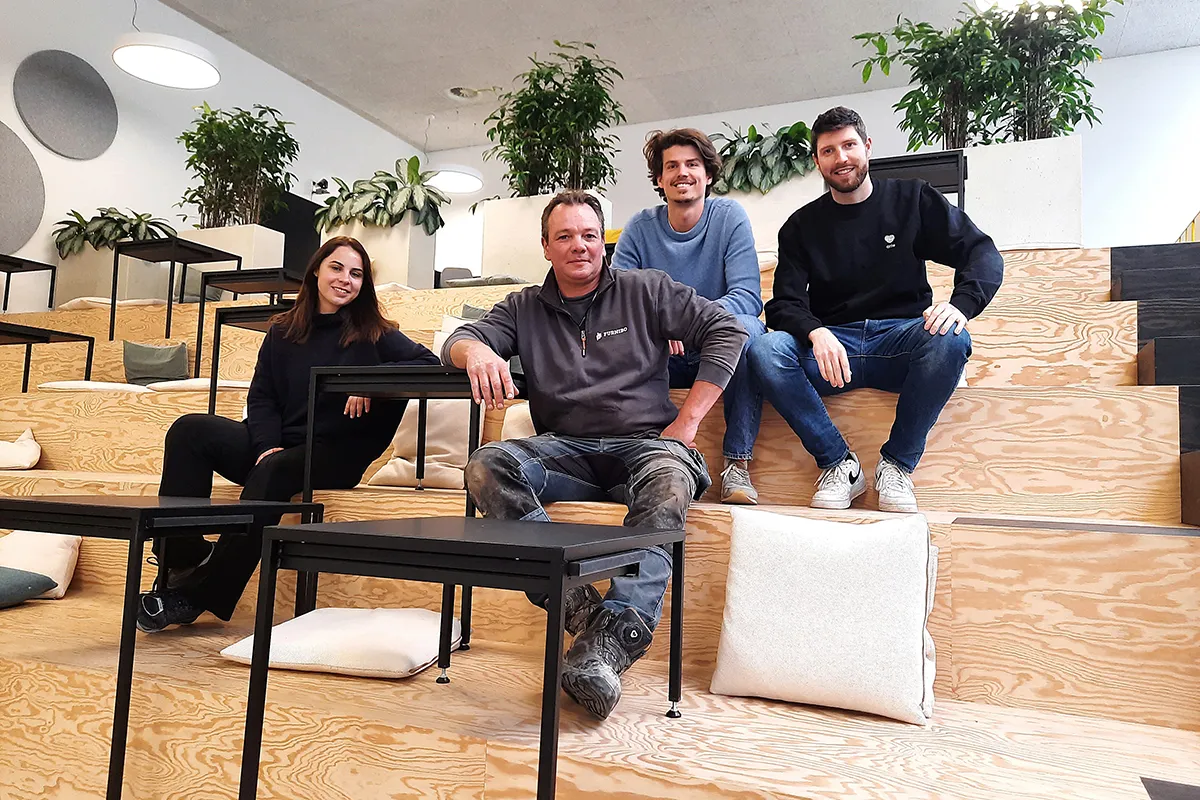
Elke Duvillers, Chris Hallemeersch, Maarten Neyens and Robbe Verfaille (Furnibo)
Some companies employ people, while others help them grow by giving them opportunities and allowing them to make their mark. Furnibo clearly falls into the second category. That is clear from the stories of four loyal colleagues, each of whom contributes in their own way to the remarkable development of this forward-thinking class 8 contractor. With its in-house precast division and prestigious projects such as SILT, it has become a familiar name in the construction landscape of West and East Flanders. They talk about their career paths, Furnibo’s innovative direction and how teamwork, digitalisation and sustainability go hand in hand with ambition and a strong focus on the human aspect. “As an employee, you won’t hit a ceiling here any time soon.”
Could you start by explaining how you came to work at Furnibo and how your roles within the company have evolved since then?
Chris Hallemeersch: “With 20 years’ service, I’m the veteran of this group (laughs). I used to work for another construction company in Ostend, and a former colleague asked me to move to Furnibo. That one phone call changed my whole life, because I accepted and later moved to Veurne. I spent 15 years as a foreman, but five years ago I was ready for a new challenge. Since then, I’ve been responsible for our in-house precast division, which I helped set up from scratch.”
Maarten Neyens: “With four years’ experience, I’m the newcomer in this group (laughs). I’m from Veurne, so I already knew of Furnibo when I started my construction studies. I had the opportunity to do a placement on the Wintercircus site in Ghent and then joined the company full-time as a site manager. It’s nice that the people who supervised my placement are now my direct colleagues. I’m happy to take the friendly teasing that comes with it, such as being jokingly called ‘the intern’.”
Robbe Verfaille: “I joined in much the same way: I did my first placement here and then came straight on board. Furnibo appealed to me because it often worked with exposed concrete. I applied before I’d even graduated as a civil engineer. I spent a while working on site myself, but when I was asked to become BIM coordinator and manager, I was delighted to focus on that. I’ve always been fascinated by drawing, so moving into digital construction wasn’t such a big step. I also look after IT and data within the company. Being able to judge fairly accurately which software can add value and which cannot is a real asset in that role. My combination of technological skills and construction background is an ideal fit.”
Elke Duvillers: “I trained as an architect-engineer and have been working at Furnibo for almost seven years now. While looking for an interesting role, I spoke to several contractors, but here everything came together best. I started as a site manager and, for the past four years or so, I’ve been a project engineer in the work preparation team.”
What makes Furnibo such a great and attractive employer?
Elke Duvillers: “The focus is on delivering forward-thinking construction projects, not simply on increasing output. I think that’s a very good principle.”
Maarten Neyens: “The camaraderie here is also a huge plus. You can approach anyone with questions, whatever their job title or years of experience. A lot of effort also goes into strengthening those bonds: team-building events, after-work drinks, company visits …”
Robbe Verfaille: “The human aspect is indeed a key pillar of our business philosophy. Another thing I really like is that we never stand still as a company and are constantly at the forefront. As a result, employees are given plenty of opportunities, responsibility and trust here, even when they’re young and inexperienced. I was only 26 when I started leading our team of BIM engineers, but that was no obstacle at all. That’s typical of this company. Furnibo grows from the bottom up, starting with young people who naturally progress over time and can each follow their own path. You won’t hit a ceiling here any time soon. So it’s no surprise that staff turnover is low.”
Chris Hallemeersch: “That hasn’t changed over all these years. When I started here, Furnibo had
40 employees. Now it has 150. Everything has changed enormously and become more professionalised, for example in terms of site safety, but the human side has remained essentially the same.”
One major trend across the industry is the drive for sustainability. How is Furnibo responding?
Maarten Neyens: “That falls under the remit of our new health and safety adviser, who devotes a lot of time and energy to looking at what we can do better to reduce our CO2 footprint, including in construction operations and waste management. On some sites, for example, we already use batteries to power site services instead of polluting diesel generators.”
Elke Duvillers: “It also gives us an advantage when tendering for public contracts. Having certain sustainability certificates puts you ahead. We’ve stepped things up another gear this year. For example, we’ll soon move up another rung on the CO2 Performance Ladder.”
A notable development within the company is the in-house production of precast brick façade elements. What prompted that decision?
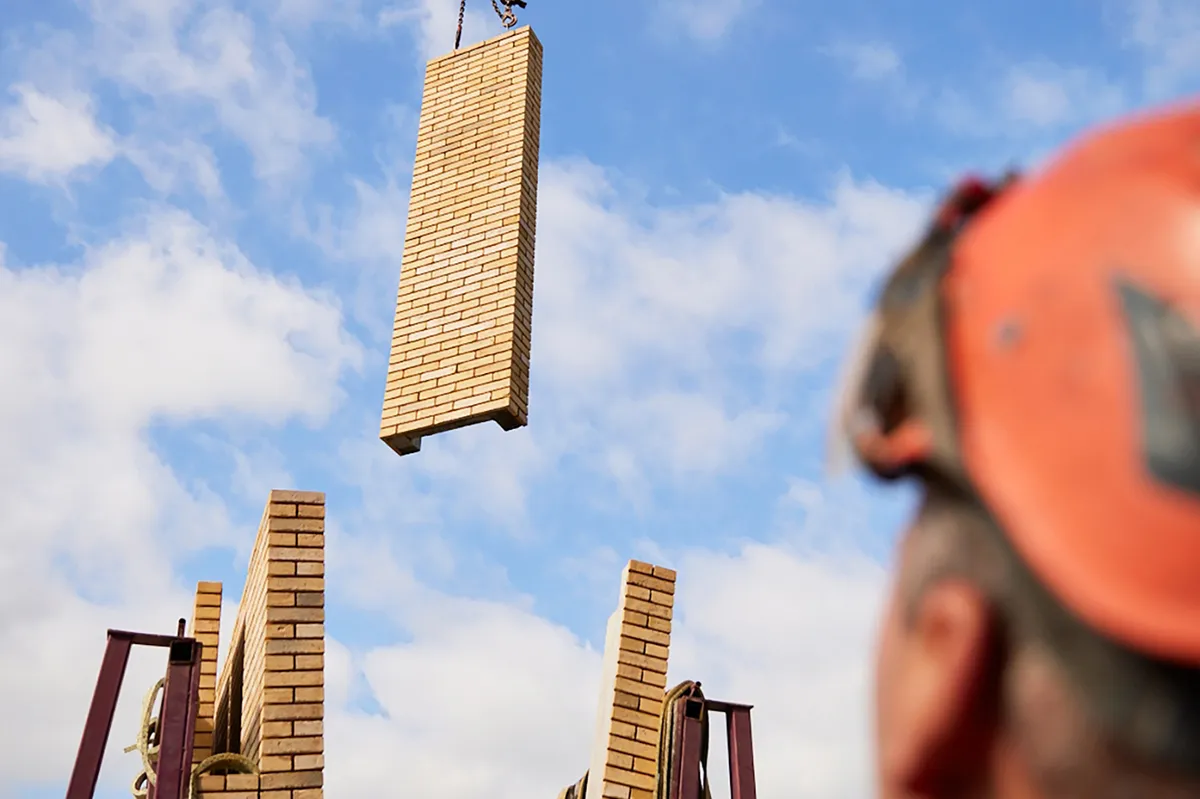
Chris Hallemeersch: “On the one hand, it’s getting harder to find good bricklayers who can achieve sufficient productivity. On the other, it gives us much greater control over the construction process. We’re not dependent on the weather and can therefore deliver just in time to the site, where the construction period is considerably shorter. In short, everything is more predictable and the risk factor is much lower. It also improves quality, makes it easy to create complex brick bonds and results in less construction waste. So the decision to manufacture our own precast brick façade elements has been a real success. At first, we produced them only for our own projects, but we now also sell to external clients, for example for the O’Sea 3 project in Ostend. So we’ve certainly got our work cut out for us (laughs).”
Elke Duvillers: “Another major advantage of our precast concept is that it eliminates the need for façade scaffolding. That broadens the range of projects we can take on. In urban settings, there isn’t always enough room for scaffolding or for storing materials, but precast brick façade elements allow us to work around that. Setting up the in-house precast division also coincided with the digitalisation of our operations. These days, we build everything digitally in BIM before starting work on site. That means much more emphasis is placed on good preparation.”
Robbe Verfaille: “Not all clients are fully on board with that approach yet, but the shift undeniably allows us to build much more efficiently. The speed we can achieve on site today is unprecedented. BIM is our standard working method on every project, large or small.”
Maarten Neyens: “We reap the benefits during the construction phase. There’s less ‘hard graft’, as we say in West Flanders. Everything runs much more smoothly and efficiently because potential clashes and problems have already been avoided. The paper drawings we used to rely on have largely been replaced by laptops and tablets, which let us zoom in on specific construction junctions and details. It makes everything much clearer.”
Besides BIM, are there any other digital tools you use regularly?
Maarten Neyens: “Yes, for example 3D scans using drones. We then overlay the resulting point cloud on the 3D building model to check for clashes, map basement and foundation walls, accurately estimate earthworks and so on. When tolerances are tight, we also use a 3D scan to check that everything will fit.”
Chris Hallemeersch: “We carried out our first 3D scans for the Suikertorens project just down the road, partly to check whether the façades were perfectly straight. They gave us crucial information for installing the precast brickwork. We’ll undoubtedly continue to digitalise our precast operations in the future. I’m thinking, for example, of using QR codes.”
Elke Duvillers: “We also hold meetings online regularly and use all kinds of other software systems, including for HR, resource planning and depot management.”
Robbe Verfaille: “Artificial intelligence has obviously also entered the picture. We’re keeping a close eye on developments, because if we adopt AI in practice, we want to do it properly. It can’t just be a gimmick. At the moment, we mainly use language models, which we’ve integrated into a web app to create a secure data environment for the whole company. Our employees can now get digital help with written tasks, so they don’t waste unnecessary time on them during busy periods and can focus even more on their core business.”
How do you see the future for yourselves and for Furnibo as a whole?
Robbe Verfaille: “I won’t be short of challenges in my role over the coming years. The AI tools we currently use are just the tip of the iceberg. Construction-specific applications will undoubtedly follow, so it’s important to keep a close eye on developments and make the right choices. The fact that a colleague and I are given time to work on this every day says a lot about Furnibo’s forward-thinking approach. That’s why I’m optimistic about both my own future and that of the company.”
Chris Hallemeersch: “I still enjoy working here too. I’m someone who needs a challenge, and I certainly have one now, because a lot lands on my desk: orders, quotations, coordination … The precast business will keep me busy for quite some time. If things keep moving at this pace, our precast division will soon be too small. Who knows, we may eventually need to move to another site, but one step at a time, of course.”
Elke Duvillers: “Chris is much more than just head of the precast department. He has so much hands-on experience that we regularly turn to him when we have questions or run into problems. He often comes up with a valuable tip or an old-school fix that helps us move forward. That’s collegiality again, making all the difference at crucial moments. As for me, my priority over the coming years is to keep growing with the company. Both my experience and the complexity of our projects are increasing, so that only makes the work more interesting and challenging. I’m delighted to see that the knowledge and experience I’ve gained enable me to make a real contribution.”
Maarten Neyens: “I haven’t been at Furnibo for very long, but I can’t see myself leaving any time soon. Personally, I’d like to take on larger, more challenging projects in the future. References such as the Suikerbrug in Veurne and SILT in Middelkerke look great on your CV, and I’m sure there will be plenty more to come. I’m hugely interested in the hands-on work on site itself, so moving up to project manager isn’t something I’m looking to do just yet. But never say never, of course. Especially not at Furnibo (winks).”
Question about this story? Ask your question
Keep following this
Get an email when a new story is published. No account needed.
- SubjectGeneral







