











“Using water sustainably is a must”
Against the backdrop of global warming and climate change, we are all aware of the need to change our behaviour. Although 72% of the Earth’s surface is covered by water, just 3% of it is drinkable. In other words, clean drinking water is a scarce and valuable resource. DELABIE’s water-saving solutions are therefore particularly useful in public buildings …
This change in behaviour is already well under way in our personal lives. By taking shorter showers, flushing the toilet more economically or turning the thermostat down by one degree, we try to save water and energy in simple ways. In public buildings, however, we behave differently as users. After all, we do not pay the bill ourselves. And any faults or leaks are less likely to be spotted and fixed quickly. Average water consumption there is around 200 litres per person per day, 50% higher than at home. In some specialised facilities, such as hospitals and wellness centres, consumption can even reach 500 litres per person per day. These figures speak for themselves, especially when you consider that 40% of the water used simply goes to waste without us noticing. This is due to leaking pipes, taps left running or dripping, toilets that keep running …
Self-closing and electronic taps
Owners of public buildings are also aware of this issue and are actively seeking sustainable solutions. Their aim is not only to achieve a favourable EPC rating, but also to save drinking water. DELABIE contributes to this environmentally conscious approach in line with environmental certification schemes such as HQE, BREEAM, LEED and DGNB. “Our solutions for optimising flow rates and limiting run times are examples of how water and energy consumption can be reduced,” the company says. “Our self-closing and electronic taps are specifically designed for non-residential buildings. Their performance far exceeds the highest standards set by labels such as WELL, WEPLS, EU Ecolabel and European Water Label, which are primarily intended for taps used in homes. DELABIE taps help building owners achieve the best results for their buildings.”
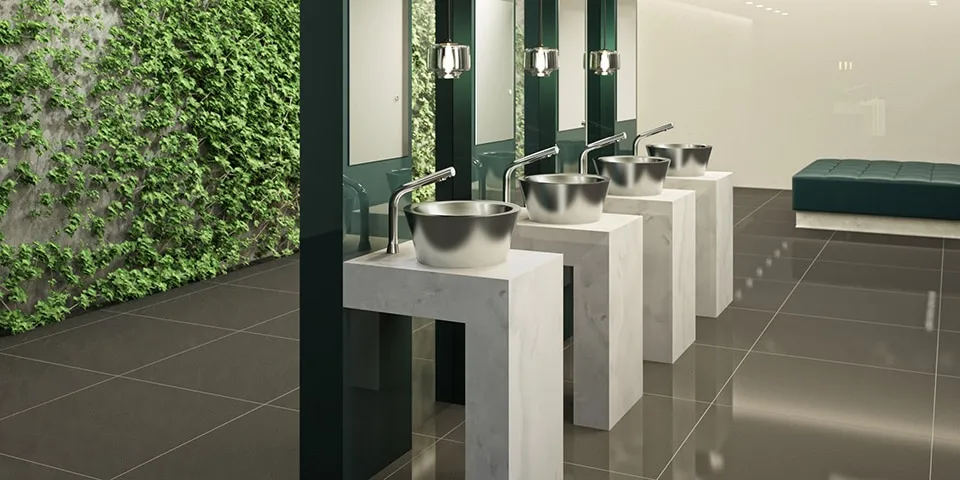
There are three basic principles for saving water in public washrooms: limited flow rates, interrupted use and guaranteed automatic shut-off.
Three basic principles for saving water
There are three basic principles for saving water in public washrooms: limited flow rates, interrupted use and guaranteed automatic shut-off. To give users better control over water consumption, DELABIE taps have flow rates limited to 1.5 l/min at the washbasin and 6 l/min in showers. “These flow rates are among the lowest in the world,” says
DELABIE. “Interrupting the water flow and automatic shut-off reduce waste and counter users’ carelessness. Washbasin taps close automatically after 7 seconds. The 3-second urinal flush and the ‘mass mode’ on electronic urinal flush valves are examples of how water volumes can be optimised. The direct-flush toilet valve is also specifically designed to meet the demands of public washrooms. Its robust and effective design greatly reduces the risk of leaks. What’s more, direct flushing uses mains water pressure, while its powerful flush ensures efficient performance, meaning a single flush is enough. To optimise water consumption, direct-flush toilet valves are available with dual flush, 3 l/6 l, adjustable to 2 l/4 l.”
Self-sufficient and economical
DELABIE’s self-closing taps operate entirely autonomously, without an electronic power supply. “They therefore consume no energy. And because the self-closing mechanism is self-cleaning, we can guarantee a service life of more than 500,000 operations,” says DELABIE. “This range is also made entirely from durable, recyclable materials. Our electronic taps, whether mains- or battery-powered, also require little energy thanks to pulsed active infrared technology. The infrared beam is emitted intermittently, reducing energy consumption while ensuring reliable detection. Battery-powered models have an average battery life of 350,000 cycles, or 3 to 6 years, depending on frequency of use. In short, all our solutions and systems make it possible to save considerable amounts of water and energy without compromising efficiency or user comfort.”.
Question about this story? Ask your question
Keep following this
Get an email when a new story is published. No account needed.
- SubjectGeneral







