











Vandenbussche and AUAR open first robotic microfactory for modular housing units
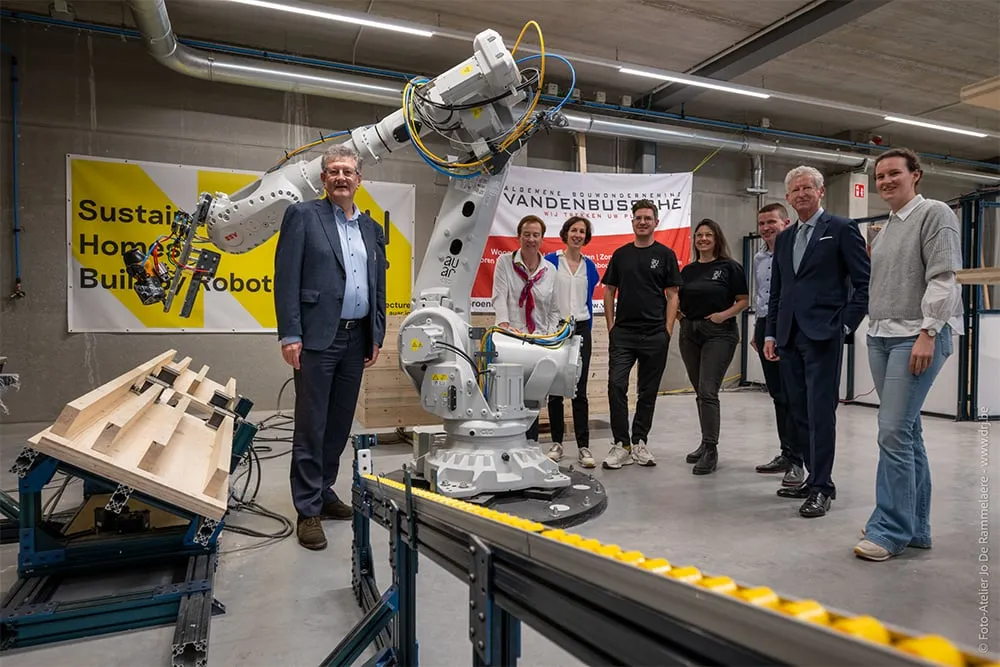
Visitors to Wintercircus in Ghent will be immediately impressed by this renovated historic landmark. What many do not know is that all the timber building elements used in the refurbishment were produced by robots. The supplier is construction company Vandenbussche from Aalter, which has set up a specialist division, or ‘microfactory’, together with its sister company Qubus and tech start-up AUAR. Flemish Minister Matthias Diependaele and Mayor Pieter De Crem had the honour of being the first to see the microfactory in action. It will now also be used to build modular housing units.
There is a pressing need for high-quality, affordable housing in Flanders. An estimated 300,000 homes will need to be added by 2040. This will require a significant increase in productivity. However, the construction sector is facing difficulties today, and considerable efforts will be needed to meet that target. “Everyone knows that finding suitably skilled workers is a challenge. Our margins are also under pressure. To keep pace with market demand, we are committed to innovation,” says Kristof Defruyt, CEO of Vandenbussche Bouw.
At the end of 2022, Vandenbussche joined forces with London-based tech start-up AUAR. Founded by Mollie Claypool and Flemish entrepreneur Gilles Retsin, the company develops robotic technology that enables construction companies to build modular housing units. “We believe that extensive automation can make the construction process more affordable and efficient. This should save us a great deal of time and enable us to reduce costs. The process itself will also become much more transparent, as production times will be known in advance,” says Kristof Defruyt.
Affordable modular housing units
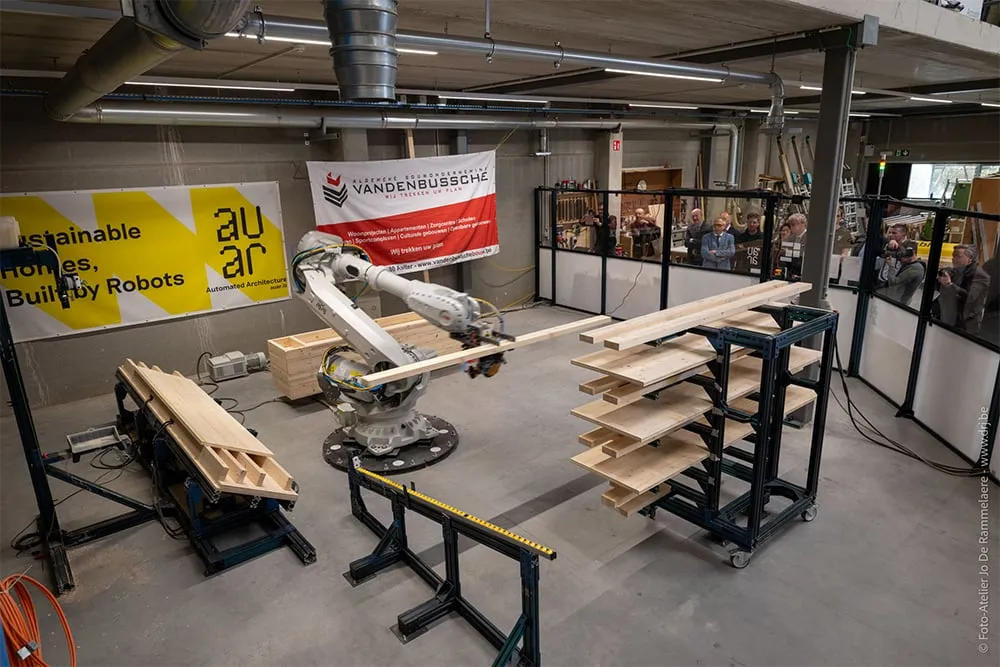
Modular housing has traditionally been a capital-intensive construction activity. AUAR’s technology changes that. “This is where we stand out from other players,” explains Gilles Retsin of AUAR. “Our robotic cells are relatively compact, making them an affordable, quick-to-deploy and scalable solution. What’s more, the control system uses AI, so a design can be generated and converted into building elements with ease. This means that the operator working with the robot only needs to validate the process. As a result, this is an ideal solution to the productivity problem the sector has been grappling with for years.”
Vandenbussche was convinced, and a few months ago the first robotic cell was installed at its site in Aalter, in a so-called microfactory. Among other things, it produced the timber frame for the interior of Wintercircus in Ghent. “It was a very successful project, but our main aim now is to use the microfactory to produce modular housing units. We are targeting large-scale projects, such as care homes, schools and apartment buildings of up to six storeys. That is where the greatest efficiency gains can be made.”
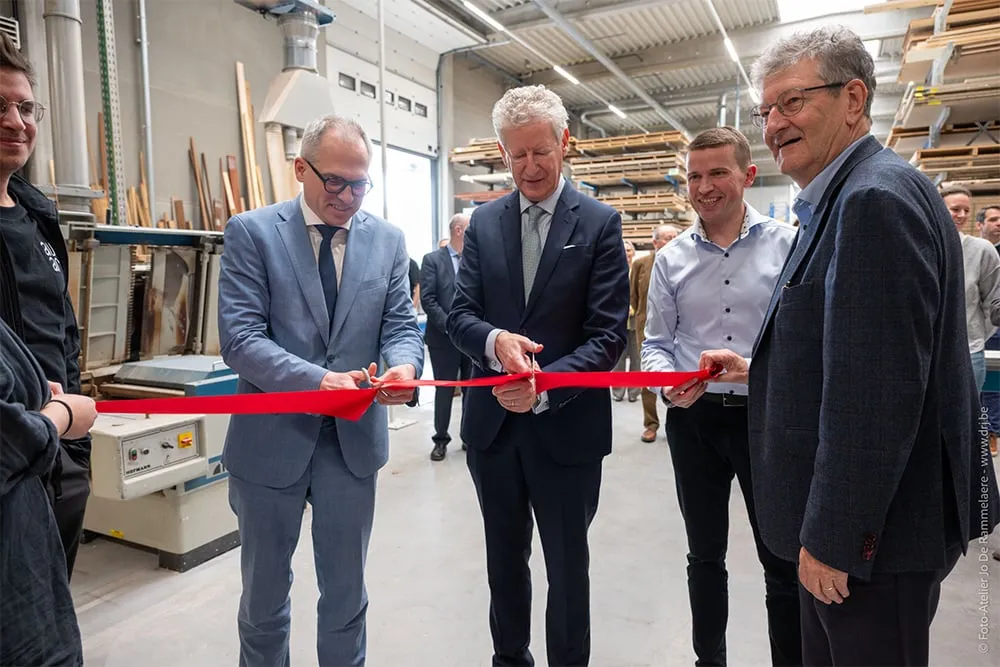
Matthias Diependaele, Flemish Minister for Housing, visited the microfactory and officially opened it alongside Pieter De Crem, Mayor of Aalter. The minister was impressed by the technology. “Our highly innovative businesses in Flanders are ready to meet the challenges facing the Flemish housing market. Industry in Flanders will play an important role in creating housing supply. This partnership between Vandenbussche and AUAR clearly demonstrates that. They combine expertise with modern technologies such as AI and robotics.”
Aalter gets the first one
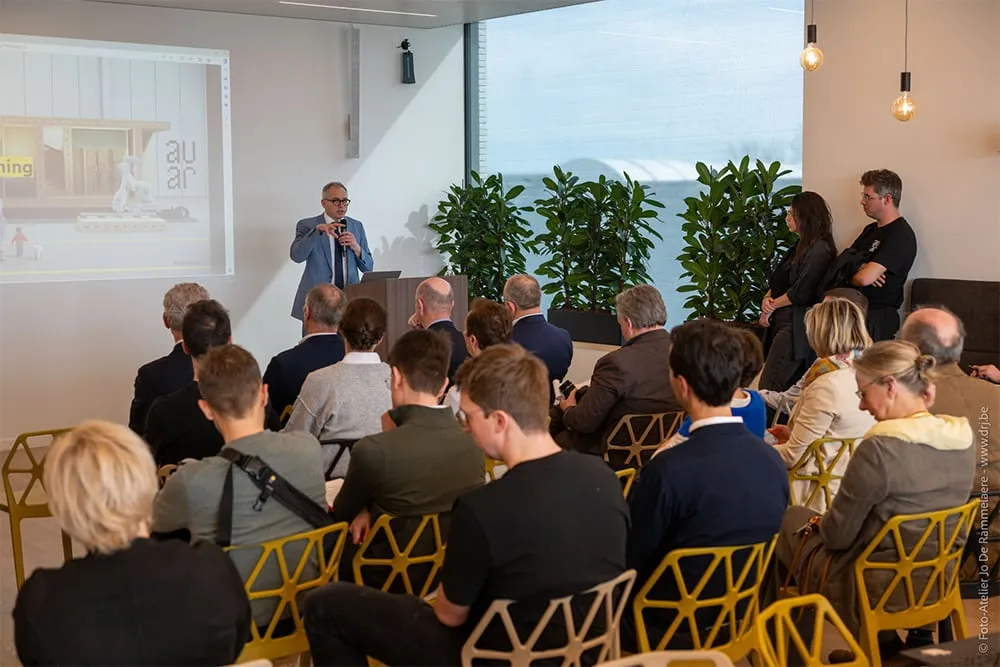
Mayor Pieter De Crem is proud that the first factory is located in Aalter. “Here at Vandenbussche, they are proving that construction is about much more than simply laying bricks. Modular construction takes things a step further, bringing robotics, technologies and top-quality materials together.”
The microfactory is also unique in its kind: Vandenbussche is home to the first one in Europe. AUAR hopes to roll out its technology widely in the near future and install robotic cells in other parts of the world. By 2030, the company aims to build a network of 40 partners and deliver 75,000 homes a year. “That is certainly ambitious, but by no means unattainable. In a housing market under pressure worldwide, we are offering an affordable alternative that allows construction companies to boost productivity while reducing their environmental footprint. Our technology can therefore help the sector make progress on every front. I am convinced that we can help transform the housing market,” concludes Mollie Claypool of AUAR.
Question about this story? Ask your question
Keep following this
Get an email when a new story is published. No account needed.
- SubjectGeneral







