











Ventilation systems and COVID-19: some guidelines
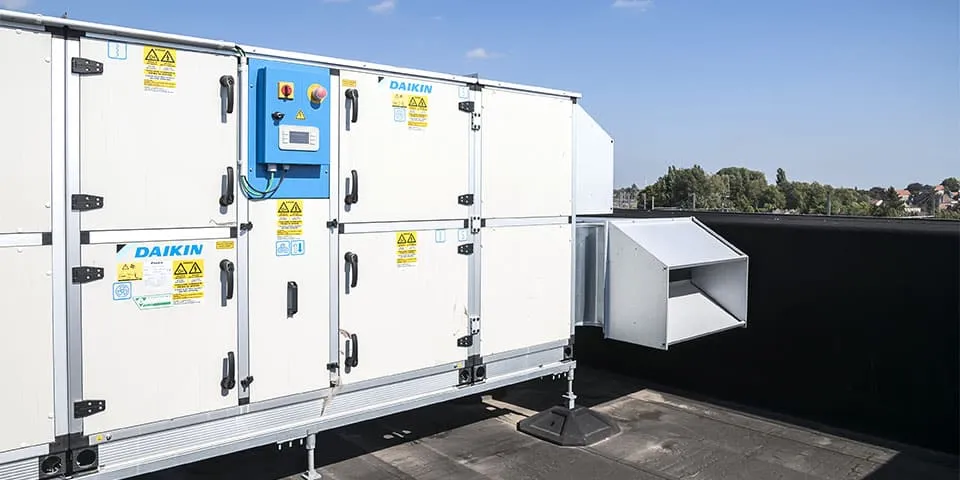
What about HVAC systems in the time of coronavirus? Daikin, a market leader in climate control systems, provides information and clarification on several points relating to the maintenance and operation of Air Handling Units in an environment with COVID-19.
The current COVID-19 pandemic raises many questions, across almost every area of life. The HVAC sector, too, needs to be aware of several technical precautions that can be taken during the COVID-19 pandemic.
Ventilation remains essential
It is recommended that the supply air and extract ventilation rates be increased. Ventilation aims to purify the air by diluting or displacing contaminants (air supply) and removing them (air extraction). In general, it is assumed that increased ventilation reduces the number of infections. REHVA, the Federation of European Heating, Ventilation and Air Conditioning Associations, provides some specific guidelines. It recommends extending operating hours, and even running ventilation 24/7. The same applies to toilet extract systems, which should also run continuously. The maximum possible amount of outdoor air should be supplied, and the number of people in the room should be minimised. This increases the volume of air per person.
Where mechanical ventilation is not available, it is important to use window ventilation to ensure adequate airing.
Humidification and air conditioning have no practical effect
COVID-19 is quite resistant to changes in its environment and is only affected by a relative humidity above 80% and a temperature above 30°C. Such conditions are not feasible or acceptable in buildings, partly because of thermal comfort requirements. Humidification therefore offers no solution for preventing the transmission and spread of coronavirus.
Safe use of heat recovery sections
It is recommended that heat exchangers be switched off during the pandemic, as virus particles may leak from the extract air into the supply air. If leaks in the heat recovery sections are suspected, adjusting the pressure or using a bypass may be an option to prevent higher pressure on the extract side from causing leaks to the supply side.
Do not use recirculation
Virus particles in return air ducts can re-enter a building, so recirculation dampers should be closed. If this causes problems with cooling or heating capacity, this should be accepted: preventing infection and protecting public health are more important than ensuring thermal comfort.
No need to clean ducts or replace outdoor air filters
In terms of maintenance, duct cleaning appears to have virtually no effect. Viruses attached to small particles are unlikely to enter ventilation ducts and will normally be carried away by the airflow. There is also no need to replace outdoor air filters. Although filters are designed to clean the air, their capture efficiency for virus particles is limited. Coronavirus particles measure 80-160 nm, which is smaller than the capture range of fine filters (capture efficiency 65-90% for PM1). Virus particles aggregate with larger particles that are already within the filters’ capture range. In the rare event of outdoor air contaminated with viruses, fine outdoor air filters provide reasonable protection against low concentrations and the possible spread of viruses in outdoor air. Normal maintenance procedures can be followed when replacing filters. In this context, clogged filters are not a source of infection, but they can reduce the air supply, which may have a negative effect on potential indoor infections. Filters should therefore be replaced in accordance with the normal procedure when pressure or time limits are exceeded.
For more detailed information, Daikin refers readers to the REHVA website and related documents: https://www.rehva.eu/activities/covid-19-guidance
Question about this story? Ask your question
Keep following this
Get an email when a new story is published. No account needed.
- SubjectGeneral







