











Want a higher EPC rating? Start with insulation!
Anyone familiar with the principles of the Trias Energetica will already know that insulation is the most effective way to improve a home’s energy performance. It is also by far the best way to quickly and significantly improve its energy performance certificate rating, while qualifying for the label grant and the interest-free renovation loan of up to 60,000 euros being introduced in Flanders next year. This is borne out by calculations commissioned by Recticel Insulation, a major player in thermal and acoustic insulation, for its 2020 Insulation Barometer.
To meet Europe’s energy targets, all existing homes in Belgium must be energy-efficient by 2050. In Flanders and Wallonia, this means achieving label[i] A or higher on the home’s energy performance certificate[ii]. Brussels is aiming for label C+ or higher by 2050. In terms of the average calculated energy score, the target is 100 kWh/m²/year or less in Flanders and Brussels, and a maximum Espec (specific annual primary energy consumption) of 85 kWh/m²/year in Wallonia.
We are still a long way from meeting these targets, as the first 2020 Insulation Barometer from Recticel Insulation has already shown. It was the first to compare the latest energy performance figures for residential buildings across Belgium’s 3 regions, finding that no fewer than 99% of all houses and 95% of all flats still fall short of the targets. And not by a small margin: the average calculated energy scores in the different regions are almost 3 times higher than the 2050 targets.
Trias Energetica
“When considering an energy-efficient renovation, you should always bear in mind the basic principle of the Trias Energetica,” explains Pieter Bailleul, Technical Manager Belux at Recticel Insulation. The principle is that, to save energy in a socially responsible way, the first priority is to prevent energy waste through effective insulation. The second is to make maximum use of renewable energy sources: sun, wind, earth and water. Finally, any fossil fuels you still need should be used as efficiently as possible, for example with a heat pump or a condensing boiler.
Insulation, to keep energy and heating demand to a minimum, is therefore the absolute priority.
Worked example
“Anyone who follows the Trias Energetica principle and starts their renovation by investing in insulation is not only taking the smartest approach. They will also improve their home’s energy performance and energy rating significantly in the most effective way,” Pieter Bailleul continues. “Much more so than if they invest in energy-efficient technologies for heating, domestic hot water, ventilation or electricity generation.
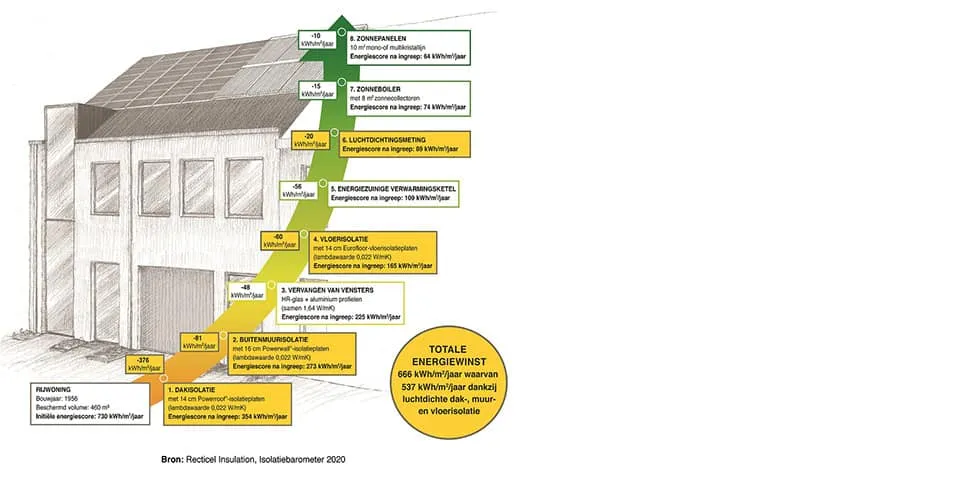
For our 2020 Insulation Barometer, we calculated that renovating[iii] a terraced house with an initial energy score of 730 kWh/m²/year would save 376 kWh/m²/year through roof insulation, 81 kWh/m²/year through external wall insulation and 60 kWh/m²/year through floor insulation. In addition, good airtightness can deliver a further 20 kWh/m²/year in energy savings on the EPC.
In other words, roof, wall and floor insulation together save as much as 537 kWh/m²/year, while installing an energy-efficient boiler saves just 56 kWh/m²/year, 8 m² of solar thermal collectors only 15 kWh/m²/year, and 10 m² of PV panels a mere 10 kWh/m²/year.”
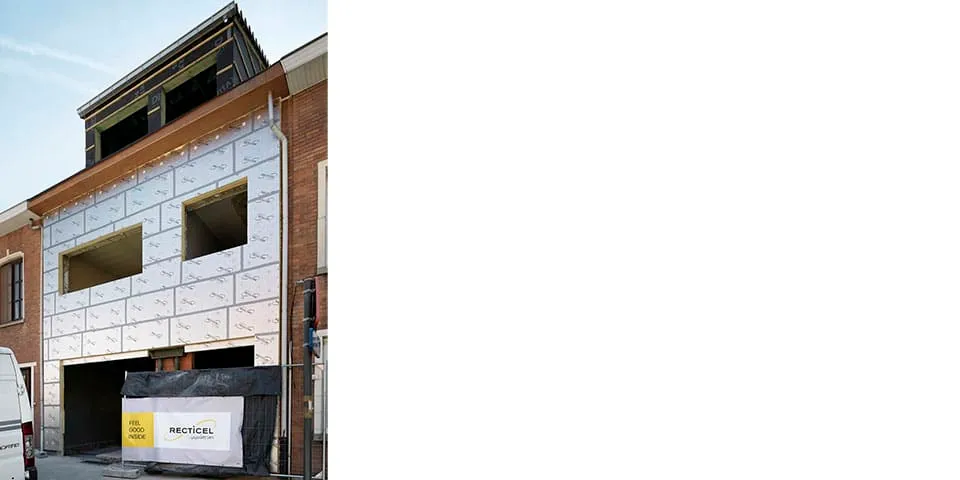
Recticel: BENOvatie project, Nicole Lens, Hazeschransstraat 38, 2650 Edegem: Powerwall external wall insulation boards and Rectitape insulation tape, battens for Eternit façade panels.
Label grant and interest-free renovation loan of up to 60,000 euros
Recticel Insulation’s recommendation to make roof, wall and floor insulation the absolute priority in an energy-efficient renovation or BENOvatie (a renovation aligned with the energy ambitions of Renovatiepact 2050) applies to everyone. But it is particularly useful for people in Flanders who, from next year, acquire a home or flat outright through purchase, gift or inheritance, as this group will be eligible for a label grant and an interest-free renovation loan of up to 60,000 euros if they carry out a sufficiently thorough energy renovation to noticeably improve the property’s energy rating.
As decided by the Flemish Government in July, from 2021 anyone who acquires a home with label F or E and improves its energy rating to C, B or A within 5 years can claim a label grant of 2,500, 3,750 or 5,000 euros respectively. From next year, renovations that take flats from label F, E or D to label B or A will qualify for grants of 2,500 and 3,750 euros respectively.
In addition, from 1 January 2021, new homeowners in Flanders will be able to take out a renovation loan (from a bank) or an energielening+ (from the local energy house) of up to 60,000 euros, with a maximum term of 20 years. The Flemish Government will cover the interest, making the loan interest-free for the new owners. Anyone who acquires a home with label F or E and improves its energy rating to C, B or A within 5 years will be able to take out an interest-free loan of 30,000, 45,000 or 60,000 euros respectively from 2021. From next year, new owners of flats renovating from label F, E or D to label B will be able to borrow up to 30,000 euros interest-free, or up to 45,000 euros if they renovate their flat from label F, E or D to label A.
For more information, visit www.isolatiebarometer.be
You’ll also find an extensive white paper there.
[i] Energy labels on the energy performance certificate (EPC) correspond to ranges of total theoretical energy consumption, expressed in kWh/m²/year. These consumption levels are calculated based on the building’s characteristics (house or flat, number of façades, etc.), insulation level and technical systems (heating, ventilation, etc.) under normal conditions of use. A home rated A or B is highly energy-efficient.
[ii] The Energy Performance Certificate (EPC) is a document that must be prepared for houses and flats offered for sale or rent. It informs prospective buyers and tenants about the energy performance of the property in question.
[iii] This worked example concerns a Flemish terraced house built in 1956, with a protected volume of 460 m3. The roof was insulated with Recticel Insulation Powerroof insulation boards with a lambda value of 0.022 W/mK and a thickness of 14 cm. The external walls were insulated with Powerwall insulation boards with a lambda value of 0.022 W/mK and a thickness of 16 cm. The floor was insulated with Eurofloor floor insulation boards with a lambda value of 0.022 W/mK and a thickness of 14 cm.
Question about this story? Ask your question
Keep following this
Get an email when a new story is published. No account needed.
- SubjectGeneral







