











Wienerberger makes sustainability a top priority
The construction sector and society as a whole face complex challenges in terms of sustainability and circularity. Wienerberger is taking a proactive approach, pursuing a wide range of initiatives. The well-known brick manufacturer is closing loops in its production process, encouraging circular use of materials through reuse and recycling, and reducing CO2 emissions. The latest milestone in this transition is the opening of a new CO2-neutral production line at its site in Kortemark. Katrien Nottebaert, CCO and director at Wienerberger België, explains.
Katrien Nottebaert: “Sustainability is in Wienerberger’s DNA. Our ceramic solutions are sustainable by nature: they have a long service life, are made from natural materials and have a low environmental impact in production. For example, a load-bearing structure built with Wienerberger ceramic adhesive blocks has a comparable or lower environmental impact than one built with masonry blocks made from other materials or with frame structures. Another sustainability advantage of our ceramic building materials is that the raw materials are extracted, manufactured and processed locally. Most of our production sites are conveniently located near waterways. Transporting goods by water saves many kilometres on the road and therefore reduces CO2 emissions. The end-of-life scenarios for these building materials are also strongly regional, as they are reused or recycled locally.”
One of your main priorities is closing the loops in the production process. What exactly does that involve?
“After clay pits have been worked, they are restored and returned to society as nature reserves, recreational areas or farmland. Next, we reduce the need for primary raw materials by using secondary raw materials in the production process. A good example is the 100% reuse of fired production waste, or the use of by-products from other industries. We also close the water loop by collecting rainwater and treating and reusing production wastewater. This means no wastewater is discharged.”
Does your circular approach go further than closing all those loops?
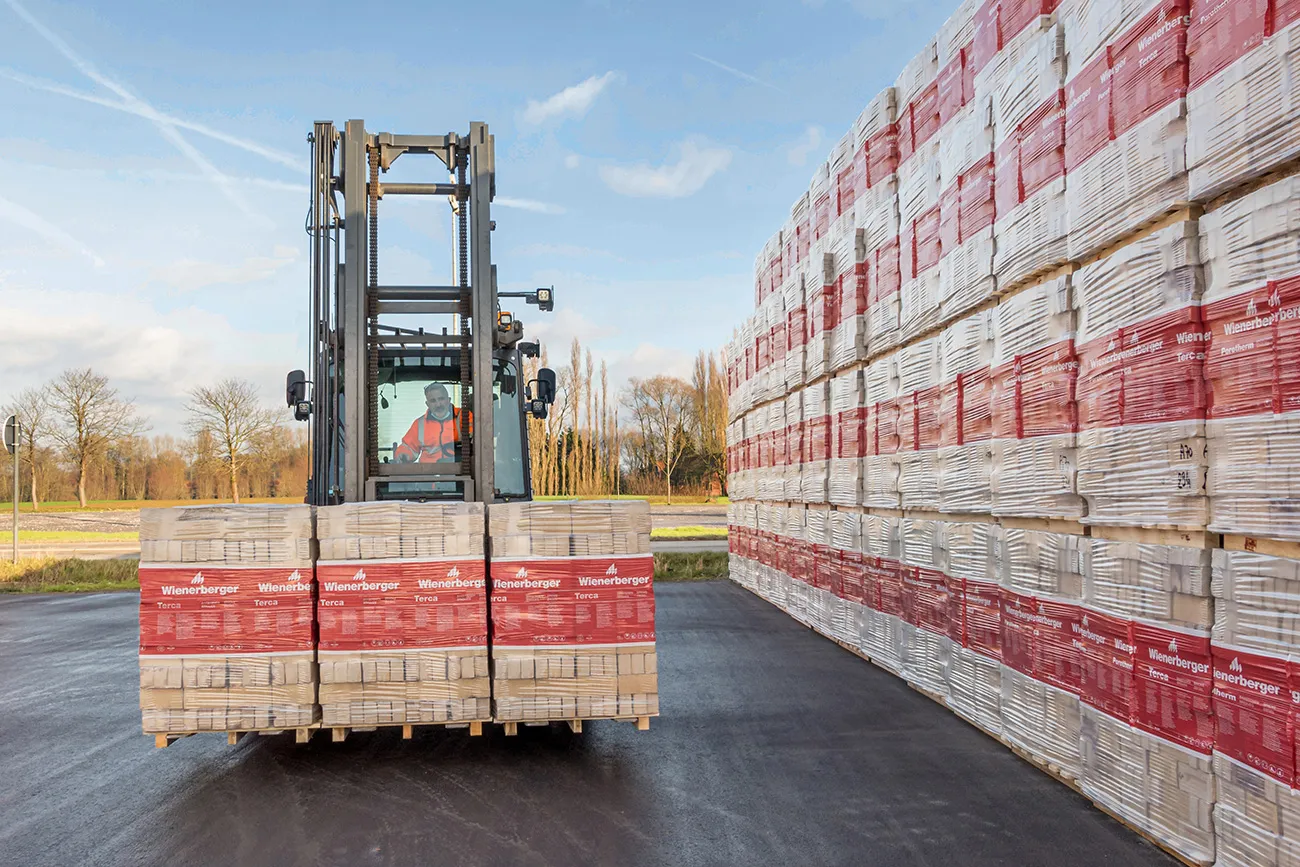
“Absolutely! We have also made our packaging as circular as possible. First, we are replacing our printed shrink-wrap packaging, which is already made from 30% recycled plastics, with an unprinted stretch hood. It is completely transparent and, like the existing covers, is made from 30% plastic waste. The unprinted hood can be fully recycled into new transparent film, making it completely circular. Another advantage is that the stretch hood uses up to 30% less material, as it is stretched before being fitted around the products. Safety information and branding are added to the packaging on a thin band wrapped around the stretch hood. Ink is used only on this very thin film. It accounts for less than 5% of the total packaging weight and is fully recyclable. Wienerberger has also developed a circular solution for pallets. Our roof tiles are already delivered on returnable pallets, and we are currently rolling this out for our masonry blocks, with façade bricks to follow in the next phase.”
When developing new products, Wienerberger uses the building layers model. Could you explain what that means?
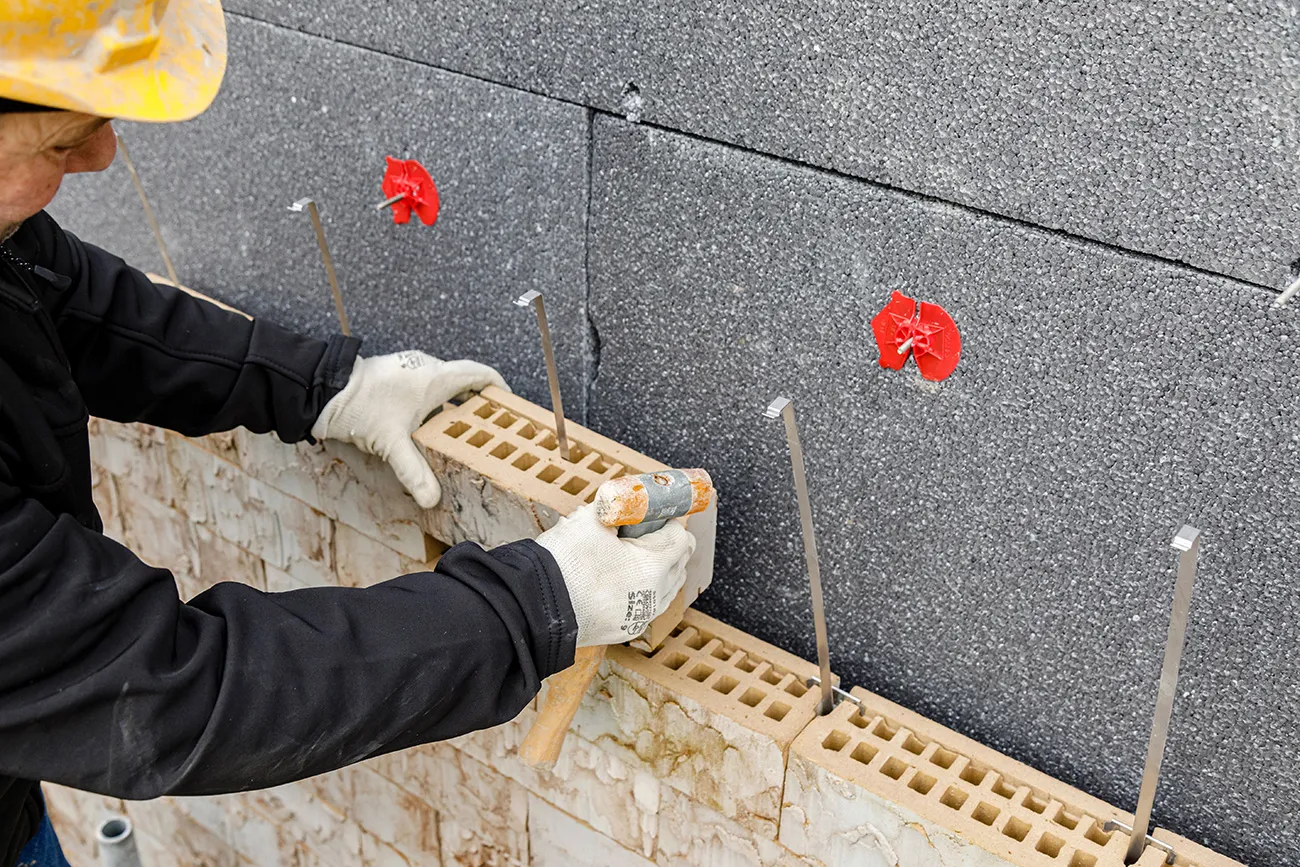
“The building layers model divides building elements into different layers according to their functions, with each layer having a different service life. The expected lifespan of the load-bearing structure may differ from that of the building envelope, which affects the potential for reuse later on. Separating the load-bearing structure from the building envelope increases the potential for recovery and recycling. And since the envelope is renewed more frequently than the load-bearing structure, it makes sense to focus circular solutions there, such as the stackable façade brick ClickBrick, masonry using lime mortar, or roof tile cladding. Even when building elements cannot be retained or reused, recycling can still provide circular solutions. For example, we are working with Tracimat to find ways of collecting recovered ceramic products separately and keeping them uncontaminated. This increases the likelihood of repurposing them as high-quality raw materials for producing new ceramic materials, and avoids downcycling them into mixed rubble. We are already able to use roof tiles that cannot be reused in the production of new masonry blocks. There are many more opportunities to explore in urban mining to increase the circular potential of ceramic products.”
Wienerberger aims to be fully CO2-neutral by 2050. How do you plan to achieve that?
“By systematically switching to CO2-neutral production processes. Our new production line in Kortemark is a first for the industry. The site uses brand-new electric production technologies for both the kiln and the dryer. This means no fossil fuels are used at all. 25% of the electricity for the production process comes from an on-site PV installation, with the rest supplied by 100% green energy. The kiln uses radiant heat, and its waste heat is recovered in the dryer. We are also working hard to decarbonise our other sites. We are building two wind turbines at our site in Beerse, together capable of generating 17 million kWh a year and saving 7,700 tonnes of CO2. And all our production sites already generate some of their electricity using extensive PV installations.”
The new production line in Kortemark is also said to be highly innovative in other respects. How so?
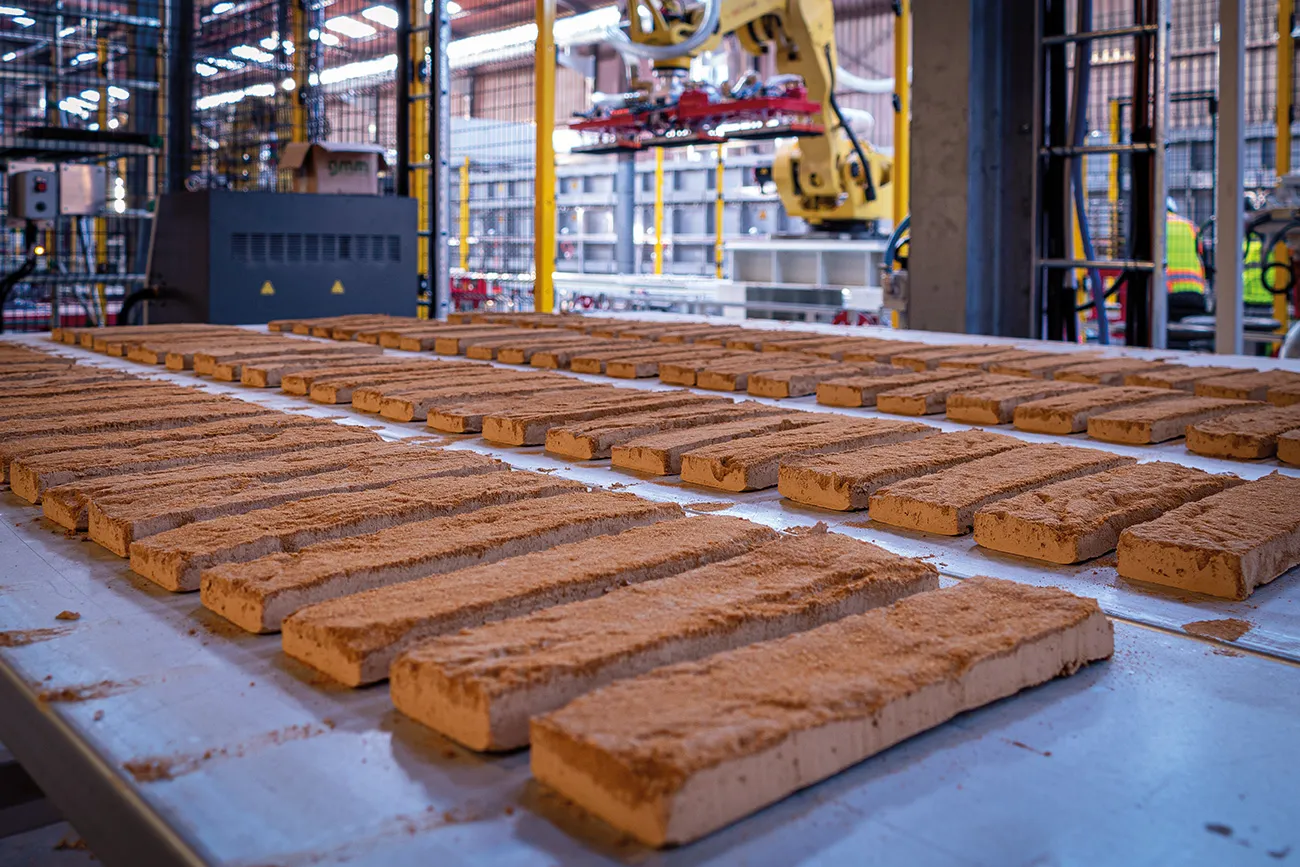
“It produces brick slips directly, at around 2 centimetres thick, which avoids creating waste. The shaping technique is also unique, resulting in hand-moulded brick slips that are exceptionally accurate in size and stable in shape. This reduces variations in thickness, length, width and curvature, making our products ideal for the precast industry too. A third innovation on the new production line is digital engobing, an innovative colouring technique being used in our country for the first time. This not only does away with the drawbacks of the traditional approach, such as set-up losses and limited flexibility, but also opens up new creative possibilities.”
How exactly does ‘digital engobing’ work?
“It is similar to a digital printer, which applies the desired colour at pixel level in an ultra-thin layer of clay on the dried brick slip before firing. The possibilities offered by this printing process are virtually unlimited. It is a major step forward, because a new colour normally requires changes to the clay composition and production process, which is obviously much more labour-intensive. The brick slips from the CO2-neutral factory also come in eco-friendly packaging. The slips are no longer packed in EPS boxes, but grouped into packs of twenty using just two minimal straps, stacked on a returnable pallet and protected with a circular cover.”
Alongside decarbonisation, dematerialisation is another key focus in reducing CO2 emissions. What steps have you taken in this area so far?
“Our interlocking roof tiles are 10 to 12% lighter than they used to be, but just as strong. We also now make our masonry blocks using less material. Their density is 850 kg/m³, which means they weigh up to 150 kilograms less than a standard ceramic building block and less than half as much as alternative materials. In the façade brick segment, there is the Eco-brick, which is up to 3.5 centimetres thinner than a traditional façade brick. And we now also have 2 cm-thick, CO2-neutral brick slips. In short, Wienerberger is making sustainability a top priority, and will continue to do so!”
Een zakelijke vraag aan Wienerberger nv? Get in touch
Companies in this story
Keep following this
Get an email when a new story is published. No account needed.
- SubjectGeneral
- CompanyWienerberger nv







