











Will 3D concrete printing become the new norm?
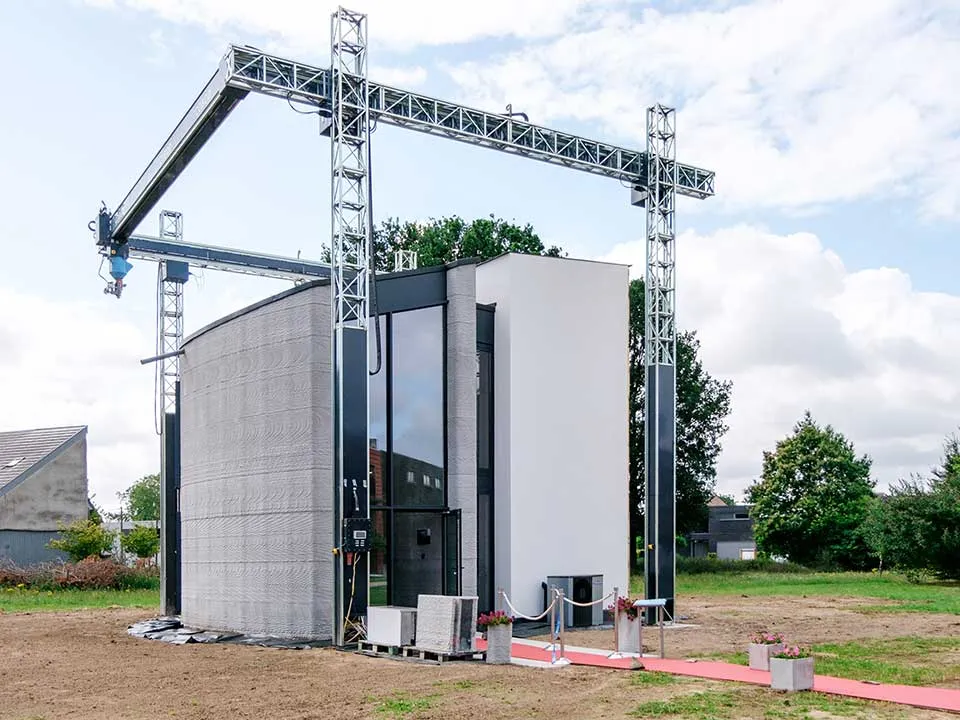
It may have been somewhat overshadowed in a year dominated by the coronavirus crisis and all its associated upheaval, but 2020 also saw a Belgian world first.
At the Kamp C site in Westerlo, a fixed 3D concrete printer built a two-storey, 90 m² home in a single operation. Was this merely a bit of construction-industry showmanship, or a major milestone that will radically change the future of the sector? We asked project manager Marijke Aerts.
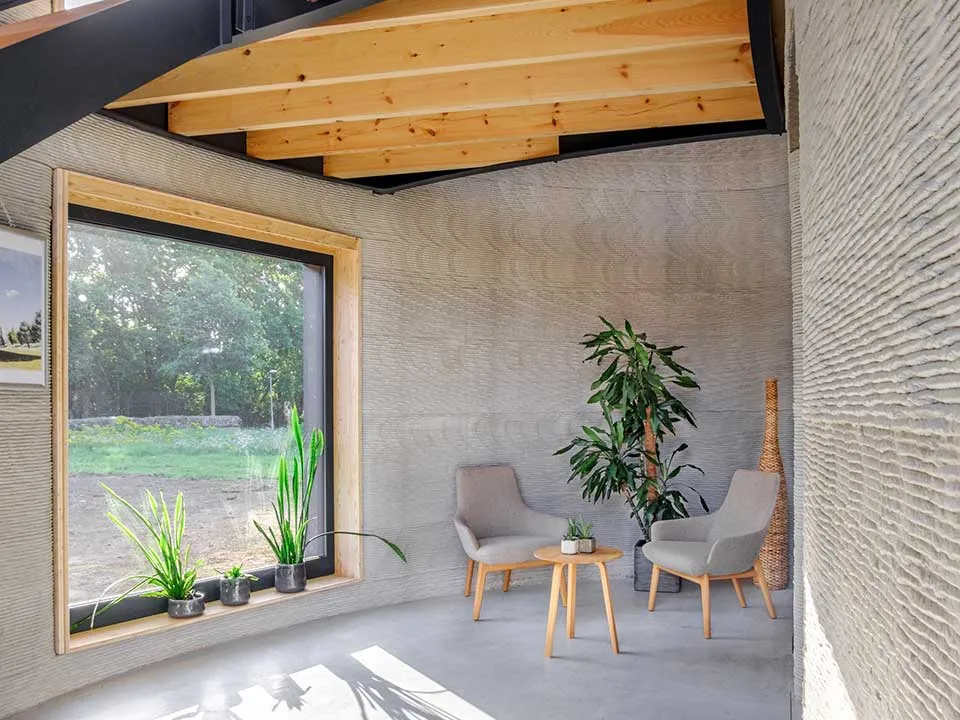
Marijke Aerts: “The 3D-printed demonstration home on our site was built as part of the C3PO project. Kamp C’s aim is to accelerate the transition in construction and demonstrate the added value of innovative technologies. To facilitate the breakthrough of 3D concrete printing, we launched the C3PO project in 2017, with support from the Flemish Government and the European Regional Development Fund. At the request of the project partners, who came from both the construction industry and the scientific community, this resulted in the creation of an impressive showcase project designed to challenge our conservative construction sector. We have certainly succeeded: six months after the home was completed, I’m still answering emails and calls every day from interested parties at home and abroad. It has certainly made an impact, so mission accomplished!
How exactly did the printing of the demonstration home work?
“First, we conducted extensive market research to identify the right type of printer, which even took us as far as China. In the end, we chose a fixed four-column system (gantry system), within which the print head can move freely. We then spent another year researching the printer’s capabilities, the consistency of the concrete and so on. Next, the architectural drawings by Trias architecten were converted into a BIM model and uploaded to the 3D concrete printer using special software. The printer then got to work on its own and completed the entire building envelope in one go.”
And that was your work done?
“No, of course we had to make sure everything was right. For example, the consistency of the concrete was matched to the printer’s operating speed. We used specially developed printing mortar, in collaboration with Saint-Gobain Weber Beamix, which opened the first concrete printing plant in Europe in Eindhoven in 2019. The mortar, made with a specific cement mix for printing applications, had to be sufficiently, but not excessively, hardened by the time the printer laid the next layer. Weather conditions also played a significant role, of course. It took three weeks to complete our demonstration home, but in future it should be possible to print a home like this in just a few days.”
The concrete was printed in layers, clearly visible inside the home. Is it also possible to print smooth fair-faced concrete?
“Absolutely! As part of our project, we deliberately chose to make the layered structure as visible as possible, so visitors could see at a glance how the printing process worked. But rest assured, you can also achieve a much cleaner look and feel. Some print heads, for example, automatically smooth the concrete layers to create smooth walls. 3D concrete printing certainly offers a wealth of aesthetic possibilities, as it can readily be used to create architectural features such as cantilevers, curved walls and all kinds of textures, as we also demonstrated in building our demonstration home. What’s more, this innovative printing technique lets you create forms that would be much harder, or even impossible, to achieve using conventional construction methods. Circular structures, curves, undulating walls … the potential is enormous.”
Does printing in layers affect the thermal conductivity and strength of the concrete walls?
“No, because the layers are not simply ‘laid on top of one another’, they are also compressed slightly as they are laid, creating a homogeneous whole. The compressive strength of the concrete is three times that of a conventional concrete block. And because the home was printed as a single piece, there are no additional thermal bridges, which can be an issue with assembled printed homes.”
With the benefit of hindsight, is there anything you would have done differently?
“One important lesson we learned is that it is crucial to make the BIM model, and even the architect’s drawings, ‘printable’. We found that 3D printing requires a specific approach that differs quite considerably from the way a conventional construction project is handled. Translating the designs took the students from Thomas More University of Applied Sciences, who were also closely involved in the project, a great deal of time and effort, especially as they had to make all the changes manually. In our view, that process still needs to be optimised to improve the productivity and efficiency of 3D concrete printing. There is also certainly room for improvement in the software.”
The construction of your demonstration home was a world first and attracted a great deal of attention. In ten years’ time, will we look back and conclude that this project changed construction for good?
“If you want to ‘launch’ innovative techniques, you always need iconic showcase projects that can act as a kind of ‘shop window’. By building our demonstration home, we certainly succeeded in highlighting the many possibilities and the enormous potential of 3D concrete printing. But does that mean we’ll soon be printing houses on a mass scale in Belgium? No, I don’t think so. It will take time before 3D concrete printing becomes more cost-effective and ‘optimal’ than other construction techniques, but I am convinced that our project can help get things moving. We have since developed a follow-up programme (KIEM) to encourage actual market introduction, identify the remaining barriers and use concrete case studies to show existing businesses and start-ups how interesting the printing technique could be. One such case involves printing circular foundation bases for large storage tanks. 3D concrete printing is already an interesting option for applications like these, because formwork for circular concrete structures is relatively expensive and labour-intensive. The printing technique eliminates the need for formwork, which could save an estimated 60 % in materials, time and money.”
Are there already other concrete printing projects in the pipeline?
“Absolutely. News of our demonstration home has been picked up around the world and has undoubtedly inspired many people and businesses. I recently saw a video of an American company printing horse stables, for example. In Germany, an apartment building with three storeys was recently built using a larger version of our printer. And there is activity here at home too: Van Roey has applied the expertise it gained through the C3PO project to create a white-water flume at a new swimming complex. I wouldn’t claim that printed homes will be commonplace in ten years, but I do think that by then 3D concrete printing will be regularly used for certain applications. We would certainly be enormously proud if our demonstration home proved to have set the ball rolling for good.”
Vraag over dit verhaal? Stel je vraag
Blijf dit volgen
Bij een nieuw verhaal krijg je een e-mail. Geen account nodig.
- OnderwerpGeneral







