Bouwen aan Vlaanderen is part of Louwers Mediagroep: 45+ trade platforms in the Netherlands, Flanders and Wallonia. Trade magazines, websites, newsletters, video and podcasts, since 1987.
World first: Kamp C is the first to 3D-print an entire house in one piece
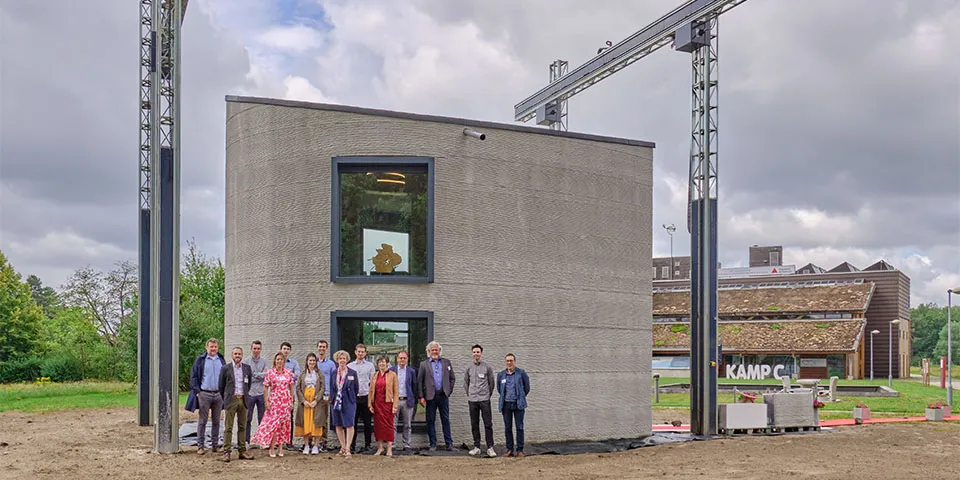
At Kamp C, the provincial Centre for Sustainability and Innovation in Construction in Westerlo, a house was printed using Europe’s largest 3D concrete printer. The 90-square-metre home was printed in one piece using a stationary printer. This is a world first.
Flanders’ first 3D-printed demonstration home is now complete. It is located on the Kamp C site in Westerlo. The house has two storeys, measures 90 square metres and stands eight metres tall. It is the size of an average terraced house in the Kempen region.
“What makes this unique is that we printed the house as a single structure using a stationary 3D concrete printer,” says Emiel Ascione, project manager at Kamp C. “The homes printed around the world so far have only had one storey and have often been printed in sections in a factory and assembled on site. We printed the entire building envelope as one piece on site.”
The house was printed as part of the European C3PO project, with support from the ERDF (European Regional Development Fund). The project partners hope this achievement will encourage the construction sector to incorporate 3D concrete printing into its building methods.
Kathleen Helsen, Deputy for Housing and Chair of Kamp C “There is already considerable interest from the construction industry. 3D printing in construction is rapidly gaining ground all over the world. A wide range of applications, from printing temporary accommodation to entire apartment buildings, are already being put into practice, but this is new to Flanders. Yet the construction sector faces extraordinary challenges: we need to reduce material and energy consumption, cut CO2 emissions and minimise waste, while demand for high-quality, affordable homes continues to grow, and so on. At Kamp C, we believe new technologies such as 3D concrete printing can help address these challenges. That is why we have created this unique facility on our site, where construction companies can experiment with 3D printing alongside research and educational institutions.”
De video laadt pas als je op afspelen klikt.
Three times stronger
The printed house is three times stronger than a home built with clay blocks. “The material’s compressive strength is three times higher than that of a conventional clay block,” explains Marijke Aerts, project manager at Kamp C. This first house is a test building, and research will establish whether its strength is maintained over time.
Aside from the fibres in the concrete, only minimal shrinkage reinforcement was used. The printing technique eliminates the need for concrete formwork. This is estimated to save 60 per cent on materials, time and money. In future, a house could be printed in two days. Adding up all the printing days, the house at Kamp C was printed in just under three weeks.
Demonstration home
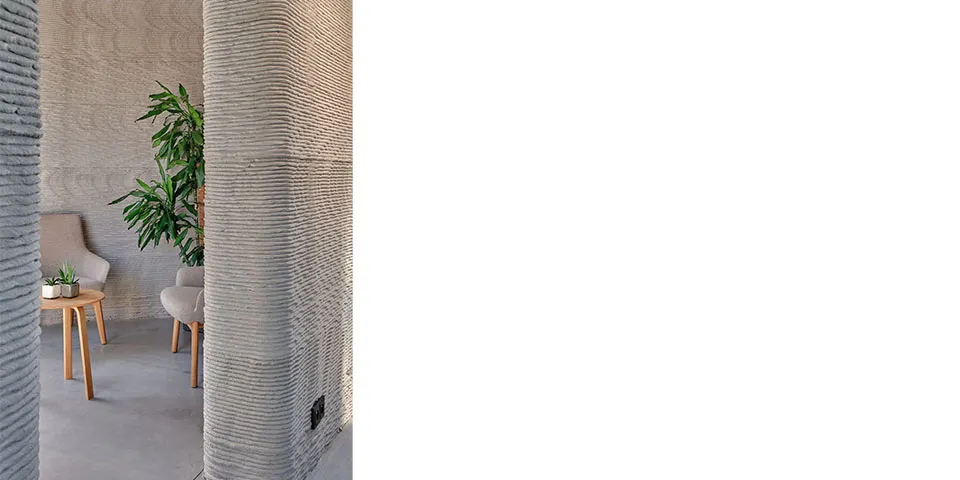
The home is a demonstration building designed to showcase as many of the techniques and possibilities of 3D printing as possible. “It features a printed cantilever, highly curved walls and several different wall types. Solutions were also incorporated for the conventional building junctions to make them entirely free of thermal bridges,” explains Ascione. “The house is being developed into a low-energy home equipped with all mod cons: it has underfloor and ceiling heating, special façade-integrated solar panels and a heat pump, and a green roof is planned.”
“When we started construction, we did not know what function the building would serve. The aim was to print a building with the floor area, height and shape of an average modern home, but as a demonstration building with a range of possible uses. This is a principle of circular construction. It can serve as a home, meeting room, office or exhibition space. The building can be visited by appointment from September,” says Piet Wielemans, architect at Kamp C.
Project
The house is part of the European C3PO project, which aims to accelerate the adoption of this innovative technique in Flanders. Eight partners from the worlds of science and business are joining forces: Beneens, ETIB/CONCRETE HOUSE, Groep Van Roey, Thomas More, Trias architecten, Ugent and Vicré. Saint-Gobain Weber is also contributing to the project.
This article is part of the C3PO project. Through the ERDF-funded C3PO project (‘Co-creation: 3D Printing with Enterprises’), the partners received €668,320 in support from Europe. The project is part of the Kempen Integrated Territorial Investment (ITI). ITI stands for Integrated Territorial Investment, an integrated strategy for a specific area that brings together different European funds and programmes.
Find the right company in the sectorSearch by product, field, region or project in the company directory and across all Bouwen aan Vlaanderen articles.
We use cookies to keep the site working properly. With your consent, we also use cookies for statistics and third-party banners. Read more in our privacy and cookie statement.