Pollution on carved frieze now a thing of the past
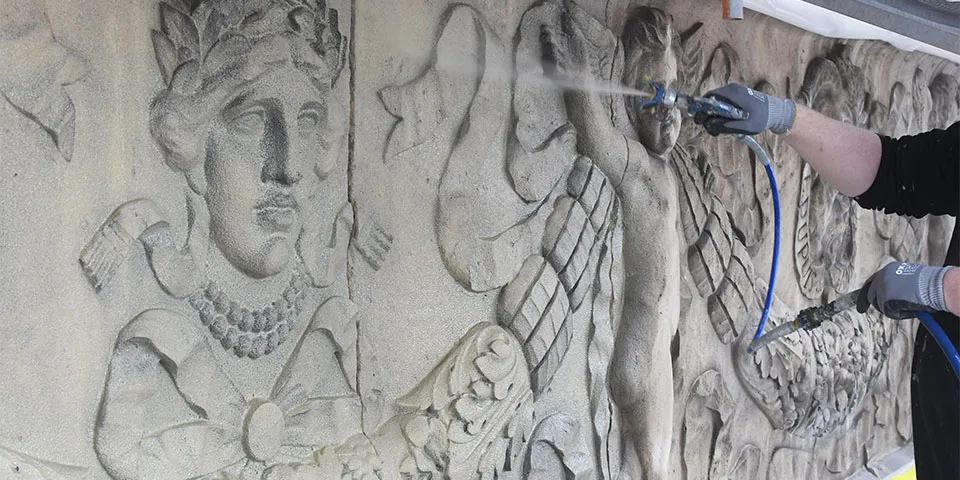
The use of leaded petrol was phased out in Europe at the end of the last century, but many buildings still bear the effects of decades of exposure to polluting particles. Remmers developed Clean Galena, a safe, effective and easy-to-use method for removing this and other forms of pollution. The restoration of the Royal Museum of Fine Arts gave the company the opportunity to use the product on a large scale in Belgium.
“We developed Clean Galena at the request of the French market,” says managing director Filip Moens. “France has many historic limestone buildings. More than elsewhere, they suffered from vehicle emissions in the heavy traffic of Paris.” The first French buildings to call on Remmers for help were no minor projects: the Louvre, the Hôtel de Rohan and the Musée Carnavalet. “The entire side of the Louvre along the Seine has already been treated with Clean Galena,” says Moens.
The Hôtel de Rohan, in the well-known Marais district, houses the French National Archives. Following the current restoration, it will open its doors to the public in 2021. The Carnavalet is also undergoing extensive restoration. In principle, this charming museum about the history of the city of Paris, which is unfortunately less well known outside France, will reopen later this year.
Also for iron and copper
The name Galena comes from the Greek word galena. It is not only a lead mineral, it also means ‘soft’. “Clean Galena is not only ideally suited to removing lead from limestone, it can also tackle other forms of metal pollution, such as stains caused by iron or copper. Other types of natural stone are also suitable. So London’s Big Ben will soon chime from the thoroughly cleaned clock tower of the British Houses of Parliament, on the banks of the Thames in Westminster.”
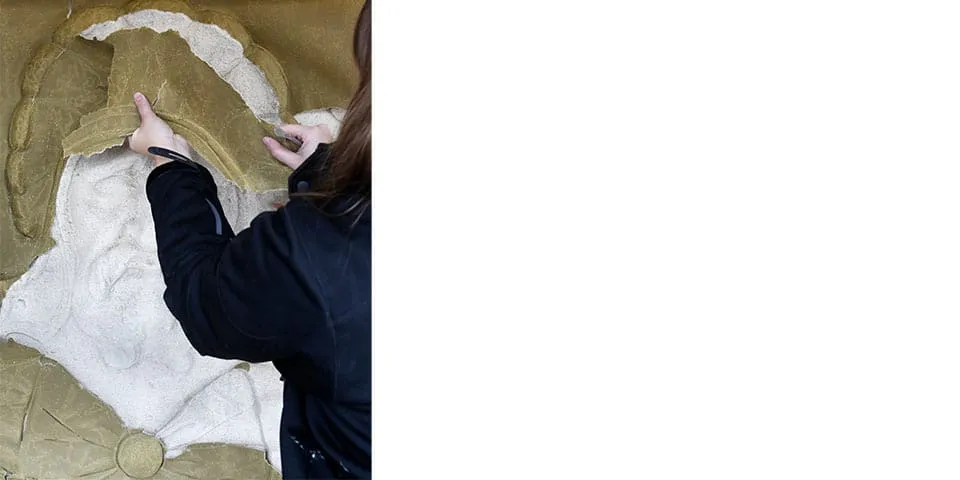
The poultice that has absorbed the pollution is very easy to remove.
Paste
Clean Galena is a clay-based paste. “You can apply it by hand with a spatula or, on larger surfaces, using conventional paint-spraying equipment. It then forms a kind of poultice on the stone.
It is important to wet the areas to be treated beforehand. This prevents the material from penetrating too deeply into the pores of the stone. In any case, you use far less water and energy than with
methods such as sandblasting.”
Application
The cleaning product is applied in a 2 mm-thick layer. “On a flat wall, this means using just 2.5 to 3 kg per square metre.” In Antwerp, Clean Galena was used not to clean a flat wall, but the carved frieze on the museum’s north façade. “Once the paste had been applied, it only needed to dry for two or three days. By then, it had drawn the dirt out of the stone and absorbed it
itself, and had started to crack. The staff of main contractor Artes could then simply peel it off and dispose of the dried poultice with the construction waste. The pollution had disappeared completely, while the patina of the natural stone was preserved. Our motto is therefore ‘as gentle as possible, as intensive as necessary’.
Familiar territory
Historic Antwerp is very familiar territory for Remmers, too. “For most projects, we first carry out trials to determine which of our products is best suited. This was the case at the cathedral and, more recently, at the Handelsbeurs.”
Question about this story? Ask your question
Keep following this
Get an email when a new story is published. No account needed.
- SubjectMonuments