Acoustics squared with innovative window, door and façade solutions
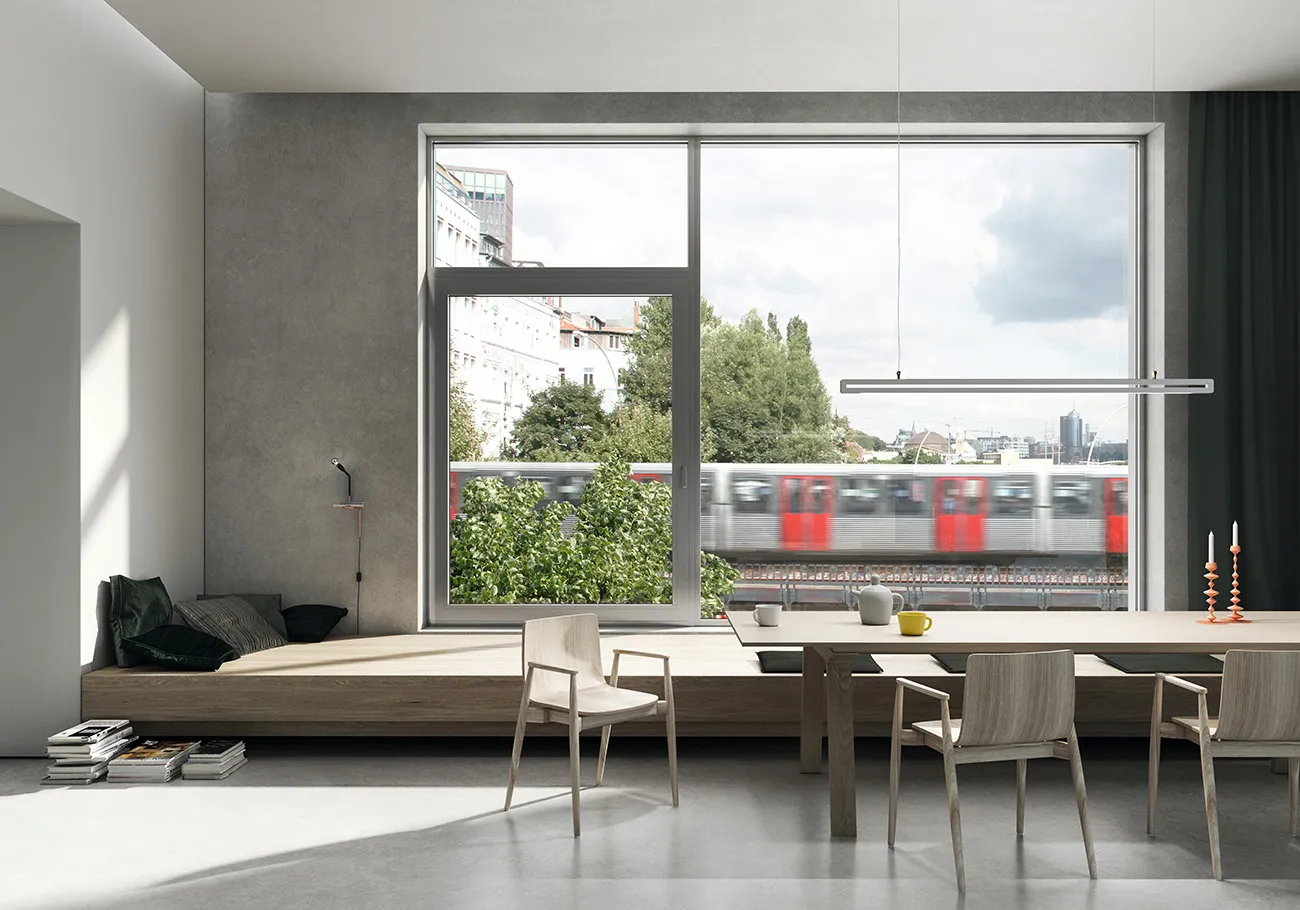
In recent years, numerous scientists have reached the same clear conclusion: poor acoustics make people ill. That is why, when it comes to external joinery, the focus is no longer solely on energy efficiency and U-values, but also on noise reduction. As a specialist in aluminium systems for windows, doors and (curtain) walls, Schüco has developed innovative applications that not only optimise building acoustics, but also reduce noise levels in urban environments. These include special windows that let you ventilate without letting in noise, and even a user-friendly calculation tool that enables realistic simulation of the intended noise reduction.
Stress, difficulty concentrating, poor sleep … the adverse effects of poor acoustics are numerous. This is why the World Health Organization has drawn up guidelines to reduce noise levels in cities and improve overall liveability. “We are keen to take our social responsibility seriously when it comes to creating an attractive built environment. That is why we have developed specific solutions to help optimise acoustics in and around buildings,” says Joep Römgens, Head of Engineering BeLux at Schüco.

Balancing acoustics and ventilation
The first priority is to keep noise out. Schüco therefore aims to make its windows, doors and (curtain) walls as soundproof as possible. “This involves the exciting challenge of finding the ideal balance between acoustics and ventilation, another crucial consideration when it comes to the comfort and health of building users,” explains Joep Römgens. “For example, we have developed acoustic windows that retain their sound-insulating properties when tilted open. They are fitted with an additional profile containing sound-insulating cassettes. This ensures that all incoming fresh air passes through an acoustic buffer, while the acoustic seal remains closed.”
“We offer both a single-shell system (AWS 90 AC SI, providing sound insulation of 30 to 32 dB) and a double-shell system with a greater ventilation volume (AWS 120 AC SI, providing sound insulation of 30 to 39 dB). Another example is our ‘Kastenfenster’, where two independently operable windows are installed one behind the other in a box, with an air space between them that provides thermal and acoustic insulation. Finally, we offer project-specific solutions such as loggias, where closable balconies act as acoustic buffers, and we can also provide fully bespoke solutions if required.”
Working with designers
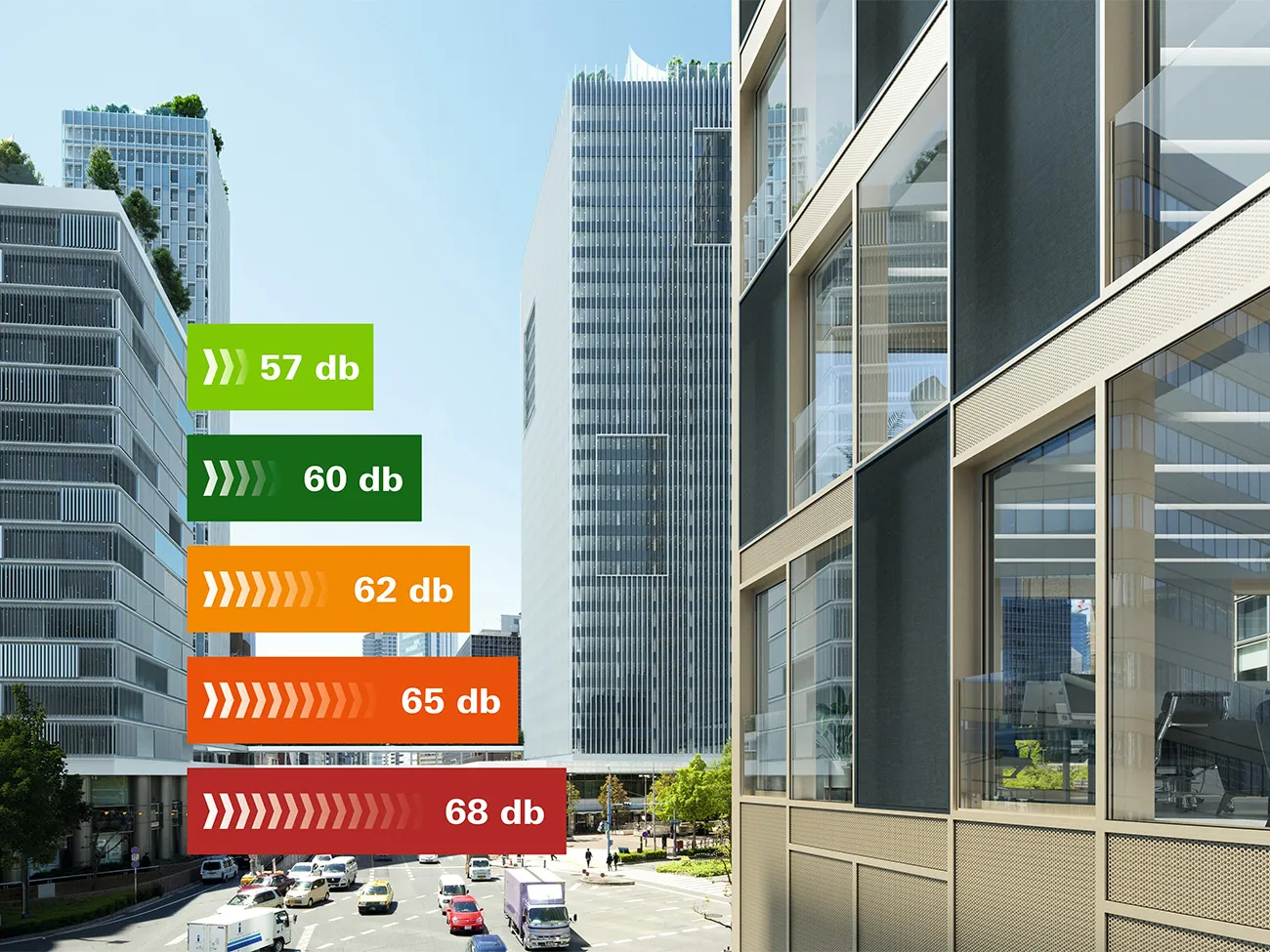
However, Schüco is much more than a supplier of high-quality window, door and façade systems. It is also keen to work with designers to reduce noise levels in the built environment. “This can be achieved by shaping façades in a particular way, using sound-absorbing materials, or incorporating relief or perforations in strategic locations,” explains Joep Römgens. “For example, our product range includes the Schüco AF UDC 80 Green Façade, an attractive green façade that also dampens sound. There is also the FACID 65 system, which stretches perforated fabric over a sound-absorbing backing. Sound-absorbing louvres and micro-perforated profiles are also among the options.” Joep Römgens stresses that Schüco specialists should be involved as early as possible, especially when integrated project solutions are required. “Only then can we work together to find the best solution. Rather than using expensive special profiles or glazing, it may be far more effective to reduce the noise load on the outside with a suitable façade solution. That way, you get two benefits in one: a better living environment with less noise pollution, and better acoustics inside the building.”
Calculation tool and acoustic test centre
The offering is not limited to product and project solutions. Schüco has also launched an online calculation tool, Schüco SoundCal, which lets you configure a specific window yourself. “The noise reduction you achieve depends on the profile and glazing you select. You can listen to a simulation using an audio clip of the ambient noise, first with the window open and then closed. This lets you anticipate the real-life situation and avoid disruptive acoustic problems,” explains Joep Römgens.
Finally, Schüco has an acoustic test area at its technology centre in Bielefeld, Germany. “In this real-time
setup, you can test up to four rooms for sound transmission between them and flanking sound through the façade,” says Römgens. “As the importance of good acoustics continues to grow, we will be investing much more in this area over the next two years. We will double our testing capacity for sound-insulating elements, even though we already have one of the largest acoustic test centres in Europe!”
Question about this story? Ask your question
Keep following this
Get an email when a new story is published. No account needed.
- SubjectAcoustics