Round table: “Fire safety is no longer treated as a poor relation”
Text Tim JanssensImage Dieter Meyns
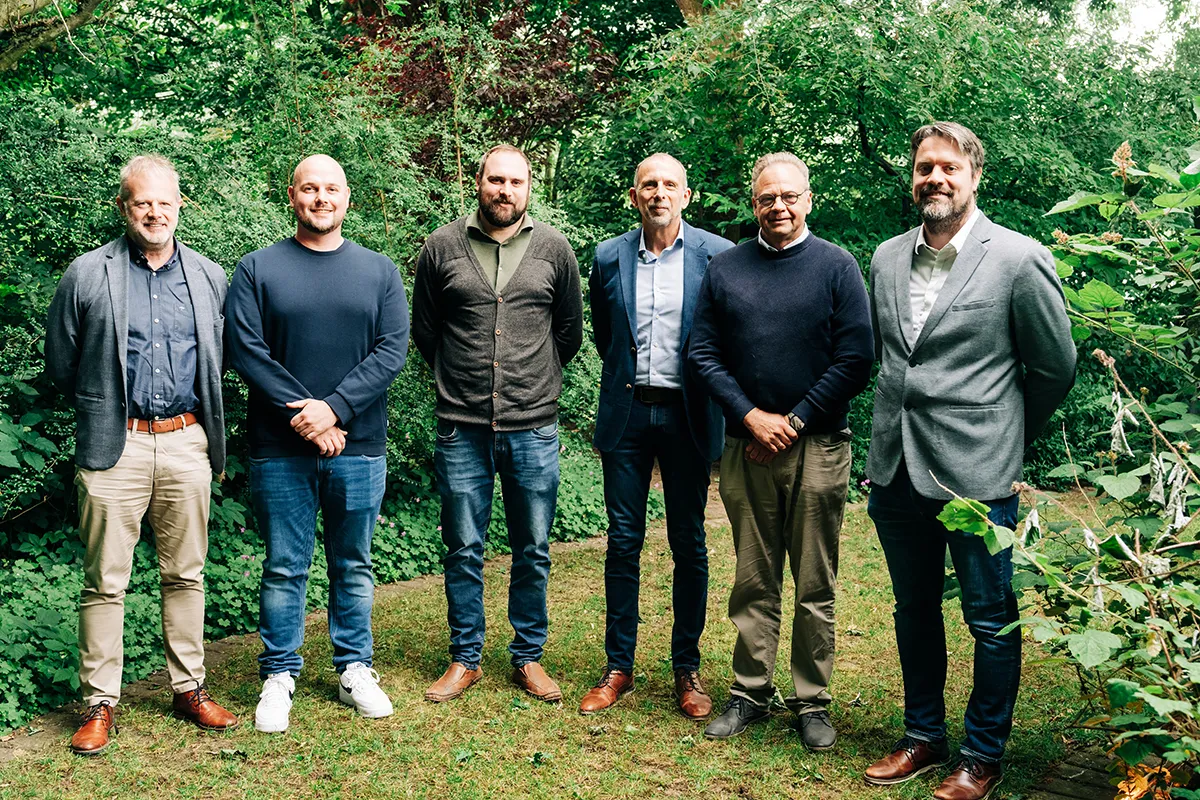
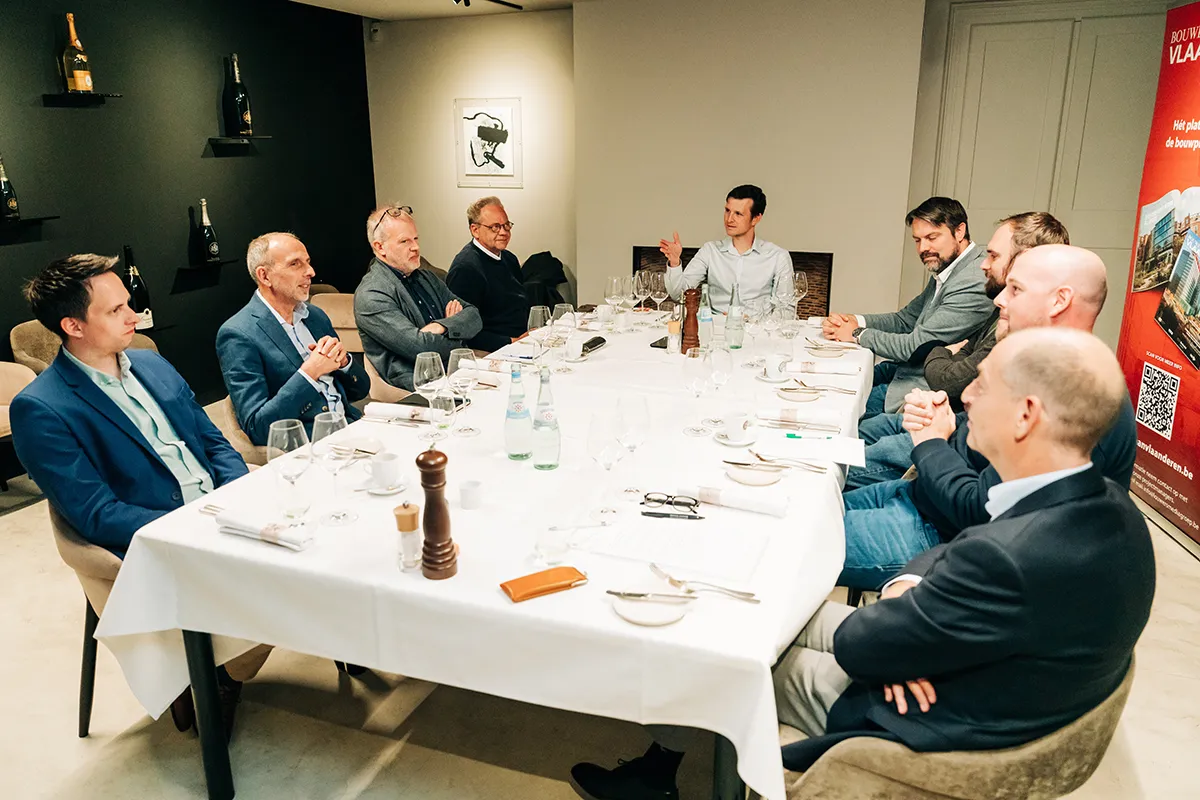
Few areas of expertise in construction are as complex, and for some even downright impenetrable, as fire safety. Are we talking about fire resistance or reaction to fire? Do Belgian or European standards apply? What test procedures must manufacturers put their fire-resistant building products or systems through, and do these provide an adequate guarantee at all? In many cases, arriving at the right answer is a job for specialists. Bouwen aan Vlaanderen therefore invited six experts in the field, renowned for their passionate commitment to fire safety. They dissected some of the hot topics in their area of expertise and brought order to the confusion, with a crackling fire in the background.
Participants
• Kurt Van Den Bergh, Technical Manager Belux at Reynaers Aluminium
• Koen Van Gasse, Senior Product Manager at Soudal and Vice-President of PFPA
• Steven Paulussen, Managing Director at Houthandel Paulussen
• Danny Jonckheere, Managing Director at Fire! doors & projects
• Louis Cortvriendt, R&D Manager at De Coene Products
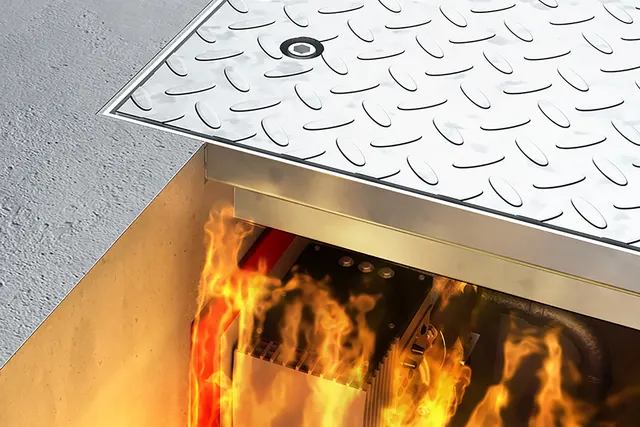
• Rony Verbuyst, Project Engineer at ACO Belgium
Good morning, gentlemen. Let’s start with a look at the current situation. Where do we stand on fire safety today? Has there been much progress in recent years?
Kurt Van Den Bergh: “My experience is that not much has changed in terms of fire resistance, but the requirements for reaction-to-fire classes have become stricter, particularly for façades. This is undoubtedly linked to several serious incidents in the recent past. There have also been a number of initiatives to make it easier for construction professionals to comply with the regulations. Take Buildwise’s Technical Information Sheets, for example. There was nothing like that five years ago, so it’s a positive development.”
Koen Van Gasse: “Overall, standards have indeed improved, but we still regularly come across tradespeople who say, ‘I’ve been doing things the same way for thirty years, and no one’s ever told me it had to be done differently.’ In a sense, they need protecting from themselves, because their lack of knowledge could lead them to do the wrong thing. Everyone is expected to know the law, but when it comes to fire safety, there’s certainly still work to be done.”
Danny Jonckheere: “It’s certainly not a straightforward subject, as standards continue to evolve in line with changing building use. Take the Royal Decree on car parks that is in the pipeline, for example, prompted by the rise of electric vehicles and the associated charging infrastructure.”
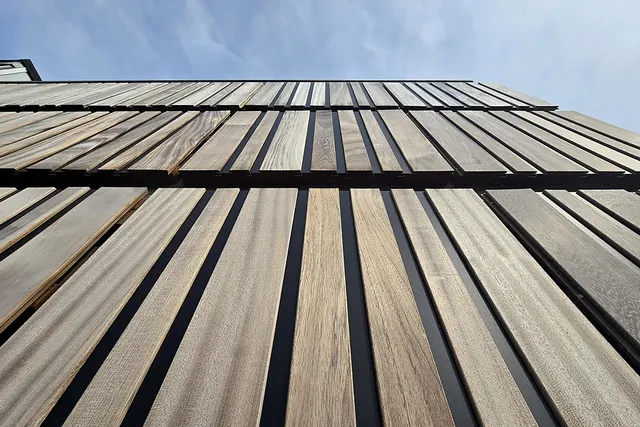
Steven Paulussen: “In my own niche, timber façades, I’ve seen a positive development. In the past, products were classified for their fire class on a product basis, whereas now their end use is taken into account. This means that even highly combustible bio-based insulation can now be safely incorporated into buildings. Recently, butt joints have also been tested as part of EN 13823 (the SBI test), to assess how façade connections perform. Standards are adapting, and manufacturers are required to know their products well. That’s an excellent thing, too, because I’ve noticed that manufacturers and construction companies no longer see fire safety as a necessary evil. In fact, they use it as a USP to set themselves apart.”
Louis Cortvriendt: “In 2022, we moved over to the EI1 regulations for fire doors. It took a lot of time and effort to bring all our certificates into line, partly because of the new testing process, but we’re now fully up to speed. Even so, our customers still install ‘Belgian doors’ on projects that do not require a building permit. Naturally, it takes time for such a major change to take hold in practice. It’s only in the past year that the balance has tipped in favour of EI1 doors.”
Rony Verbuyst: “When we introduced fire collars in floor drains in 2012, with German certification, ISIB told us we couldn’t. We then had them tested by ISIB as well so we could launch them on the Belgian market, although at the time they were still referring to legislation from 1968. Fortunately, that’s now a thing of the past, and we’re much more up to date. REI ratings are also being used, so a lot has changed for the better. But of course, there’s always room for improvement.”

As mentioned, there have been several major fires in recent years, both in Belgium and abroad (London, Valencia, Copenhagen …), which have received extensive media coverage. What impact have they had?
Koen Van Gasse: “Unfortunately, something serious always has to happen first, usually with many casualties or the loss of valuable assets, before action is taken. The Grenfell Tower inferno in the UK, for example, brought about a seismic shift. Fifteen years ago, the UK was the cowboy of fire safety, but since then, people there have started thinking about it very differently. Valencia was another tragic wake-up call. Tighter scrutiny of fire safety is a good thing in itself, but it has to remain workable. Affordability is an increasingly pressing issue, and testing everything down to the last detail to eliminate every potential risk makes the costs astronomical. We need to distinguish between what makes sense and what doesn’t, and guard against over-regulation.”
Kurt Van Den Bergh: “The pendulum does sometimes swing a little too far. It’s becoming increasingly difficult to find the experts needed to provide technical advice during project development. Fortunately, I do think other parties could eventually take on that role. Buildwise comes to mind first, as it already has the necessary expertise.”
Steven Paulussen: “Every building is a product of its time. If it complied with the regulations in force and the accepted test methods when it was completed, it’s obviously difficult to decommission it later because changing knowledge has raised doubts about its fire safety. I fear that fires are almost as inevitable as natural disasters, but we do have a duty to learn from them, in particular by taking mitigating measures based on risk analyses to reduce the potential human and material toll.”
Rony Verbuyst: “This is something that should be regulated much more at European level. Every country has different legislation, so we’re still a long way from getting it right.”
Despite the introduction of European legislation, do major differences between member states remain?
Koen Van Gasse: “Many countries are taking the lead in raising the overall standard, but imposing the same legislation everywhere remains a utopian dream for now. I also know from experience that drafting a new European standard is a painfully slow process. By the time it is finally published, a good ten years may have passed, and it is already out of step with reality, because new building materials and methods will inevitably have emerged in the meantime. In the past, you could turn to an independent knowledge institute such as ISIB for the grey areas that arose as a result. But since it ceased to operate, we have been forced to work by consensus, in other words, to seek the best possible solution together. That sounds fine until there’s disagreement or problems arise. Then the umbrellas go up faster than you can turn on the light.”
Danny Jonckheere: “The lack of a neutral sounding board to cover specific applications is indeed a major problem today. Quite apart from that, not all clients, architects and contractors are equally clear on the EI1 issue. We are the only country in Europe to take such a strict line. What’s more, we have a small market with a limited number of players, which means there are also relatively few fire tests and certificates available. So for specific or atypical applications, you’re often in the dark and have to seek a consensus. We make too little use of the experience and expertise available in neighbouring countries. France has a much wider range of fire tests and certificates, but products tested in accordance with French standards cannot be used in Belgium. And yet they know a thing or two about fire safety there as well …”
Louis Cortvriendt: “It works the other way round, too: we test to the highest European class here, but our certificates are of little use abroad. In some countries, products have to be tested locally before they are approved, which clearly runs counter to the idea of a unified European framework. We have a customer who installed EI1-30 doors in France some time ago. It later turned out that the EI1 doors installed did not comply, so they had to be removed and replaced with EI2 doors. That’s a real shame. I have no problem with carrying out additional tests if required, but those expensive basic tests should be recognised across Europe.”
Speaking of fire tests, how closely do theoretical conditions and results reflect what happens in practice? Is there sometimes a gap?
Steven Paulussen: “Unfortunately, yes. Fire-retardant treatments for timber façades are a good example. Some of them leach out completely within a few weeks. This can lead to situations where highly combustible ayous timber is theoretically upgraded from fire class F to fire class B using a leaching fire retardant, only for it to be back at fire class F in practice before the project has even been properly completed. This is due to a flaw in the test procedure, which will fortunately be corrected soon. EN 16755, the standard for the durability of fire-retardant treatments, is about to change. That will bring a lot of malpractice to light and cause quite a stir …”
Koen Van Gasse: “Testing is essential, but as I said earlier, a degree of common sense is also needed. You can start testing everything in every possible way to rule out every conceivable danger in theory, but in practice you risk missing the point, because every fire test costs a fortune and represents a huge investment for manufacturers. Sometimes good really is good enough.”
Kurt Van Den Bergh: “A clear, workable document such as TV 282 is a step forward in that respect. If you follow it, you can be sure you comply with the requirements without having to carry out a test. I see that as a positive development, because a fire test focuses on a specific situation, whereas in practice you’re always starting from a blank sheet. Designers regularly come up with something new, which means certain tests are no longer applicable.”
Steven Paulussen: “Tests are, by definition, snapshots in time. If you pass, you’re considered safe forever, even though that says nothing in itself about how a product will behave over time or under specific conditions, particularly in exterior applications. Unless the long-term perspective is properly factored in, no test has any value.”
How much impact do installation and workmanship have on fire safety? Do you ever come across anything that gives you cause for concern?
Danny Jonckheere: “Basic mistakes are still made on many building sites when foaming and packing gaps, allowing for clearances around doors, and so on. They often involve small details that aren’t immediately visible, but they are there all the same. And anyone who has carried out fire tests knows that the slightest weaknesses are where things go wrong.”
Steven Paulussen: “As a manufacturer, you strive for perfection, but how much of that remains when someone on site is working against the clock? It remains a tension that can compromise the quality of the work and, in turn, fire safety.”
Kurt Van Den Bergh: “Errors in airtightness and watertightness quickly come to light, but poor fire-safe construction is far less noticeable, or may not be noticed at all. Until something goes badly wrong later, of course … That is why we only work with certified installers for our fire-resistant solutions, and do our best to support them. They have to obtain an installation certificate, attend all the training courses we organise, appoint an internal manager … It is not a completely foolproof system, of course, but I am convinced it significantly reduces the margin for error.”
Louis Cortvriendt: “A small caveat to that: specifications increasingly state that a certified installer must be used, even though this is not required by Belgian law. In principle, a BENOR certificate and correct installation in accordance with that certificate are sufficient. This sometimes causes confusion for the fire brigade and can make it unnecessarily difficult to regularise buildings.”

Koen Van Gasse: “It also regularly happens that certified installers hire subcontractors to carry out the work for practical reasons or because they are short on time. So much for guaranteed workmanship, which in my view largely depends on supervision. The level of supervision in construction could certainly be increased. It is essential to prevent misconceptions and keep cowboys off our building sites.”
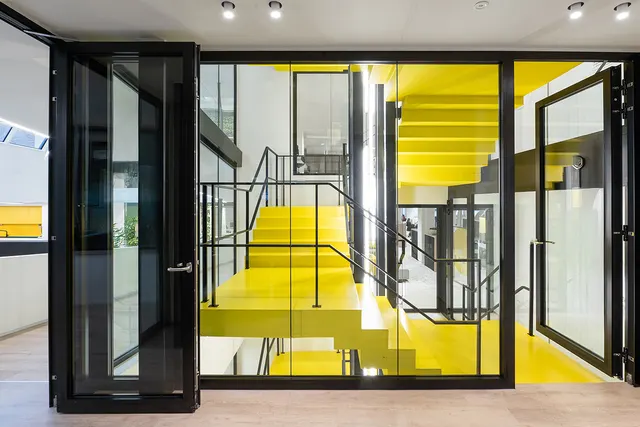
Danny Jonckheere: “We also find that supervision still falls short. Until a few years ago, fire-resistant glazing was installed exclusively by specialist firms, but now even companies that build conservatories and install balustrades are suddenly taking it on. The result is all manner of installation errors, despite these being very expensive products. We really need to put a stop to that.”
Kurt Van Den Bergh: “There is also little focus on maintenance and inspection. In many buildings, the original performance assumptions for fire-resistant products are no longer adequately upheld over time. You obviously can’t dismantle a building envelope to check whether it still meets the standard, but critical elements such as service penetrations and fire doors should be inspected regularly.”
Rony Verbuyst: “People come round every few years to check whether fire extinguishers are still working properly and need replacing. So why not check all the service penetrations and fire doors
at the same time?”
Koen Van Gasse: “Mandatory periodic inspections could indeed help solve some of the problem. They are already standard practice in the industrial sector, but are much less straightforward in apartment buildings, because who would carry them out and, above all, pay for them? The owner, the property manager, the residents …? Sometimes the question is not ‘whether’ but ‘who?’”
Steven Paulussen: “In that respect, I would put less faith in legislation, because by definition it comes too late. I would focus instead on insurance companies, which will inevitably do more on risk management in the near future. For example, anyone who still opts for a façade build-up with a leaching fire-retardant treatment may soon have to pay an additional premium or guarantee periodic retreatment to get their building insured.”
What changes would you like to see in the near future, or what step should we take urgently to ensure fire safety even more effectively?
Steven Paulussen: “To return to leaching fire-retardant treatments: in my view, EN 927-3 could become the standard test method for all exterior materials. In other words, expose them facing south at a 45° angle for a year to assess the long-term impact of UV radiation and precipitation. It is a free test that gives a much more accurate picture of what happens in reality than the other permitted test methods, yet nobody uses it. And yet it is officially ‘the benchmark method in any dispute’.”
Louis Cortvriendt: “We would like to see wider acceptance of European legislation, so that differences between Member States become the exception rather than the rule. That would avoid a great deal of red tape and additional work.”
Koen Van Gasse: “General awareness of fire safety has increased, but that has not always translated into knowledge. Training for construction professionals therefore remains an important area to address. Belgian architects have to study for five years, and fire safety accounts for a meagre hour of that, so there is plenty of room for improvement, especially given that they are jointly and severally liable for the fire safety of the buildings they design for ten years. The knowledge of carpenters, electricians, façade contractors and others could also be improved. In short, all
construction professionals should be properly equipped with the necessary knowledge, and that starts with what they learn in the classroom.”
Kurt Van Den Bergh: “That’s right. Architects are expected to be specialists in everything these days, but the safety of people must surely be one of the top priorities. More attention should also be paid to maintenance. What is built today is good, but what about after five, ten or twenty years? That question is not asked often enough at present.”
Danny Jonckheere: “There is a need for an independent sounding board to help us think through specific installations. The gap left by ISIB urgently needs to be filled. Buildwise has already been mentioned as an alternative, but perhaps another solution would be to follow the French model more closely, where a control body is also assigned the fire safety brief?”
Rony Verbuyst: “There is no proper legislation for hatches yet. When we carry out fire tests, they are based on walls, doors, cladding and so on, which of course are not 100% the same. That is something I would like to see change. Overall, though, we are pleased with the attention fire safety is receiving today, because it remains an essential parameter.”
So, to sum up, fire safety remains a work in progress, but a lot has also changed for the better?
Steven Paulussen: “Absolutely. Sometimes you risk sounding negative by listing everything that still needs attention, but it must also be said that we have made enormous progress. As in any other field, there are things from the past that would no longer be acceptable today. But when you see how much ambition there is, how much knowledge is being shared and how much advice is sought from the right people and organisations, you can only conclude that we are operating at a high level when it comes to fire safety.”
Koen Van Gasse: “Collaboration is a common thread in our sector. We are all focused on our own niches, of course, but only by pooling our expertise can we arrive at a building system that achieves the required classification. Everyone understands that: the whole picture has to add up.”
Kurt Van Den Bergh: “Manufacturers’ interests and concerns are also taken more into account nowadays when it comes to regulations. Suppliers and contractors are where the knowledge lies, and fortunately they are increasingly involved in important decisions, for example through working groups. This is one of many positives that we
can only welcome.”
Question about this story? Ask your question
Companies in this story



Keep following this
Get an email when a new story is published. No account needed.
- SubjectFire safety
- CompanyReynaers Aluminium
- CompanySoudal
- CompanyDe Coene Products
- CompanyACO