Ambitious district heating project sets care organisation on course for a sustainable future
Text VEB, Tim JanssensImage Medialife
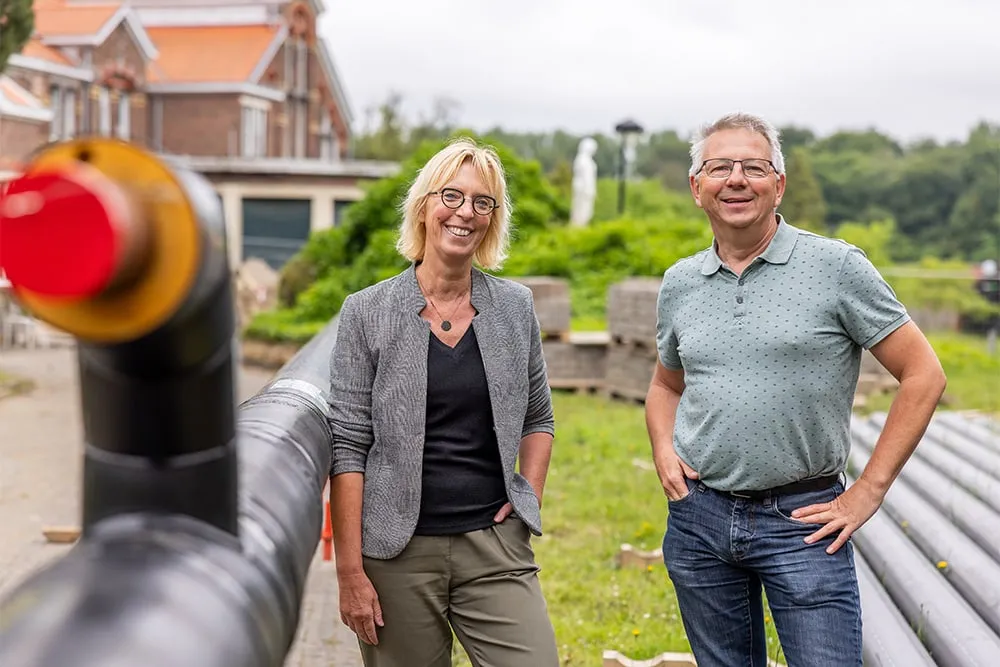
Bringing all residential care together at the historic Caritas site in Melle is the long-term goal of KARUS vzw. To make this possible, the psychiatric care organisation has drawn up an ambitious master plan. The energy-efficient renovation of its ageing buildings presents a major challenge. The installation of an underground district heating network and the implementation of an advanced building management system fit perfectly with this ambition. We visited the site and spoke to Elsie Porrez (infrastructure manager, technical services and environmental coordinator) and Dirk Focquet (infrastructure staff officer).
KARUS is a well-known name in the East Flanders care sector. The non-profit organisation was formed in 2018 through the merger of two psychiatric hospitals, Sint-Camillus in Ghent (Sint-Denijs-Westrem) and Caritas in Melle. Its hospital offers a broad range of treatment programmes for children, young people and adults, as well as support for housing and wellbeing. To better meet the needs of a diverse range of care users in future, KARUS plans eventually to deliver all its specialised treatment programmes at its 32-hectare site in Melle. It will roll out a carefully designed master plan in phases over the next ten years. A key requirement is the thorough renovation of the campus’s ageing and/or vacant buildings, some of which date back to the early twentieth century, in consultation with the Agency for Immovable Heritage and VIPA. “It is a difficult balancing act, with the energy targets presenting a major challenge,” say Elsie Porrez and Dirk Focquet.
Dirk Focquet: “Our renovation story began in 2019. A number of our boiler rooms had reached the end of their useful life. Taking account of our historic buildings, we looked for an efficient heating solution that would future-proof them while also offering the flexibility to integrate new technologies as they emerge. First, we mapped our site through a detailed study. We then analysed various scenarios to determine the best way to meet our heat demand, and finally weighed up a whole range of solutions.”
You ultimately opted to install an underground district heating network. What led you to that choice?
Dirk Focquet: “We strongly believe in centralised energy supply and already had some experience with it, as our campus in Ghent has a small district heating network serving six buildings. Installing a new boiler and a separate building management system in every building would have cost more in the long run. Our district heating network will also be considerably more efficient.”
Elsie Porrez: “It is a sizeable investment, but it will pay for itself quickly once the system is fully operational. Our ROI calculation showed a payback period of around nine years. After that, it will essentially be pure ‘profit’. Financing around €2.5 million from our own funds is no easy matter. Fortunately, we are eligible for a 30% grant under the Flemish recovery support scheme.”
What exactly will your district heating system look like?
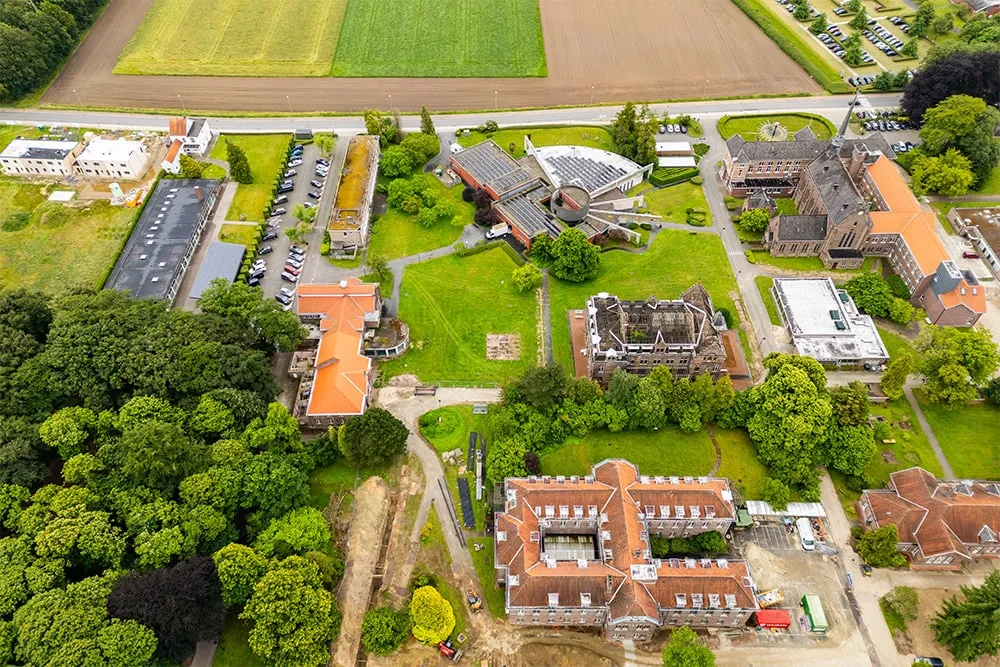
Dirk Focquet: “To make the project technically and financially viable, we limited it to the historic part of our campus. The network will not form a loop, but will consist of two separate ‘arms’. Together, they will supply central heating and domestic hot water to fourteen buildings. The network will be controlled from a new central boiler room, installed in one of the existing pavilions at the back of our site. Gas will be the primary energy source for now, but once enough buildings are suitable for low-temperature heating, we want to switch to a renewable alternative. In the meantime, we will switch off the gas-fired system at the end of the heating season and use decentralised air-to-water heat pump water heaters for domestic hot water for several months. This will already allow us to significantly reduce our gas consumption and make optimal use of the green electricity generated by our solar panels (450 kWp in total). We will be expanding the PV installation shortly, so we are doing everything we can to reduce our energy consumption.”
Elsie Porrez: “The central building management system, which we are implementing alongside the district heating network, will also be a real game changer, as it will allow us to control and monitor heat and energy demand much more effectively. For each building, we will be able to fine-tune heating curves and operating schedules to match the thermal performance of the building envelope and occupancy levels. This will deliver two benefits: optimised consumption and greater comfort for our care users. The latter is particularly important, because the last thing they need is the distress of indoor temperatures that are too cold or too warm.”
How far have you got with installing the district heating network, and what are the main challenges?
Dirk Focquet: “The first arm of the network has been complete since June. We are working in a psychiatric care setting, so safety is naturally our number one priority. The flow of people and vehicles around the site and access to the various buildings are also important considerations. By working in two phases, we can manage these issues as effectively as possible. We hope to complete the second arm by the end of this year.”
Elsie Porrez: “There are no clear plans showing the utilities buried underground, so the excavation work has to be carried out very carefully. We are taking the opportunity to survey and map the ground thoroughly at the same time. The site is also quite undulating. To ensure all the pipes are level, we have to dig down as far as 3 metres in some places. Alongside installing the district heating network, we are also renewing the fibre-optic network, outdoor lighting and supply pipes to the external hydrants. This means we only have to dig up the ground once, keeping disruption to this construction period.”
How does installing the district heating network fit into your efforts to create a sustainable, climate-neutral future?
Elsie Porrez: “Thanks to this project, we are on track to meet our interim climate targets for 2030. With the rollout of our master plan, we should also be well placed to meet our final climate targets for 2050. It is no easy task to reduce energy consumption so significantly in this particular setting, but we have complete confidence in our approach. VEB is helping us piece together this complex puzzle and make the best possible use of the resources available. We greatly appreciate their support.”
Question about this story? Ask your question
Keep following this
Get an email when a new story is published. No account needed.
- SubjectHVAC