











Building sustainably and making homes affordable
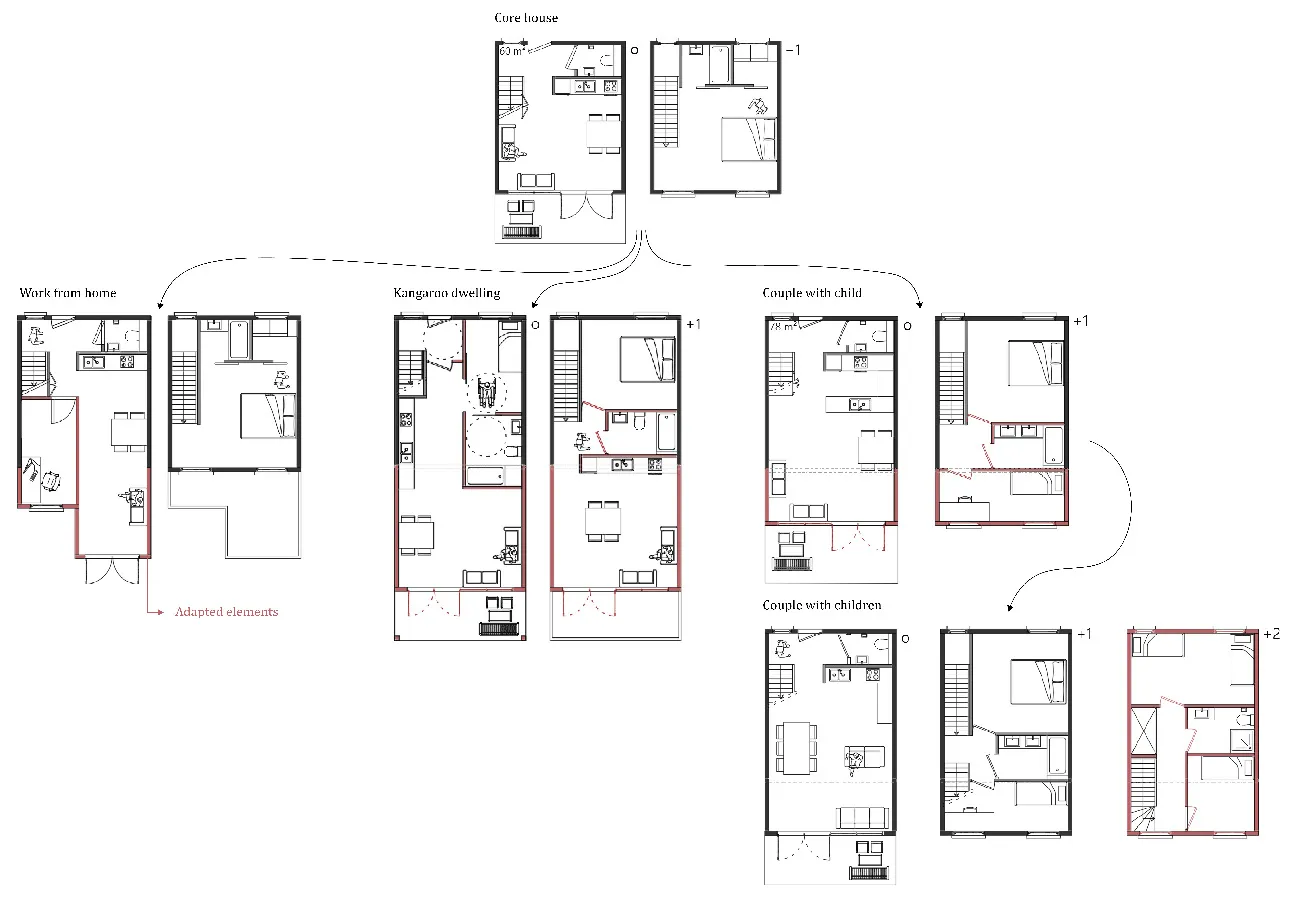
Building sustainably and making homes affordable may seem like conflicting aims. Yet Charlotte Cambier, from the VUB Architectural Engineering research group, has shown in her doctoral research that adaptable homes are indeed cheaper than conventional ones. An ‘adaptable building’ is one that can be modified more easily, using less construction material and generating less waste, to suit changes in residents’ living arrangements, for example living alone, a traditional family household, intergenerational living, cohousing or working from home. Cambier was able to demonstrate in her study that all costs for an adaptable home, from construction to demolition and including maintenance, repairs and replacements, are lower.
VUB research shows it can be done with adaptable homes
The construction sector is responsible for 39% of CO2 emissions. The Flemish government has therefore decided that, from 2023, new-build homes must be low-carbon. Combined with rising house prices, this is making home ownership an increasingly unrealistic prospect. Recent research by doctoral student Charlotte Cambier, supervised by professors Niels De Temmerman and Waldo Galle (Architectural Engineering, Vrije Universiteit Brussel), shows that adaptable construction can play an important role in addressing both challenges.
Planning for change from the outset
An ‘adaptable building’ can be modified more easily, using less construction material and generating less waste, to meet residents’ changing needs. How? By arranging spaces in advance so they can be changed easily, and by making components such as joinery and internal walls demountable and reusable. In Cambier’s study, the adaptable home starts with a small core that can be extended in different ways. Comparing this type of home with a typical Flemish terraced house made it possible to assess the two housing types across several criteria.
The research shows that all costs for an adaptable home, from construction to demolition and including maintenance, repairs and replacements, are lower than for a conventional home.
Cambier: “This is because, initially, the adaptable home includes only the spaces needed for the household’s circumstances at that time. Fewer materials therefore need to be purchased, reducing the initial costs. In the years that follow, maintenance costs are also lower because fewer building components, such as joinery and finishing materials, need to be maintained and repaired. For the same reason, the adaptable home uses materials more efficiently and has a lower environmental impact.
Sustainable construction is about more than just the quantity of materials. Sustainability also depends on the materials used. The home in the study was therefore designed using both conventional materials, such as concrete or brick, and demountable materials. The latter make modifications easier, for example by using lightweight materials joined with reversible connections (e.g. timber frame construction and bolts).
Cambier: “Using different materials made no financial difference, but it could prove more cost-effective in the long term. Demountable materials can be resold after use. And it is a sustainable approach because the materials can be reused. With conventional building materials and techniques, this is practically impossible and not financially viable. Otherwise, there would not be a skip on site for every renovation today.”
Sustainable construction: the VUB Circular Retrofit Lab shows the way
As part of the same research programme, the VUB Architectural Engineering research team inaugurated the Circular Retrofit Lab in 2019, converting eight iconic student rooms on the Etterbeek campus into Europe’s first circular renovation project. Having demonstrated its technical feasibility, the team then asked: ‘How can we make circular construction affordable?’ It is now investigating how making the right decisions during the design process can increase the circularity of buildings while reducing costs over the long term. Anticipating future renovations and using reversible connections have already emerged as promising answers.
Question about this story? Ask your question
Keep following this
Get an email when a new story is published. No account needed.
- SubjectGeneral







