











Circular Real Estate sparks animated debate
Text Els JonckheereImage Management Producties
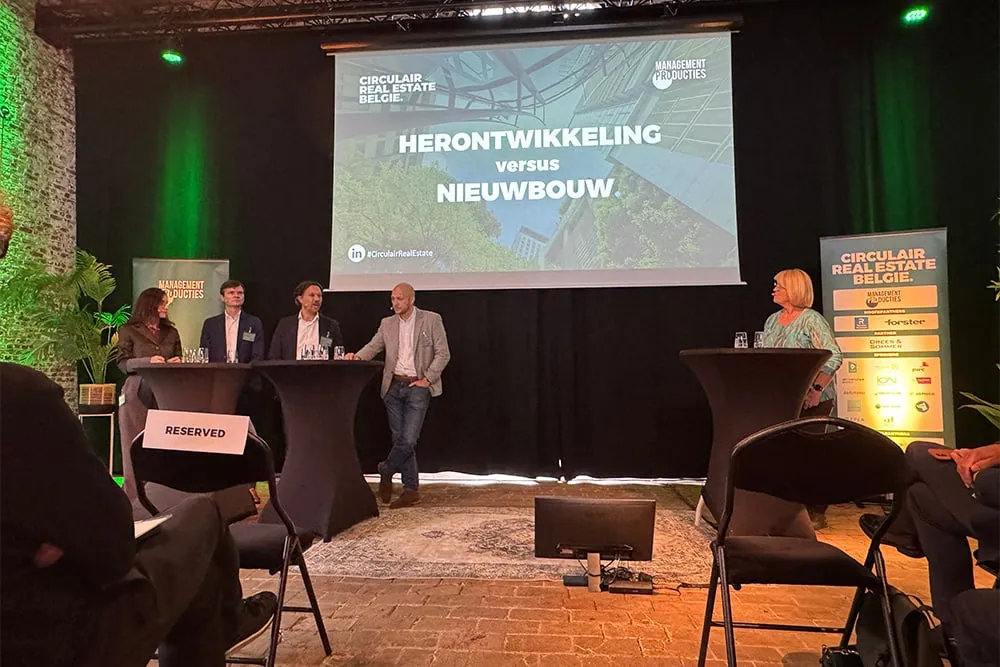
Circulair Real Estate took place on 10 October, an engaging seminar on circular real estate in Belgium. Even the venue reflected the theme: the event was held in the ‘Produits Dangereux’ hall at Tour & Taxis in Brussels. The programme was extensive and varied. As well as a tour of the circular Marie-Elisabeth Belpairegebouw, several speakers shared their experience of circularity. Attendees also enjoyed a round-table discussion, and we have summarised its key points below.
After the site visit and a networking lunch at the impressive Gare Maritime, the seminar got under way with a round-table discussion. Sarah Vermeulen (policy officer at Agentschap Onroerend Erfgoed), Davy Demuynck (CEO at ION), Hein van Tuijl (managing director at EPEA Benelux) and Timothy Bourgois (sustainability manager at Seco) were questioned by Brigitte Mouligneau (transition manager at Vlaanderen Circulair) on several dilemmas surrounding circular construction. “It would be far too easy to think we should simply follow this path and see how it goes,” the moderator said by way of introducing the session. “Several aspects need careful consideration. For example, should we opt for redevelopment or new-build?”
Sarah Vermeulen naturally argued for preserving historic heritage. “Research has shown that we need heritage to understand our place in history.” Davy Demuynck also spoke in favour of preserving historic heritage, and pointed to the positive trend of private and public organisations increasingly working together on renovation and restoration. “It is important to assess which components should and should not be retained. We aim to restore the building as fully as possible, but it must remain economically viable. Sometimes it is not financially feasible for us to redevelop old properties. Take buildings with low floor-to-ceiling heights, for example. If we remove a floor, we lose too much usable floor area. In such cases, the authorities should be more flexible and allow us to add one or two extra storeys above the building, using a timber or steel structure.”
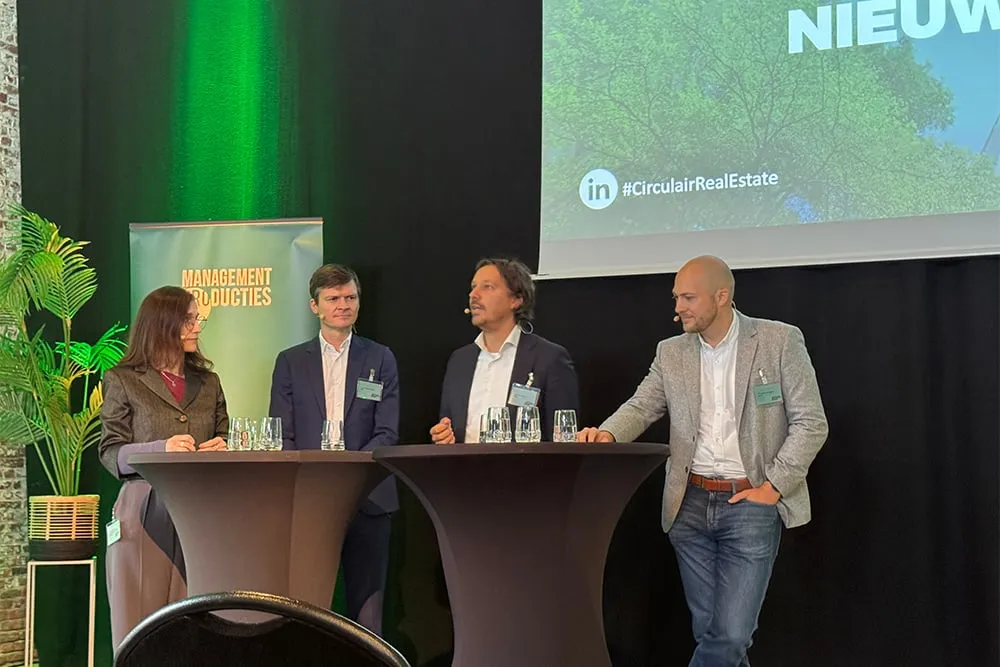
Weighing up the options
Hein van Tuijl noted that redevelopment must always be safe and provide users with the comfort they need. “There is no point in preserving a heritage building if, for example, it is impossible to remove all the asbestos. We also need to take account of advances in scientific knowledge. It is quite possible that in future we will identify further materials that prove less beneficial to health. We also find that it is often impossible to achieve comfortable acoustics in such buildings.”
Sarah Vermeulen stressed that Agentschap Onroerend Erfgoed wants buildings to be safe and is therefore allowing fewer and fewer exceptions. “That does not mean, however, that historic buildings should be replaced entirely by new-build. We must always consider which elements can be retained.”
Added complexity
All four panellists readily admitted that reuse and circularity do entail a degree of complexity. Timothy Bourgois said: “Most building components lose some of their technical properties over time. It is therefore wrong to assume that they can simply be used elsewhere. These are matters that need to be discussed and studied at the design stage. Not only in terms of structural stability, but also with regard to insurance and fire safety.”
Davy Demuynck admitted that this still does not happen often enough, mainly because obtaining permits takes so much time and effort. He called for a system that would reward reuse, including through shorter permitting processes. Finally, all the panellists agreed that a materials database should be mandatory, but at European level. “That would be a real enabler for circularity,” said Timothy Bourgois. “Even if it simply gave banks a tool to work with, it would provide a basis for offering better lending terms for projects that recover the maximum amount of materials.”
Question about this story? Ask your question
Keep following this
Get an email when a new story is published. No account needed.
- SubjectGeneral







