











Energy-efficient school buildings: what is happening in Flanders?
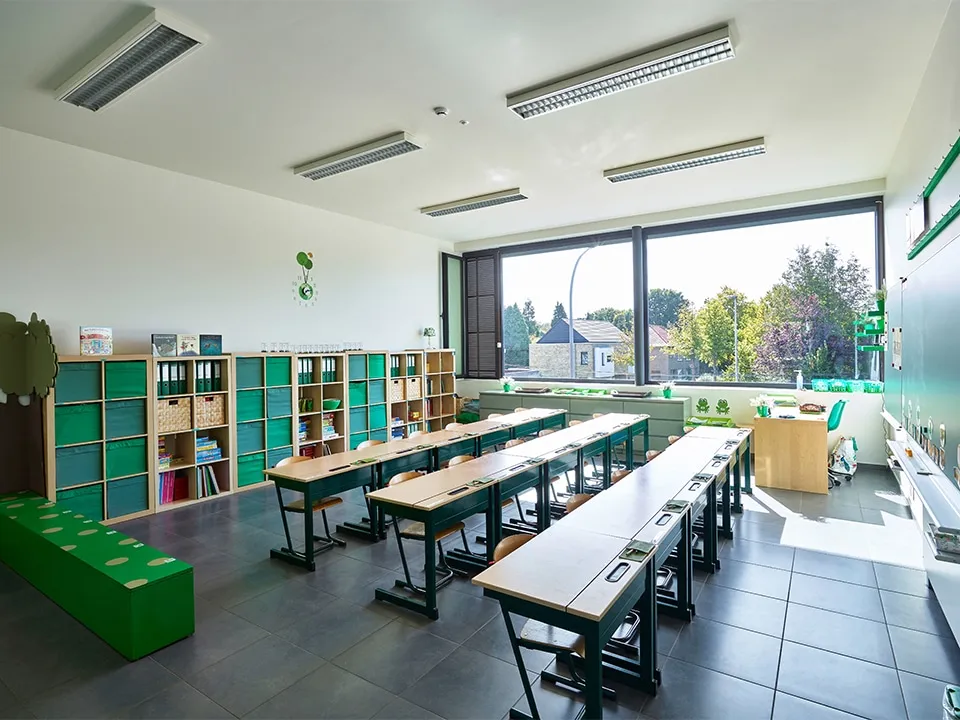
Flanders is known for its large, often Catholic school buildings, full of character but unfortunately often outdated too. In many cases, these buildings from the 1970s have seen little renovation. A survey by Nieuwsblad this summer found that schools across Flanders are outdated, with headteachers also saying that many buildings do not meet requirements. On top of this, high energy bills are further reducing school budgets, often leading to maintenance projects for buildings being scrapped. It is time, then, to take stock of the targets for energy-efficient schools and the (small) steps schools are already taking to meet them.
Energy-efficient new schools
Under Flemish legislation, new school buildings must be nearly zero-energy from 2021. This means achieving an E-level of 30 or lower and meeting EPB requirements for ventilation and renewable energy. Alongside making schools more energy-efficient, schools are also seeking to increase occupancy rates, as many are empty for half the year. Investment in an energy-efficient building therefore also takes account of its use by third parties outside school hours.
How can you improve energy efficiency?
The Flemish government also recommends making small changes to create energy-efficient schools. The three areas to focus on are insulation, lighting and heating. For lighting, for example, this could mean installing a new lighting system and LED lighting instead of incandescent bulbs. For insulation, you can also look at different ventilation systems and insulation materials. You can find all the information, together with practical examples, at onderwijs Vlaanderen.
Key takeaways from best-practice examples
Looking at various examples of schools seeking to improve their energy efficiency, we can draw a few takeaways for future building plans:
- Aim for optimal occupancy. Letting third parties use the building can help spread the high costs and improve energy efficiency.
- When choosing materials, consider acoustics and durability too.
- Combine concrete with greenery and ensure plenty of natural light. This can be achieved by planting trees and creating green roofs and planted areas.
- Invest in renewable energy, such as solar panels, alongside heat pumps and a smart thermostat. High-performance glazing and additional insulation are also essential.
- Investing in LED lighting quickly pays for itself, as schools use a great deal of lighting, especially in winter.
- Other small ways to save include energy-efficient dishwashers and fridges, as well as computers and projectors.
- Have you considered EV charging points? They can also help make optimal use of the school car park and benefit the surrounding area.
Question about this story? Ask your question
Keep following this
Get an email when a new story is published. No account needed.
- SubjectGeneral







