











WINDOW EXHIBITION ‘From Mining Municipality to Water City’
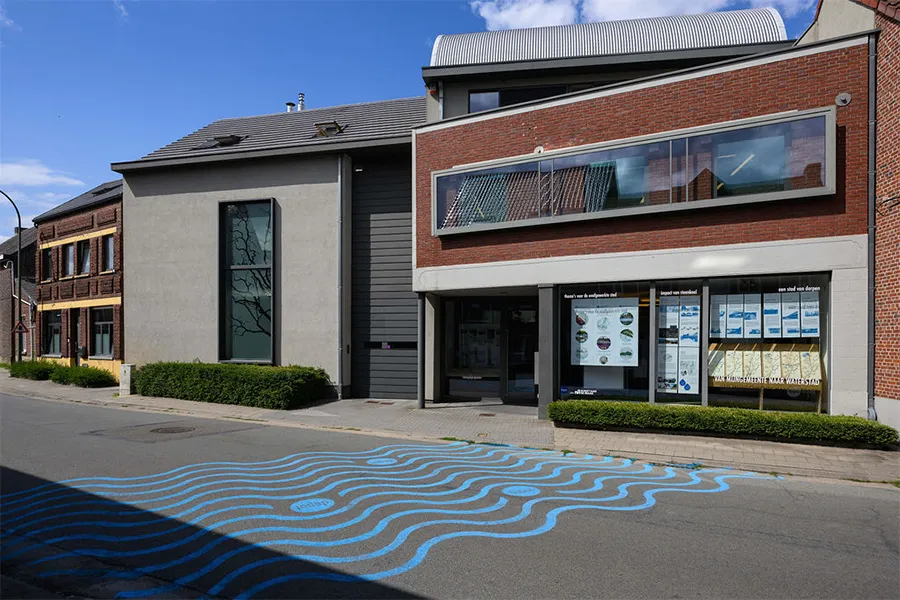
With her artwork ‘In Lieu of What Was’, Alia Farid draws attention to growing water scarcity as part of Kunst aan de Maas (Z33 & RLKM). The work is in direct dialogue with the unique water challenges of Eisden Dorp, where groundwater and drinking water must be pumped out continuously to keep the mining subsidence area dry.
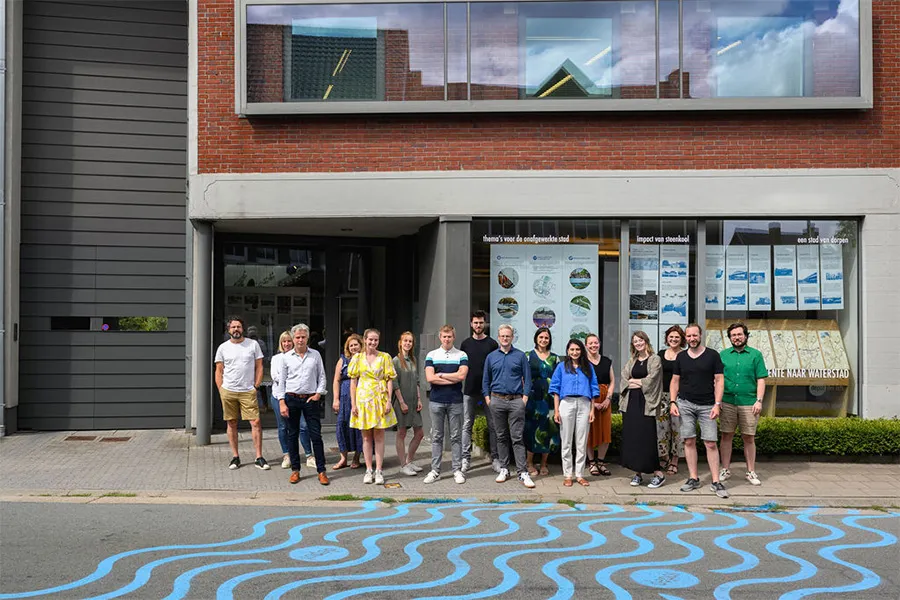
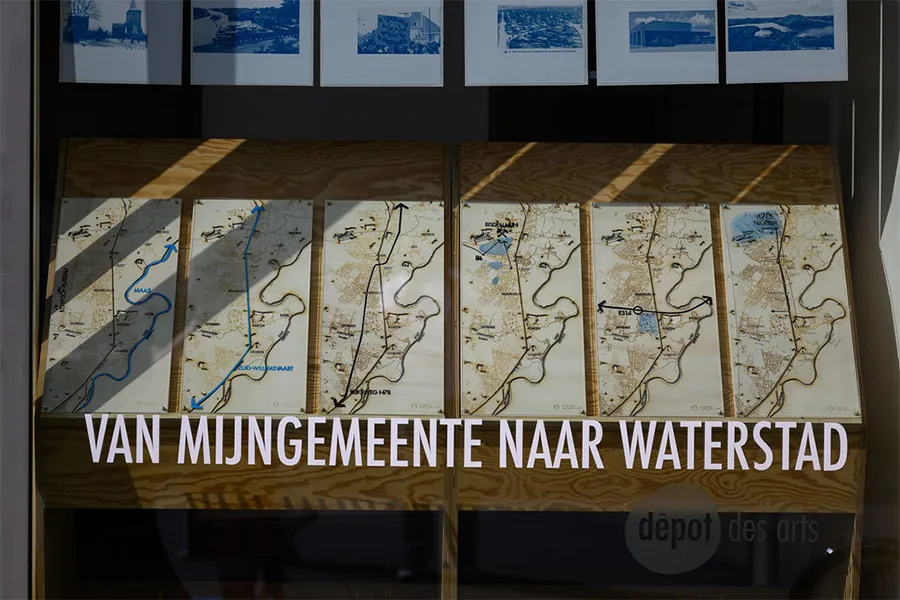
The multidisciplinary design studio Depot, based in Eisden Dorp, has long been working to turn the challenge described above into a positive story and to use water as a leitmotif for the urban development of Maasmechelen. In this context, a window exhibition, ‘From Mining Municipality to Water City’, is on display at its office at Langstraat 76 in Eisden Dorp.
“Coal mining accelerated the urban development of Eisden Dorp and, by extension, Maasmechelen. The coal mine provided plenty of jobs, attracting young men, and later their families, to settle in far-off Belgium. Plans for entirely new residential districts were drawn up at speed. Coal mining, however, lasted for a relatively short time. A century later, following the closure of the coal mine, Maasmechelen was left as an unfinished ‘city’, subsequently subdivided into plots to accommodate its multicultural population,” says architect and director Frank Jaspers, setting out the history of Maasmechelen’s spatial development over the past 100 years.
Mining left scars on the former heathland. Less visible than the spoil heaps and headframes is the subsided landscape and the associated disruption to the water system. In practical terms, this means pumping millions of litres of water from the Greven into the Zuid-Willemsvaart to keep the mining subsidence area dry.
“With her artwork ‘In Lieu of What Was’, Alia Farid draws attention to the growing global shortage of water as part of Kunst aan de Maas. The locations of the artworks were chosen for a reason. While water shortages are emerging elsewhere in Flanders, drinking-quality groundwater has to be pumped out at this site to keep the mining subsidence area dry,” says Tim Roerig of Z33.
“The challenge described above is a unique one, and one that our multidisciplinary team of architects, interior architects, designers and economists faces every day. Behind the façade of the former drinks shop with café, known locally as B-ij Bock Jaak, is the business centre ‘Depot Des Arts’. Several creative and research companies have set up their offices in the building. Collaboration comes naturally and makes it possible to take a multidisciplinary approach to construction projects,” says Joris Deckers.
Over the years, the studio has built up research and expertise on the unique mining history of its home, Eisden Dorp. With this knowledge of the area and its range of disciplines, it aims to make a difference locally and further afield. “This has led to some excellent projects in this field, such as the Kruinenpad, the Hangende Tuinen, the redevelopment of the Vrijthof, the conversion of Hotel Porta Cité and the restoration of the Sint Barbara Kerk in Eisden-Tuinwijk. These projects are part of a wider vision for the city of Maasmechelen,” says Frank Jaspers.
“When it became clear that Farid’s works in Eisden would be installed alongside the Zuid-Willemsvaart, we contacted Depot to see if we could create a win-win. This has now resulted in this unique window exhibition, which has been included as an additional programme within Kunst aan de Maas,” says Katrien Schaerlaekens, project leader at RivierPark Maasvallei.
Discover how, through the window exhibition ‘From Mining Municipality to Water City’, Depot is working towards a new identity for Maasmechelen, the city of the future, from Eisden Dorp to Eisden mijn and then to the municipality of Maasmechelen. “Just as coal mining led to urbanisation, water, another form of natural wealth, can become the leitmotif for Maasmechelen’s future spatial development. We are working towards this vision of the future step by step, through projects and studies,” says Frank Jaspers.
“Our analysis explains how Maasmechelen came into being and how it grew over the years into the place we know today. We then set out our vision for transforming the mining municipality into a water city, ready for new residents, nature, tourism and more. In short, ready for the future. The site model in the entrance hall showcases 10 landmark projects in Maasmechelen. These projects and studies stem from the overarching vision in which local water shapes the municipality’s future development,” says Marie Frioni, architect and exhibition designer.
Scan the QR code on one of the exhibition panels to visit a selection of completed projects on a pleasant walk through Eisden Dorp.
Across the street, artist Lore Vandeboel creates her own man-made landscapes using collage. “The Maasland and the Maas Valley are a great source of inspiration. Our Nationaal Park Hoge Kempen is one vast ‘man-made landscape’, transformed from a mining and gravel extraction area into a huge nature reserve. However green and beautiful the landscape may look, it is largely the result of human activity. Eisden, too, is a man-made landscape,” says Lore Vandeboel.
See www.kunstaandemaas.be, www.depot.nu, www.lorevandeboel.be
Window exhibition: free entry from 12/7 to 30/9, Langstraat 76, Eisden Dorp
Question about this story? Ask your question
Keep following this
Get an email when a new story is published. No account needed.
- SubjectGeneral







