Building Base Isolation: an effective measure against noise nuisance

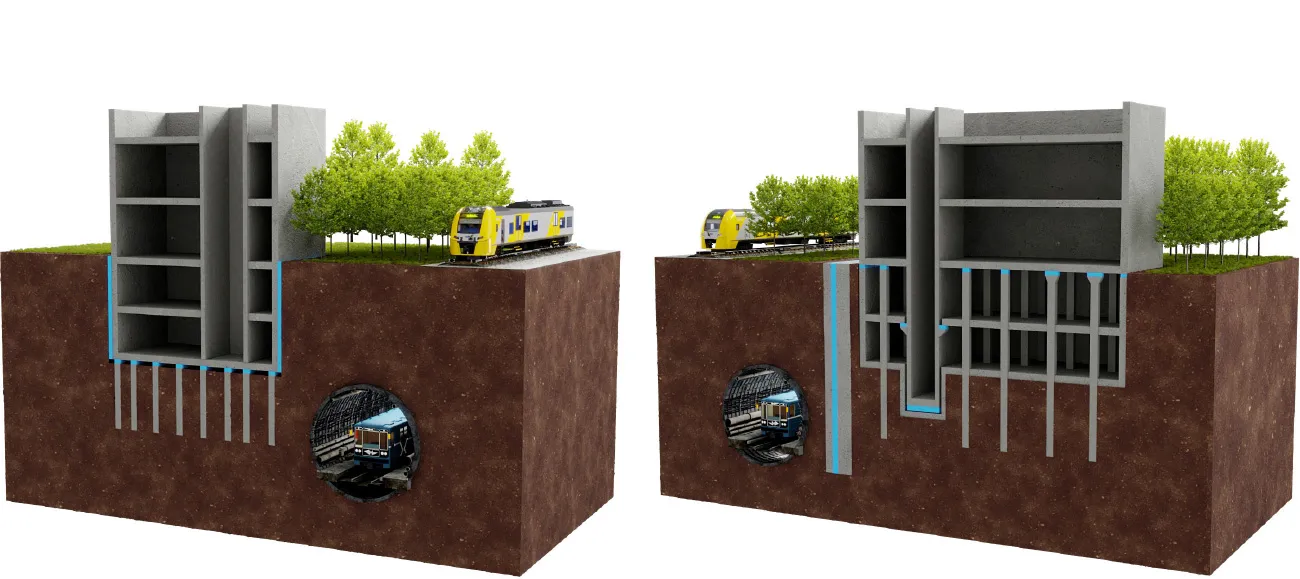
As urbanisation and population growth continue, building plots are becoming increasingly scarce. Developers are turning more and more to sites once considered unattractive, such as plots near railway lines or alongside busy roads. In such cases, developers are advised to consult an acoustic consultancy to assess the impact of different modes of transport on their investment and obtain advice on noise reduction. To achieve the desired level of acoustic comfort, the focus is often on insulating rooms, with the design adapted accordingly. It is often more cost-effective to incorporate good sound insulation during construction. This is known as ‘Building Base Isolation’.
Building Base Isolation (BBI), or the acoustic decoupling of building foundations, needs to be incorporated at an early stage of the construction process, specifically during the design phase. Structural isolators are often designed
for each project to achieve the intended reduction in structure-borne noise and vibration while ensuring the stability of the building. The latter primarily involves the impact of vertical (gravitational) loads and horizontal forces caused by wind, earthquakes and so on. In practice, the type of isolator is therefore determined by the required natural frequency, the loads involved and the available contact area.
Building Base Isolation throughout the building’s service life
BBI solutions require no special attention in terms of maintenance. However, it is common for a building’s function to change, resulting in a change in the loading conditions on the isolators. To ensure both stability and acoustic performance, new or additional vibration isolators usually need to be installed alongside the existing ones. To make this possible, it is vital to anticipate such scenarios when designing the building and allow sufficient space.
CDM Stravitec has developed an innovative replacement strategy for this purpose, called ‘Frozen Bearing Technology’. This patented technique involves inserting deeply frozen, preloaded rubber isolators into the structural joint. As the new isolators are pre-compressed, they can easily be installed in the limited space available. As the temperature of the vibration isolators rises under the influence of the ambient temperature, they expand and
gradually take up the load.
Fire safety
A key question for every structure is how it will behave in the event of a fire, and what this means for the overall stability of the building. In short, fire safety is a complex subject that calls for specific considerations. Depending on the building’s design and use, as well as national and regional fire regulations, various fire protection measures can be adopted, ranging from incorporating steel or concrete ‘failsafes’ to less intrusive measures such as compartmentation. All possible fire safety solutions should be discussed in detail with the manufacturer of the structural isolation solutions and fire safety specialists to prevent rigid acoustic flanking paths from being created.
Liedekerke station
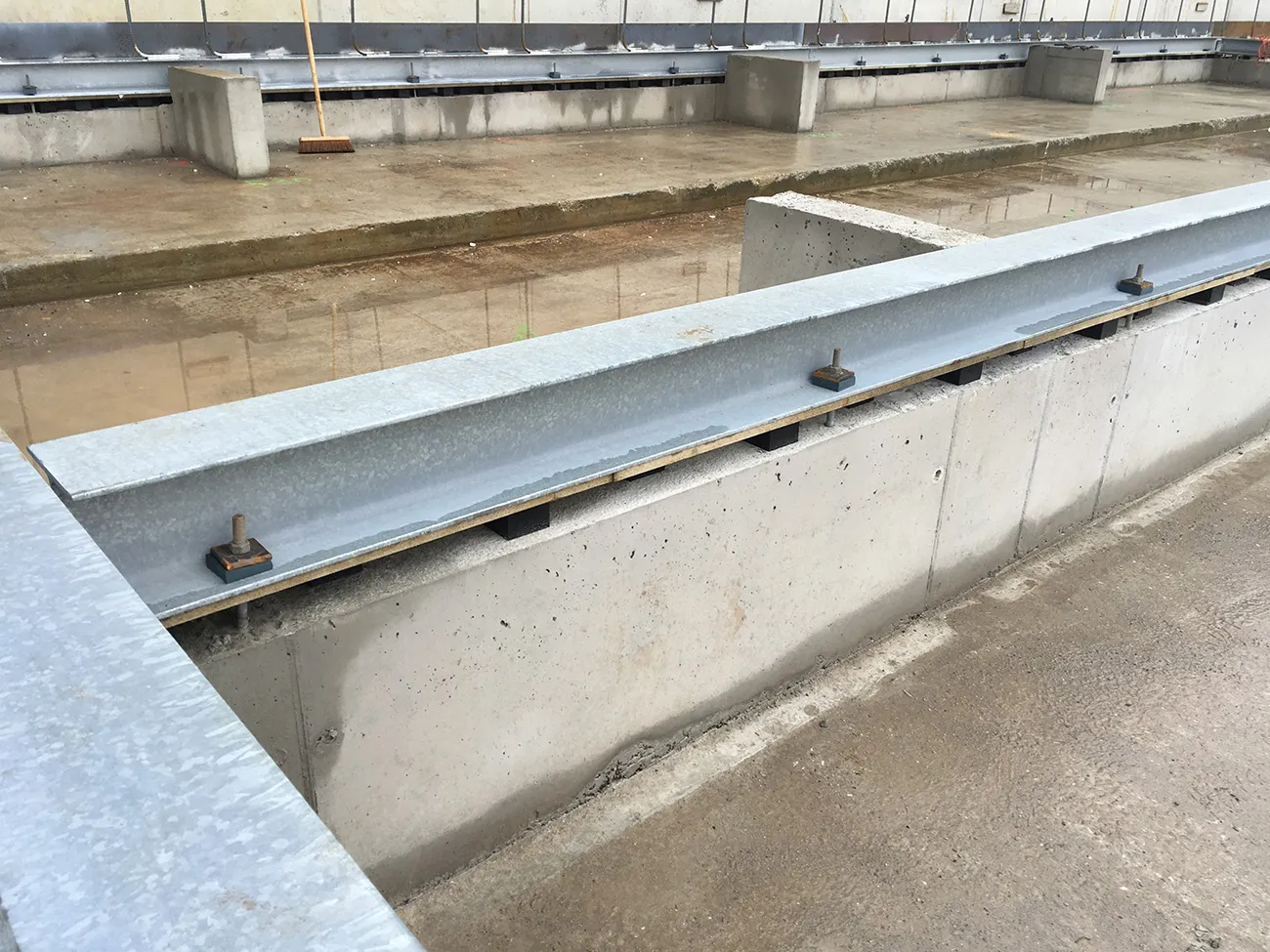
Liedekerke railway station has been acoustically isolated using Stravibase SEB and Stravibase Fix isolators. The Stravibase SEB supports, made up of rubber pads bonded to a permanent formwork plate, were installed on top of the foundation walls. The rubber pads themselves had an unloaded thickness of around 6 cm to achieve a natural frequency of no more than 10 Hz.
Vertical fixings have been provided at various points to resist horizontal forces, so rubber pads were also required here to prevent acoustic short circuits. A natural frequency of 10 Hz or lower is usually sufficient for railway traffic, as excitation typically lies between 50 and 100 Hz. This ‘mass-spring filter’ therefore effectively reduced vibrations from the railway, ensuring that station users are not disturbed by excessive radiated structure-borne noise.
Question about this story? Ask your question
Keep following this
Get an email when a new story is published. No account needed.
- SubjectAcoustics