Concrete and steel construction
Environmental impact of precast concrete structures
Text and images FEBE
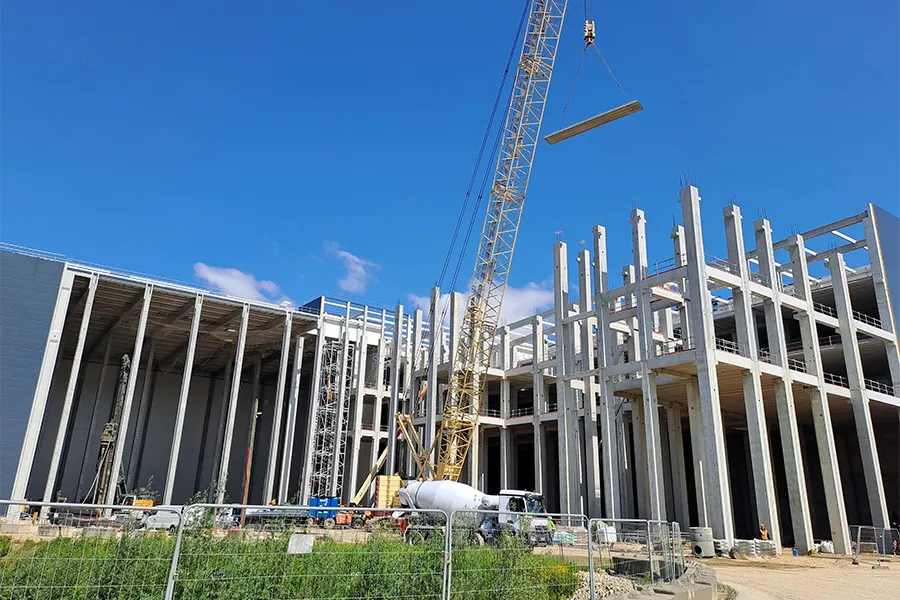
Roeselare is proving that concrete is a fully sustainable alternative to timber construction. The timber structure of the future town hall was replaced with a precast concrete structure, without compromising the ambition to create the most sustainable town hall in Flanders, with the BREEAM ‘Excellent’ sustainability rating as the ultimate goal. It is therefore no surprise that concrete performs well in a recent study by KU Leuven.
The TOTEM interface was launched in 2018 to assess the environmental impact of buildings. In 2020, KU Leuven carried out a comparative LCA study based on the interface, using an apartment building as its starting point [1]. Three structural types were compared: concrete, steel and timber, each meeting the same functional requirements. The floors in the concrete option consist of prestressed hollow-core slabs; the load-bearing internal and external walls are masonry walls made of hollow concrete blocks, while the non-load-bearing internal walls and façades consist of fired-clay bricks. The study shows that the environmental impact of the timber option is only around 5% lower than that of the concrete option.
Important caveats
This result does, however, need some qualification. For example, TOTEM does not take account of the actual service life of the building materials used, or the building’s thermal mass. TOTEM also overlooks life-cycle analyses (reuse and recycling). Yet a building’s environmental impact can be reduced by ensuring that products can be removed from it at the end of their service life for reuse or recycling [1]. Experts expect global construction activity to increase by up to 70% and raw material prices to rise sharply. Developing buildings that can be dismantled is therefore not only ecologically, but also economically, worthwhile.
Circular potential
It is technically feasible to dismantle and reuse precast concrete structural elements. Examples include Circle House in Denmark, the ReDeMaM project at TU Dresden and the ‘Moringa’ residential tower in Hamburg [2]. In the Netherlands, the Temporary Court in Amsterdam was built in 2015 and has since been dismantled into building components that are being given a new lease of life in Enschede. It will not be long before projects of this kind are also carried out in Belgium. If reuse is not possible, the last option in a circular construction sector is recycling. Concrete can be recycled 100% time and again. Most of it is used in road sub-bases, with a small proportion used as aggregate in concrete. Recently, 30,000 tonnes of rubble from the existing buildings were sorted and crushed for the ZIN project in Brussels, producing 3,500 tonnes of recycled concrete aggregate, some of which was used to produce new precast concrete [3].
Towards greater sustainability
The arguments above show that precast concrete plays an important role in delivering sustainable buildings. In addition, efforts by the cement and concrete industry to reduce raw material use and improve energy efficiency will further lower concrete’s overall environmental impact [4]. The first steps have also been taken towards using alternative binders in concrete [5]. Further improving the sustainability of the concrete sector is now more realistic than ever. Precast concrete looks to have plenty of strengths to offer …
[1] Study on the environmental impact of concrete and cement based products applied in buildings, evaluation with TOTEM, update 2020, KU Leuven for FEBELCEM (2020)
[2] Kreislaufwirtschaft in der Baubranche, Bundesverband Spannbeton-Fertigdecken
[3] https://www.ergon.be/nl/project/zin-project/
[4] Cementing the European Green Deal, Reaching climate neutrality along the cement and concrete value chain by 2050, CEMBUREAU
[5] Het Gentse duurzaamheidsrapport 2022, focus op Prosperity, Stad Gent
Question about this story? Ask your question
Wie aan Stadhuis Stad Roeselare werkte
- design teamBressers ErfgoedMentioned in City of Roeselare pioneers Flanders’ most sustainable town hall
- design teamAtelier Arne DeruyterMentioned in City of Roeselare pioneers Flanders’ most sustainable town hall
- restorationMonument GroupMentioned in City of Roeselare pioneers Flanders’ most sustainable town hall
Keep following this
Get an email when a new story is published. No account needed.
- ProjectStadhuis Stad Roeselare
- SubjectConcrete and steel construction